July 23, 2026 at 12:00 PM ET
Webinar Recap: Announcing Atom 3.0
A rebuilt Discovery and two brand-new modules, revealed live for the first time on July 23
Access Webinar Recording
Please fill out this form to access the recorded webinar.
Just over a year after launching Atom 2.0, co-founders Tomer du Sautoy (CEO) and Hamilton Evans (CTO) came back on camera to launch Atom 3.0 to a room of more than 100 research administrators. Atom 3.0 is an AI platform built for research development, spanning grant discovery, team building, and the work of putting winning proposals together. Here is a breakdown of what the team announced, demonstrated live, and answered from the audience.
We're no longer just a grant search engine. Atom 3.0 is an AI platform built for research development.
- Tomer du Sautoy, co-founder and CEO
From a newsletter to a research development platform
Atom started three years ago as a direct-to-researcher newsletter that surfaced relevant grants from across the web. Atom 2.0, launched about 14 months ago, shifted the focus to the back office and gave research development and sponsored programs teams a platform of their own. Atom 3.0 is the next step in that arc: moving beyond discovery to support more of the grant lifecycle, with AI built in from the ground up.
The through-line is capacity building. Rather than adding another tool for teams to train faculty on, the goal is to help research offices find the right grants, build the right teams, and strengthen proposals before they are submitted, all in one place.
Along the way, the team has grown to eight people and now supports more than 50 partner institutions across the US, many of whom shaped Atom 3.0 directly as design partners.
Grant discovery, now built around projects
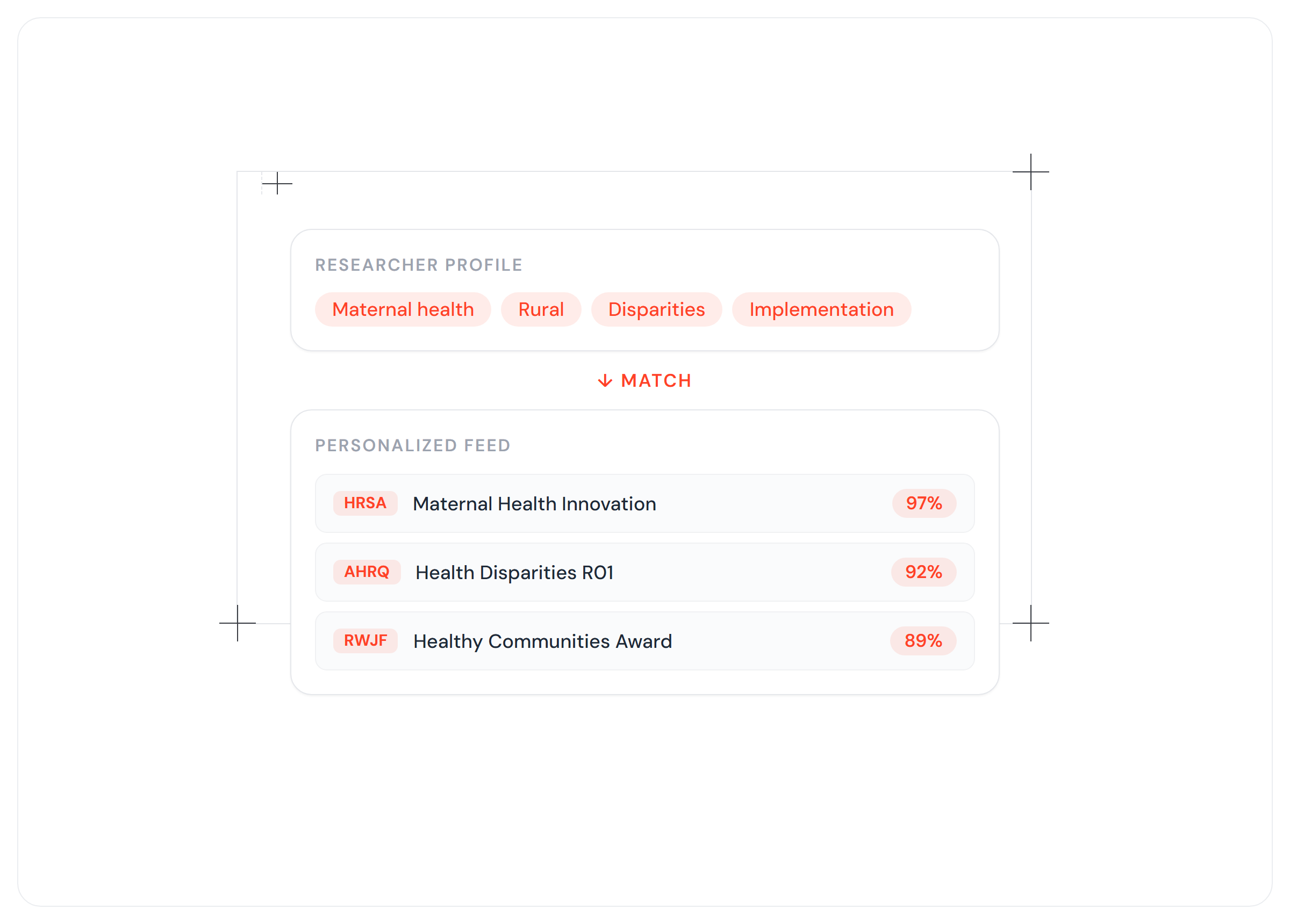
For existing customers, the core discovery experience is familiar. Atom still runs on a proprietary funding database with a semantic search engine layered on top, so you can drop in an abstract or any piece of natural language and get conceptually related opportunities back, rather than wrestling a researcher's interests down to a single keyword.
The biggest addition is projects. Researchers rarely work in a single area, and the previous model tied research interests to the user, which made searching across several lines of work difficult. Projects change that:
- Separate distinct research areas cleanly, each with its own research interests
- Search grant-by-grant within a specific project
- Share projects with collaborators, build eligibility profiles together, and keep shared favorite lists in one place
- Spin up department projects so admins can search across a department or college and push opportunities out to the right group
Finding the right collaborators
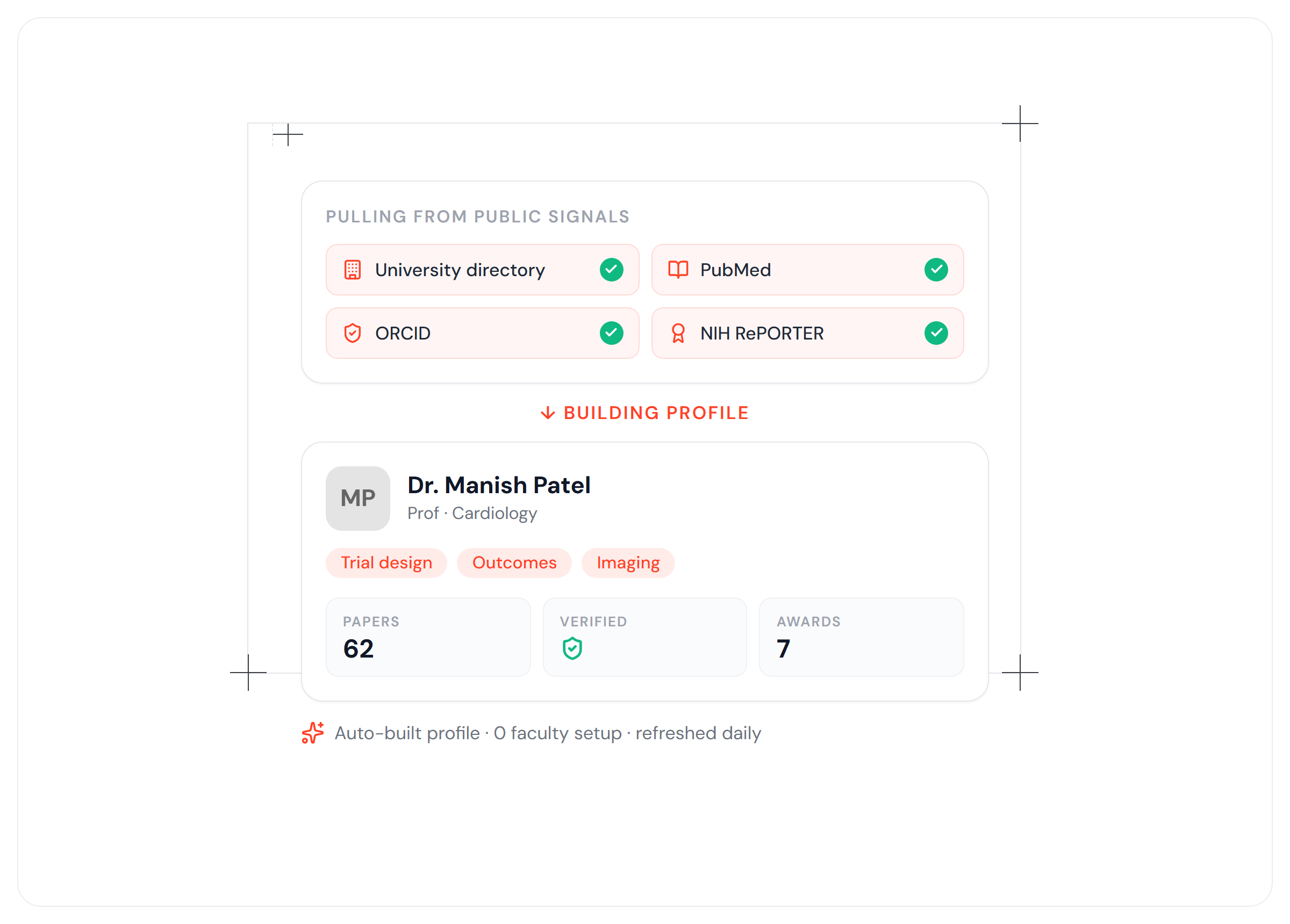
More proposals and papers are being written with collaborators than ever, so Atom 3.0 adds a dedicated way to find them. At its base is a directory of more than 1.2 million US researchers, built entirely from public information: ORCID, Google Scholar, university and lab websites, and published papers.
All of the documents uploaded into the system always remain your intellectual property. We're never using any of that information to train models.
- Tomer du Sautoy, co-founder and CEO
Private data stays private. The researcher directory is built only from publicly available information, and nothing from an institution's private Atom profiles is ever shared or used to populate it.
From there, the collaborator tools work alongside discovery:
- A collaborators tab on every grant page, with matching tuned by leading experts on how research teams are actually built, so suggestions surface through the layers of your existing network rather than at random
- Profile gap analysis that identifies what a grant needs that your profile is missing, and who could supplement it
- A researcher search that works like grant search, letting you find people by subject area and filter by institution, inside or outside your own
- A reverse lookup on any opportunity that surfaces internal faculty and external collaborators who would be a strong fit
Proposals: the heart of Atom 3.0
The proposals module is the largest thing Atom has ever built, developed over roughly a year and refined for six months with design partners. It has three parts.
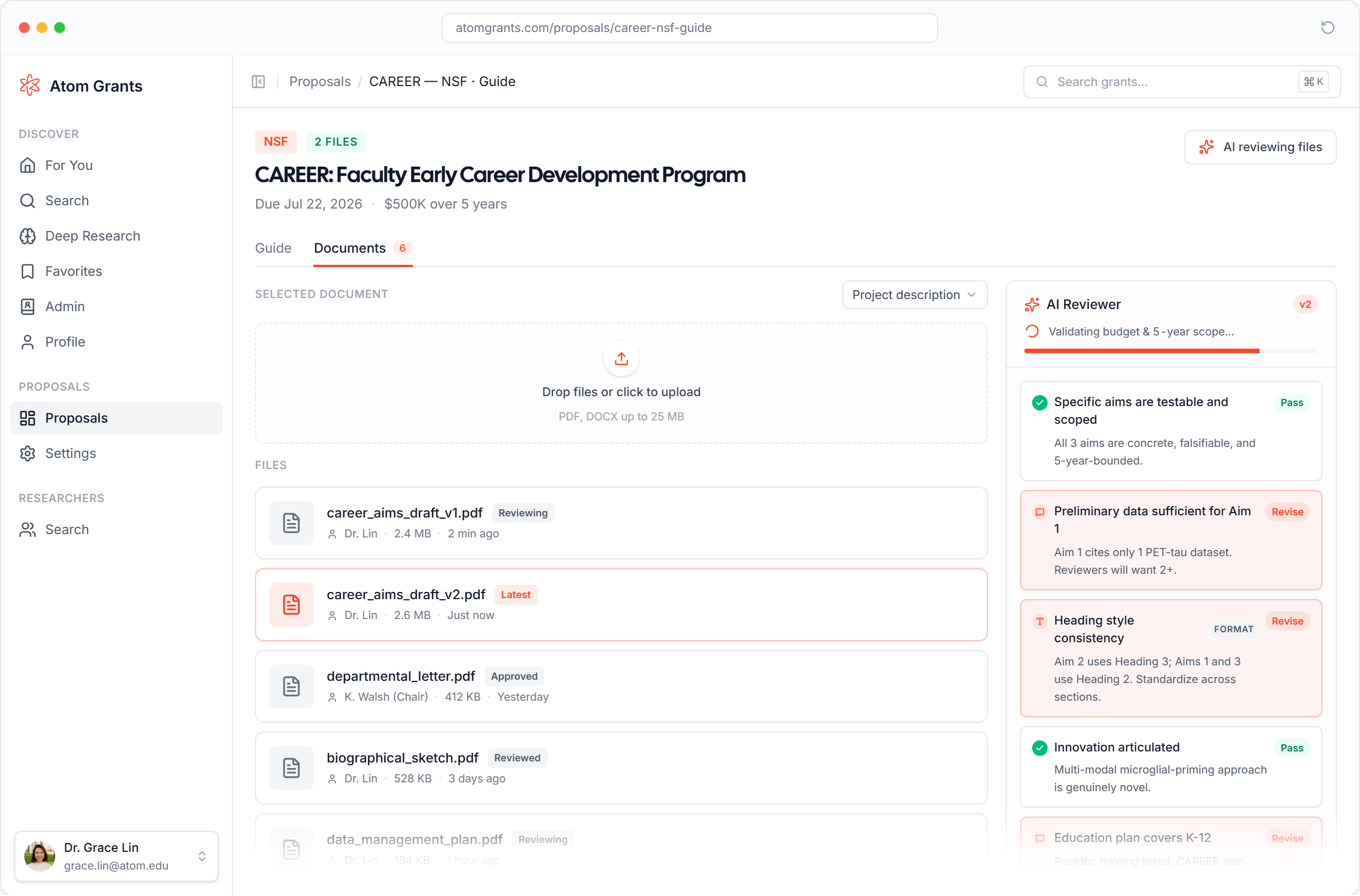
Structured guides. Starting a proposal from a grant takes two clicks. Atom reads the solicitation line by line and generates a multi-page guide covering required documents, eligibility, formatting, and key dates, with everything referenced back to where it was pulled from in the RFP or program guide. The guide is fully editable, extracts the required documents directly from the solicitation, assigns the right person to each, and sets internal deadlines based on your institution's own requirements. Researchers can download or print it to work offline.
AI review. Researchers can run an AI review on a single document against the funder's rubric and the guide's requirements, with weaknesses highlighted directly in the document. When a proposal is close to ready, a full end-to-end AI red team review runs across all documents, checking consistency, budget alignment, and justification. It is self-serve, so proposals arrive at the research development office in better shape than a first draft would be. Everything happens in a collaborative document workspace with versioning, in-line comments, tagging, and notifications by platform and email.
A note on scope: Atom does not write proposals. In line with NIH guidance, the module offers outlining and structural support, but the science stays with the scientists.
The scientists should be doing the science.
- Hamilton Evans, co-founder and CTO
The review system lowers the barrier for researchers to start getting feedback early and iterate, rather than replacing human review.
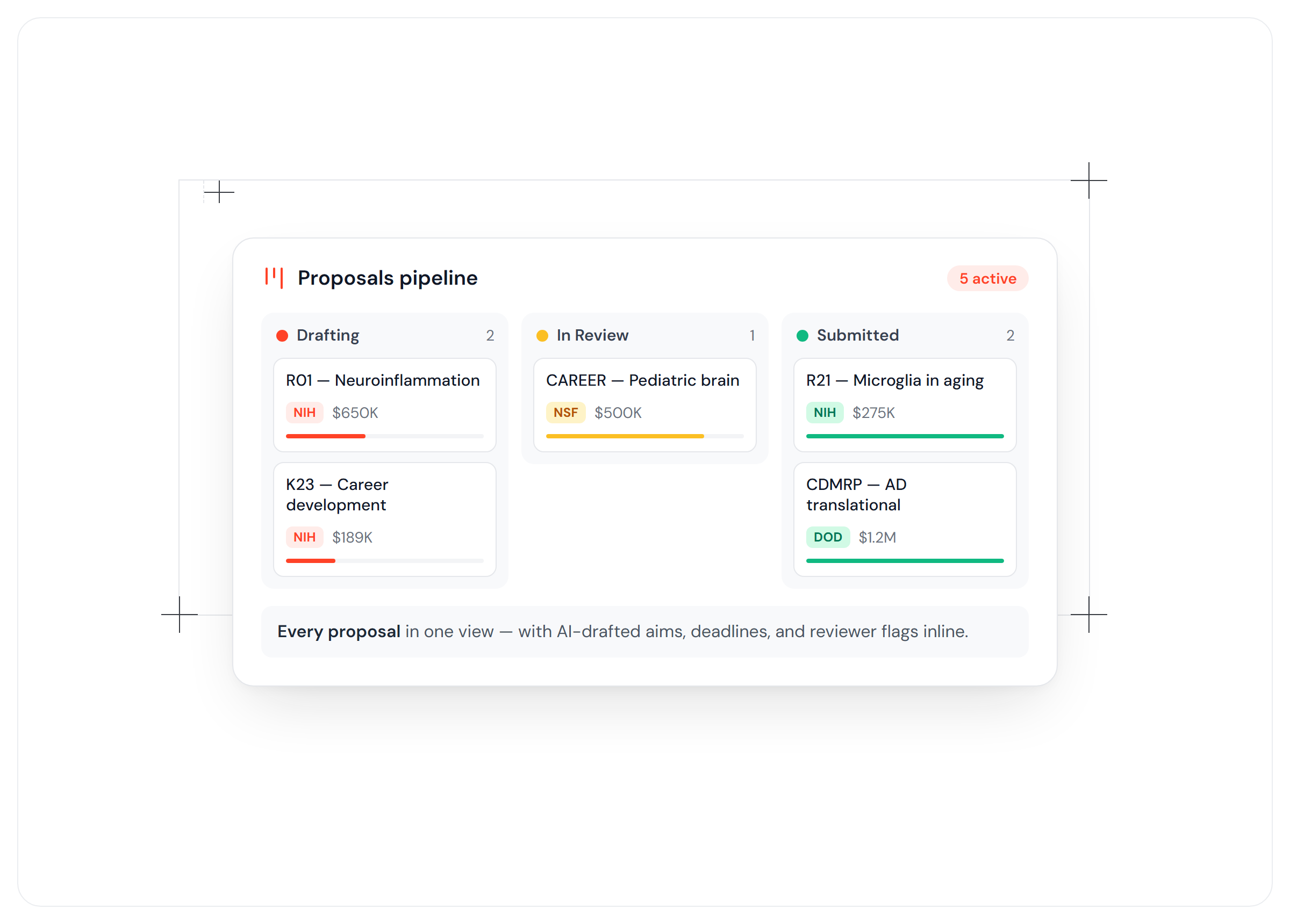
A proposals CRM. Every intent-to-submit automatically creates a project in a pipeline view, assigns the right research development officer, and sends notifications. From there, admins can see every proposal in progress by department or across the institution: which stage each is at, who is on the team, which funder it is going to, and what has been submitted or awarded.
Institutional analytics, coming this fall
Rolling out later this fall, institutional analytics builds on the engagement data existing customers already have. It adds full visibility into the proposal pipeline, filterable by agency and grant size, plus campus-wide funding trends drawn from public data and platform usage. The aim is to help institutions benchmark themselves and spot funders and subject areas that fit their faculty but are not yet being tapped.
Privacy and your data
Because unpublished research ideas are sensitive, the team addressed data handling directly. Atom uses enterprise-grade rollouts of leading models, and documents uploaded to the platform remain the institution's intellectual property. Nothing uploaded is used to train external models or Atom's own tools, and content stays within the institution's walled garden.
Questions from the room
How accurate is the AI, and how has it been validated? Every AI response, from generating guides to running reviews, runs through internal validations. Much of the system was built alongside design partners using their real, active grant listings and guides, and it has tested as highly accurate so far.
If an opportunity is amended after it is posted, does Atom catch it? Yes. Funding opportunities are checked every day for changes to amounts, due dates, and other details.
What if a funder we care about is not in the database? Send a note or leave feedback in the platform and it can usually be processed and uploaded within the day. Some international funders are still being added.
Is Atom 3.0 just added to our existing dashboard? No. The collaborators and proposals modules are additions on top of the discovery product, not an automatic upgrade.
When does 3.0 go live? It is live today and already running with customers. The team is onboarding an early adopter cohort now.
Will Atom do system-to-system submission? Not yet. Atom makes it easy to package and export files into grant management platforms such as Huron Research Suite, Cayuse, and Kuali for approval workflows and submission. Integrations with those systems are on the roadmap.
How is Atom priced? Pricing is based on institution size and research expenditures on a sliding scale, handled through a demo so it can be tailored to each institution.
You know what works and what doesn't better than we do. We're here to turn your ideas into product.
- Tomer du Sautoy, co-founder and CEO
How to get Atom 3.0
- Existing partners: reach out to add the new modules to your current Atom instance.
- New to Atom: book a demo to see the full platform. Institutions that book off the back of this webinar get limited-time early adopter pricing.
- Seeing us in person: we'll be presenting Atom 3.0 live and hosting a booth at NCURA's 5th AI Symposium on July 31st, 2026!
About the speakers

Tomer du Sautoy is co-founder and CEO of Atom. He grew up surrounded by research, studied physics through a master's, and moved into technology before coming full circle to build AI tools for the research ecosystem.

Hamilton Evans is co-founder and CTO of Atom. He studied chemistry and computer science at Middlebury College and began a chemistry PhD at Caltech before leaving to found Atom, at the intersection of research and technology.