August 26, 2026 at 11:00 AM ET
Webinar Recap: Building a Smart Research Administration Ecosystem
A Round Table on Closing the AI Gap in Research Offices
Access Webinar Recording
Please fill out this form to access the recorded webinar.
Most research offices are past the question of whether AI belongs in their workflows. The harder question is how to move from a few people running individual chatbots to something the whole office can rely on, safely. In this round table, a team from Morgan State University walked through exactly that journey: a faculty survey that started it, the security scare that reshaped it, and the day-to-day pre-award work AI now touches. Anita Mills of Ignita Consulting led the panel, and Poline Mirithu, Lulu Jiang, and Ailing Zhang shared what has actually worked in their office, and what still needs a human. The recurring theme was that the tool is the easy part. The system around it is the work.
The study that started it
Earlier this year, the Morgan team surveyed their faculty about AI tools in research administration: where people were in their adoption, what they needed, and what training would help. The appetite was clear. About 88% of participants said they were eager to adopt AI tools, but only around 45% reported being familiar with them. That gap, between wanting to use AI and actually knowing how, is the gap the panel set out to close.
The survey also pointed to what faculty wanted next. Interest in the tools was high, but the specific asks were training, a standardized process, and better communication. For the study itself, the team worked across ChatGPT, Claude, Gemini, and NotebookLM, using NotebookLM in particular for the data analysis.
From personal chatbots to an enterprise system
The path there was not a straight line: like most of us, the panel started on personal ChatGPT accounts. As they took the work on the road, presenting at conferences across three states, the feedback caught up with them: people were not comfortable with staff using personal AI tools on institutional work, and the security concern was real.
So they went back to Morgan's leadership. Their VP for Research backed the shift, and the office moved first to a team version of Claude, which Poline described as a little more advanced, then, after a couple of months of friction, to a Gemini Enterprise license that the whole institution now uses. Ailing's summary of the difference was blunt: since moving to Gemini Enterprise, her job is easier than before, because the data stays inside a platform only Morgan can access.
Two things made that possible: the first is IT as a partner, not a gatekeeper. Morgan IT supports essentially any AI work as long as it runs on the sanctioned Gemini Enterprise platform. The second is institutional momentum: Morgan launched a Bachelor of Science in Artificial Intelligence this fall, a signal of where the university is heading. As Ailing put it, leadership support is not a nice-to-have.
If your leadership does not want to invest, it stops there. When they raised the security issue, we talked to our VP for Research, he was very supportive, and that is when everything changed.
A connected ecosystem, not a pile of tools
The idea that named the session came out of one of those conferences. Sitting through seminars on AI in San Antonio, Ailing started thinking less about individual tools and more about the whole research administration ecosystem, the connected set of pieces that a proposal actually moves through: data, collaboration, policy, compliance, and budget. The team's framing is an eight-step, AI-powered ecosystem that spans the award lifecycle from funding identification through award management, rather than a scatter of one-off chats.
Two concrete efforts are pushing in that direction:
-
The Office of Research is running a new SPARC program (Sponsored Projects Administration Readiness and Knowledge), a six-month series with a case scenario every Wednesday, each week working through a different piece of the proposal: the proposal itself one week, budget and justification the next, subaward review after that.
-
The other is AI Navigator, a chatbot the office built with students. A lecturer wanted to give strong students real work, so the office handed them a problem. The first version answers the everyday routing questions that clog an ORA inbox, who to email about a proposal, who handles budget justifications, who owns subawards, pulling from information already on the website so people get there faster. The next version, still in testing, aims to help PIs assemble a proposal and generate the budget, budget justification, and NOFO-required components. The pressure behind it is concrete: the pre-award team is four people, and they had 32 full proposals for a single program due in October.
Where AI is actually saving time
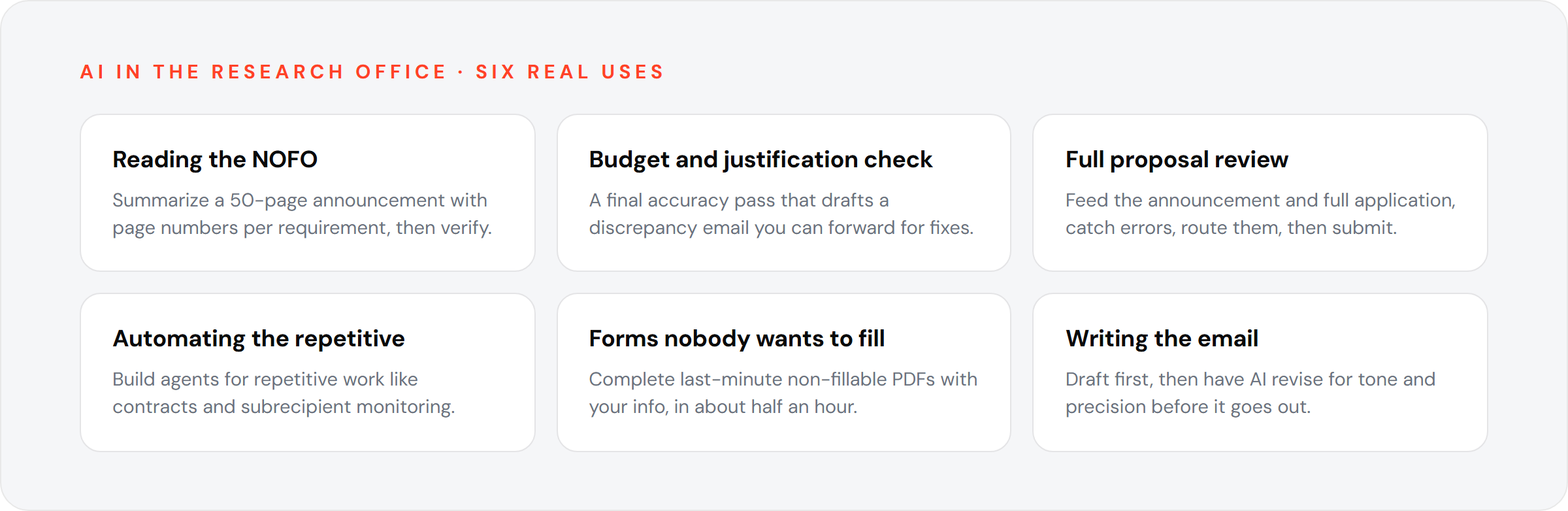
Reading the NOFO. Lulu puts the funding announcement, often around 50 pages, into Claude and asks for a summary of the requirements with the page number for each one. She then opens the original to that page and confirms. It saves her from reading line by line, without asking her to trust the summary blindly.
Checking budget and justification for consistency. Once a budget and justification are approved by the budget specialist, Ailing runs a last pass through Gemini for accuracy and consistency against the announcement. It is fast and, in her experience, accurate, and it drafts an email spelling out each discrepancy that she can forward to the PI or budget person to fix.
Reviewing the whole proposal before submission. Yes, Ailing feeds Gemini two things, the funding announcement and the complete downloaded application, and asks it to check for errors. Budget errors route to the budget person, PI errors route to the PI, and once those are corrected she submits. Because Morgan is on Gemini Enterprise, the full application stays inside the protected platform.
Automating the repetitive. With Gemini, Poline builds agents for the parts of her job that repeat, contracts and subrecipient monitoring. The agent does not replace the work; it takes the routine out of it.
Filling out the forms nobody wants to fill out. Anita's favorite time-saver: prompting Claude to complete the non-fillable PDFs a prime sponsor dumps on you at the last minute, populated with her institutional information. A recent two-day turnaround that would have been a stressful afternoon took about half an hour.
Writing the email. Ailing handles communication with funding agencies and PIs for the whole university, and English is not her first language. She now drafts, then asks AI to revise for tone and precision. A colleague once asked how her emails got so professional. Her answer: "It is AI, it is not me. I write the draft, and AI revises it."
Security is a setting, and then a system
- Turn off "improve the model for everyone." In ChatGPT, Claude, and similar tools, that one setting stops your inputs from being shared back to train the model. Lulu and Anita both flagged it as the first thing to check.
- Use a private or incognito mode when you are not on an enterprise plan, so the tool does not retain your history or learn from your budget numbers.
- Do not upload a full proposal to a public tool. If you have a protected enterprise platform, use it for anything sensitive. A public NOFO is fine to paste in; a complete application is not.
- Verify the interpretation. Asking the tool to cite the page it drew each requirement from turns "trust the AI" into "check one page," which is the difference between a shortcut and a risk.
- Know your data. Morgan is a state institution, so salaries are already public record, which removes one common worry. And Anita noted that within these tools an account's context is specific to that account and project; a budget you build is not broadcast back to the institution.
Keep a human in the loop
AI supports the work, it does not replace professional judgment.
Creating an agent is not the finish line. After the budget specialist started using theirs, it was clear she needed training to use it well, so that is where the office is spending time now. And even a good agent needs oversight, because AI hallucinates, and you have to catch the hallucination before the proposal goes out. On the common question of whether AI automates the budget, her answer was no: the budget specialist still enters the numbers; AI checks whether the result is consistent and complete.
AI often gets institutional details wrong, an indirect cost rate, a piece of terminology that varies by institution, and her first automated budget justifications came back with plenty of errors. The fix is the same discipline: let it get you started, then have the person who owns the number confirm it. Anita agreed from her own use, noting that AI sometimes strips the formulas out of a spreadsheet and leaves only a total, so review is not optional. What she values most is that the tool flags things she might have missed, freeing her to give a higher-level review instead of doing everything by hand.
Questions from the room
"Does AI automate the budget and budget justification?"
No. The budget specialist enters the numbers; AI checks the draft for accuracy and consistency, and can draft the email listing what to fix. The office built an agent for this, then learned the staff using it needed training first.
"My Copilot agents give worse output than my individual chats. Any advice?"
Anita's read: keep the model focused. In ChatGPT and Claude she works inside a dedicated project so the tool learns the context of that one task, and partitioned projects consistently outperform a general chat. If Copilot supports a similar scoped setup, use it.
"My Excel changes keep getting wiped out when I use Copilot."
Lulu's two fixes: duplicate the tab or save a copy before any big Copilot session, so you always have a "before AI" version, and be specific about the exact tab or range you want it to touch. She also does the budget itself by hand, because Copilot is slow and heavy-handed with spreadsheets, and reserves AI for the justification.
"Do you use Gemini to review the entire proposal, or only sections, to protect sensitive information?"
The entire proposal. Because Morgan is on Gemini Enterprise, the full application can go into the protected platform alongside the announcement for an error check. Without an enterprise plan, keep sensitive material out and stick to the public NOFO.
"How did you convince PIs to get on board?"
Slowly, and by choice. Some faculty collaborate closely and use the tools; others do not yet. The office is running training through the SPARC program to build confidence. And because Gemini Enterprise is available to everyone at Morgan, using it is an individual choice rather than a mandate, which lowers the resistance.
"Which AI tools do you use to source funding opportunities?"
This one went to Atom Grants' Tomer du Sautoy, who hosted the panel. His caution: general-purpose tools tend to hallucinate opportunities that are not actually open, because they are trained on the broad internet rather than verified funding data. A specialized platform gives better accuracy with the AI conveniences layered on top. He invited anyone interested to reach out to him directly.
Looking forward
The through line was consistent from the first slide to the last question: making AI work in a research office is less about any single tool than about the system you build around it, the sanctioned platform, the training, the human review, and the leadership willing to invest. Morgan's team is still early. The AI Navigator is in testing, the SPARC series has just begun, and results from the fall's proposal crush will come in October. But the shape of the answer is already clear, and it is not a product. It is a practice.
Atom Grants hosts these round tables and webinars regularly. You can find upcoming sessions on the website.
Meet the Panel
 Poline Mirithu, MS is a Grants and Contracts Manager in the Office of Research Administration at Morgan State University, where she handles contracts and subrecipient monitoring and served as a lead on the faculty AI study. She builds Gemini agents for the repetitive parts of pre-award work and helped shape the AI Navigator project.
poline.mirithu@morgan.edu | 443-885-2503
 Lulu Jiang, PhD is a Program Administrator with Morgan State University's National Transportation Center and SMARTER Center. She works at the department level, helping PIs across multiple projects apply for grants and develop budgets and budget justifications, and she brings a careful, security-first approach to using AI in that work.
lulu.jiang@morgan.edu | 443-885-1041
 Ailing Zhang, MS is a Senior Grants Manager in the Office of Research Administration at Morgan State University, with more than twenty years in research administration focused on pre-award and proposal submission. She is responsible for the university's proposal submissions and has led much of the office's hands-on experimentation with AI for budget review, compliance checks, and communication.
Ailing.Zhang@morgan.edu | 443-885-4118
 Anita Mills, Ed.D., MA, CRA is the founder of Ignita Consulting and moderated the panel. Across roughly thirty years as a researcher, research administrator, and trainer, she has focused on pre-award, system development, and modernization, and she describes herself as an early adopter of nearly any new technology.
amills@ignitaconsulting.com | (859) 512-6765 | www.ignitaconsulting.com
 Panel was hosted by Tomer du Sautoy , co-founder and CEO of Atom. He grew up surrounded by research, studied physics through a master's, and moved into technology before coming full circle to build AI tools for the research ecosystem.