September 22, 2026 at 12:00 PM ET
Webinar Recap: Impact of Integrating AI into Award Management
Pre-award and post-award management as a Research Administrator.
Access Webinar Recording
Please fill out this form to access the recorded webinar.
Overview
Most research administration still runs by hand. Sourcing opportunities, assembling proposals, checking submissions, tracking awards, and closing them out are all held together by personal spreadsheets and careful record-keeping, one document at a time. Patience Ezeike, a Senior Research Proposal and Contract Analyst at the University of Alabama in Huntsville, built this session around a simple question: what would it look like to hand the repetitive parts of that work to AI, without giving up the judgment the job depends on?
Patience walked through the full award lifecycle and showed, with real prompts and real outputs, where AI already saves time in a research office, then drew a hard line around governance and human review. AI does not replace research administrators. It makes them faster, more proactive, and more strategically valuable, as long as a person stays accountable for every decision.
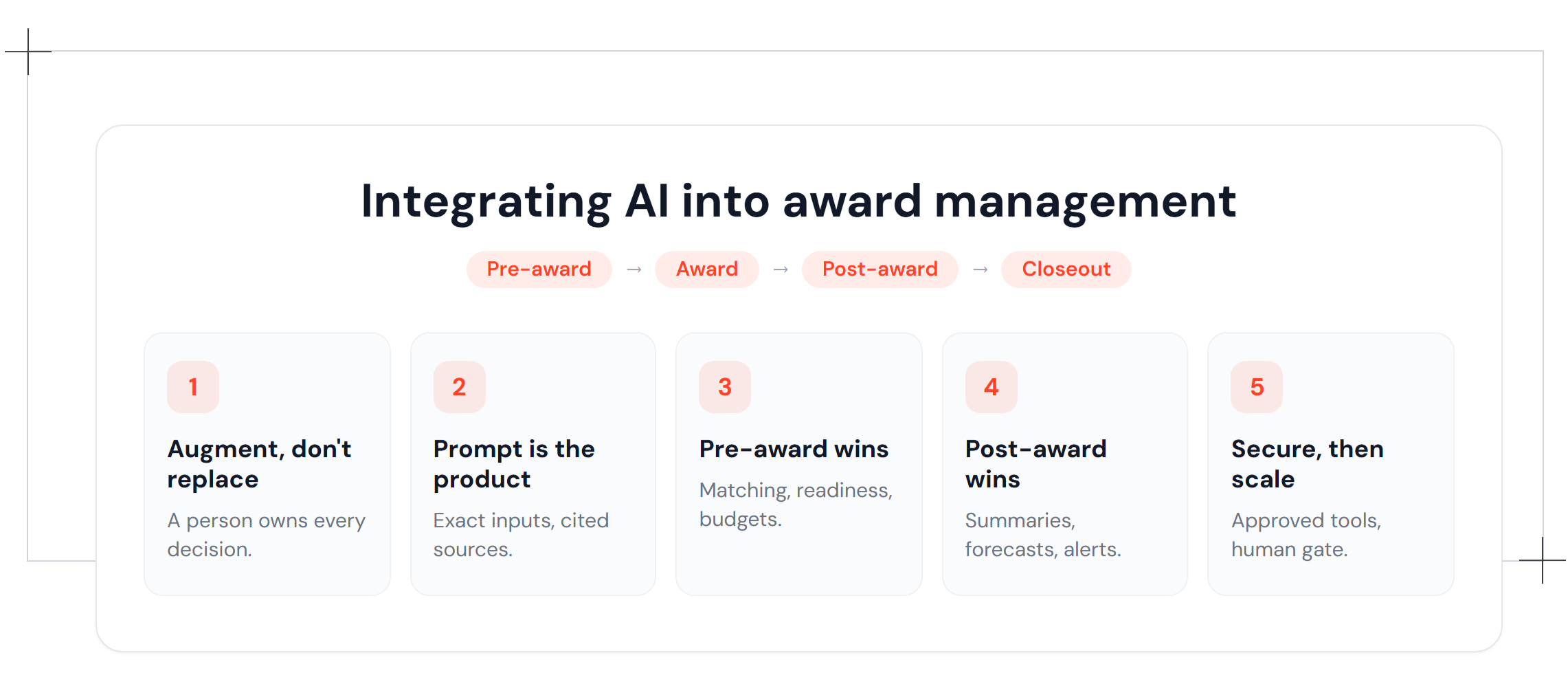
The work is manual, and that is the opening
From the search for relevant funding, to pulling together application materials, to submission, to tracking the award and its disbursement, to closeout, research managers do most of this manually and keep much of it in their own heads and files. It is document-heavy, deadline-driven, and highly regulated, and every step depends on reading sponsor and institutional requirements correctly.
That is exactly why AI helps. Not to take the work away, Patience stressed, but to cut the time spent reading long solicitations, hunting for opportunities, and rebuilding the same calculations. The goal is to move from transactional processing to proactive, predictive support, with humans still owning the real decisions.
Pre-award: matching funding, and always citing the source
Her first live example was a funding opportunity matcher. Rather than read every solicitation, she prompted an AI tool to generate a pipeline of proposals due for NASA and NSF between September and December in specific areas (plasma and physics), and to tie each result back to its solicitation. What came back was a clean table: agency, program, solicitation, research area, whether a notice of intent was required, the proposal due date, the funding amount, and the typical project duration, with links back to the solicitation pages.
The discipline in that example is the lesson. She did not just ask for a list; she asked the tool to reference each item to its solicitation, so she could click through and authenticate it against the agency itself.
I don't work blindly. I still go back to the solicitation.
That gives her a fast way to prompt PIs early: here is what is coming up, here is what it wants, let's start in time.
Pre-award: readiness checks, budgets, and justifications
From there she showed the rest of the pre-award toolkit. A proposal readiness checker reads the documents assembled for a submission and scores them against the solicitation, returning an exception list, for example "readiness 87%, missing Facilities and Equipment, budget justification needs review, biosketch and current-and-pending complete." It tells you what is missing before a reviewer or sponsor does.
The budget example was the one that landed hardest. From a single paragraph prompt, generate a three-year budget for a PI with three months of effort annually, 38% fringe, 48% F&A, yearly travel to San Francisco from Huntsville, no equipment, and a $70,000 salary over a set period of performance, the tool produced a complete Excel budget: hourly rate, effort, annual rate, fringe, F&A, and annual totals, all broken out by year. She deliberately left the PI's name out of the prompt and would add it only if she chose to use the budget. The same approach drafts a first-pass budget justification from an approved budget.
She was equally clear about the failure mode: you have to supply the exact inputs. If you leave out your real F&A and fringe rates, the tool will calculate the wrong numbers. The budget assistant gets you a fast, credible starting point; it does not excuse you from knowing your own budget.
Post-award: monitoring, forecasting, and early warnings
On the post-award side, AI shifts from drafting to watching. Feed it a Notice of Award and it can summarize the terms, extract prior-approval requirements, track reporting and expiration dates, and build an award profile. From a concise spreadsheet of award data, it can monitor burn rate, forecast how long the remaining balance will last at the current pace, and flag unusual spending or reporting gaps.
She showed an illustrative early-warning dashboard built on placeholder award numbers: each award with its financial trend, time remaining, reporting status, and a risk level, plus a plain-language insight such as a projected balance at expiration with a note to review remaining equipment and travel commitments. The value is catching the problem early. If an award is winding down with travel or equipment funds still unspent, she can reach the PI in time to act, instead of discovering it at closeout.
The same pattern carries through subaward monitoring (compare invoices to approved budgets, track agreements and expirations, flag anomalies, keep an auditable trail) and closeout readiness (open commitments, final invoices, remaining balances, equipment and cost share, and a closeout exception list).
Governance is the other half of the talk
Patience spent as much time on guardrails as on capabilities. The recurring instruction: do not work in isolation, and do not paste sensitive information into public tools. Work with your IT team to use an institution-approved, protected platform for anything that touches names, salaries, or non-public award data, and keep public tools for generic, de-identified prompts.
She framed the safe setup as layered: institutional data, a secure AI layer, sponsor and institutional rules to ground the answers, the AI's analysis, and then human approval on top. The known risks are real: hallucinations, sensitive-data exposure, bias, and over-reliance. The controls are equally concrete: approved tools only, role-based access, source-grounded responses, human approval gates, and audit logs. And the single most important habit sits with the user.
Your prompt matters.
A good prompt specifies the exact inputs and asks the tool to reference its sources, so the output can be verified rather than trusted.
Questions from the room
-
Which AI tools to use. UAH's institution-approved tool is Google Gemini, which is what Patience uses for anything involving names or sensitive information. She also uses Claude and ChatGPT, but only for public, de-identified prompts, never for data that should not leave the institution.
-
How the budget numbers were calculated. Yes, the tool computed the travel cost itself from the destination she named. The key is the prompt: give it the exact salary, period of performance, F&A rate, fringe rate, and travel location, and it applies the right figures. Leave those out and the math will be wrong, which is why you review every output.
-
Building the post-award dashboard. She does not connect the tool to live systems. She prepares a concise spreadsheet or table of award data, POP start and end dates, award amount, salaries, travel, and uploads that. From it the tool can return burn rate, a forecast, and report due dates, without needing the PI's name.
-
Connecting AI to internal systems. Not yet, and by design. Rather than open institutional systems to AI while the tools are still evolving, she extracts what she needs from the Notice of Award into a spreadsheet and works from that inside a protected, approved tool. One attendee noted the same approach could be used to benchmark burn-rate forecasting across a portfolio.
Key takeaways
- AI maps to the entire award lifecycle, from funding search and proposal readiness through budgets, award monitoring, and closeout. It augments professional judgment; it does not replace it.
- The prompt is the product. Supply exact rates and inputs, and require the tool to cite the solicitation or source so you can verify the answer.
- Pre-award wins: opportunity matching with references, readiness scoring, and first-draft budgets and justifications.
- Post-award wins: Notice of Award summaries, burn-rate forecasting, compliance and reporting alerts, and closeout readiness.
- Security is not optional. Use an institution-approved, protected tool for anything sensitive, keep a human approval gate, and maintain an audit trail.
- Start small. Begin with low-risk, high-ROI tasks like solicitation summaries, checklists, deadline extraction, and email drafts, then expand into decision support.
AI does not replace our jobs as research administrators. It only makes us work better, faster, more proactively, and more strategically valuable.
Webinar Slides
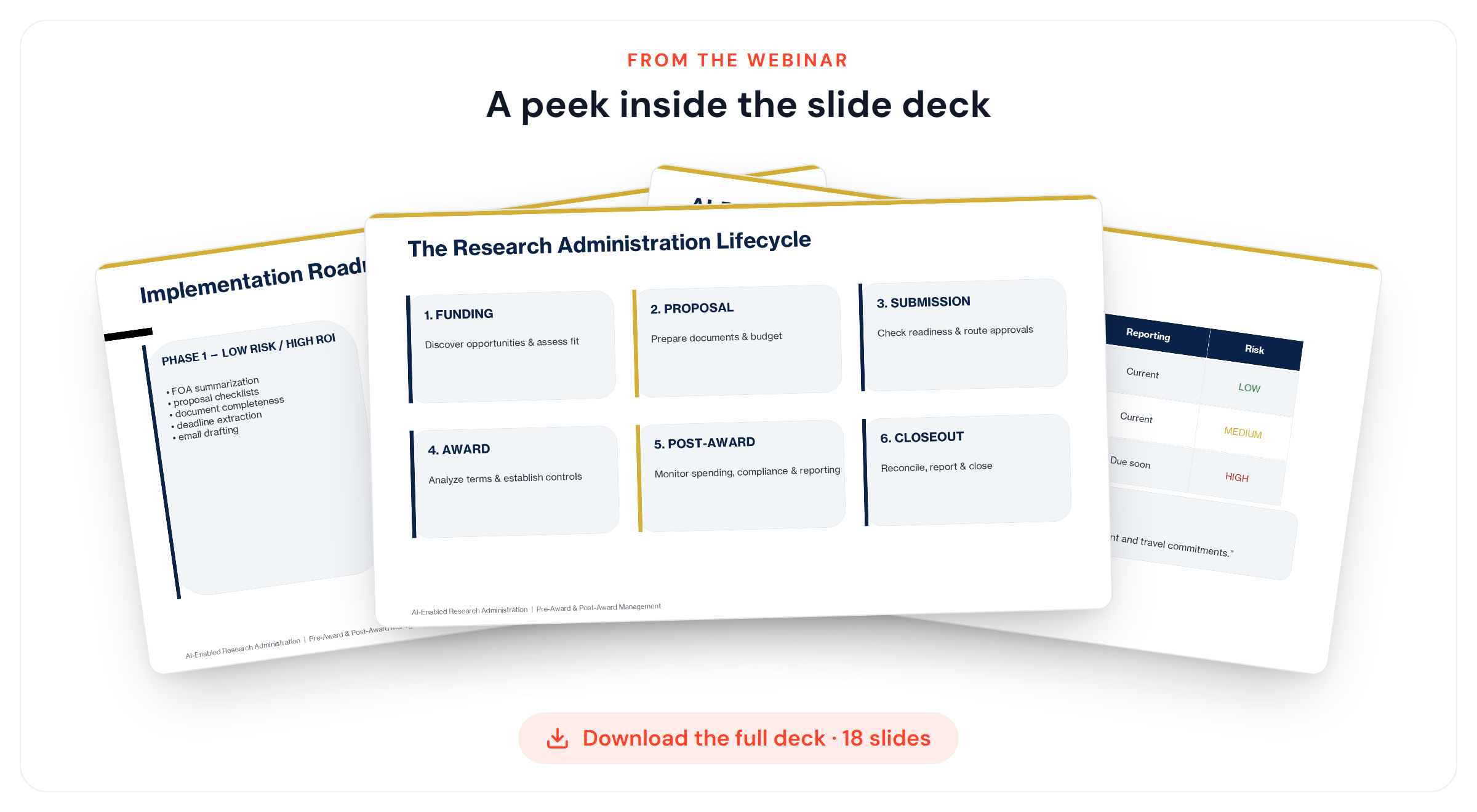 Patience has prepared slides that were used during the webinar, that you can download here - Impact of integrating AI into Award Management
About the speaker

Patience Ezeike is a Senior Research Proposal and Contract Analyst at the University of Alabama in Huntsville, where she works across both pre-award and post-award research administration, from proposal development, budgets, and contract analysis through award setup, monitoring, and closeout.
She approaches AI as a practitioner: quick to show where it saves real time in day-to-day grants work, and just as quick to insist on approved tools, verified outputs, and a human in the loop.