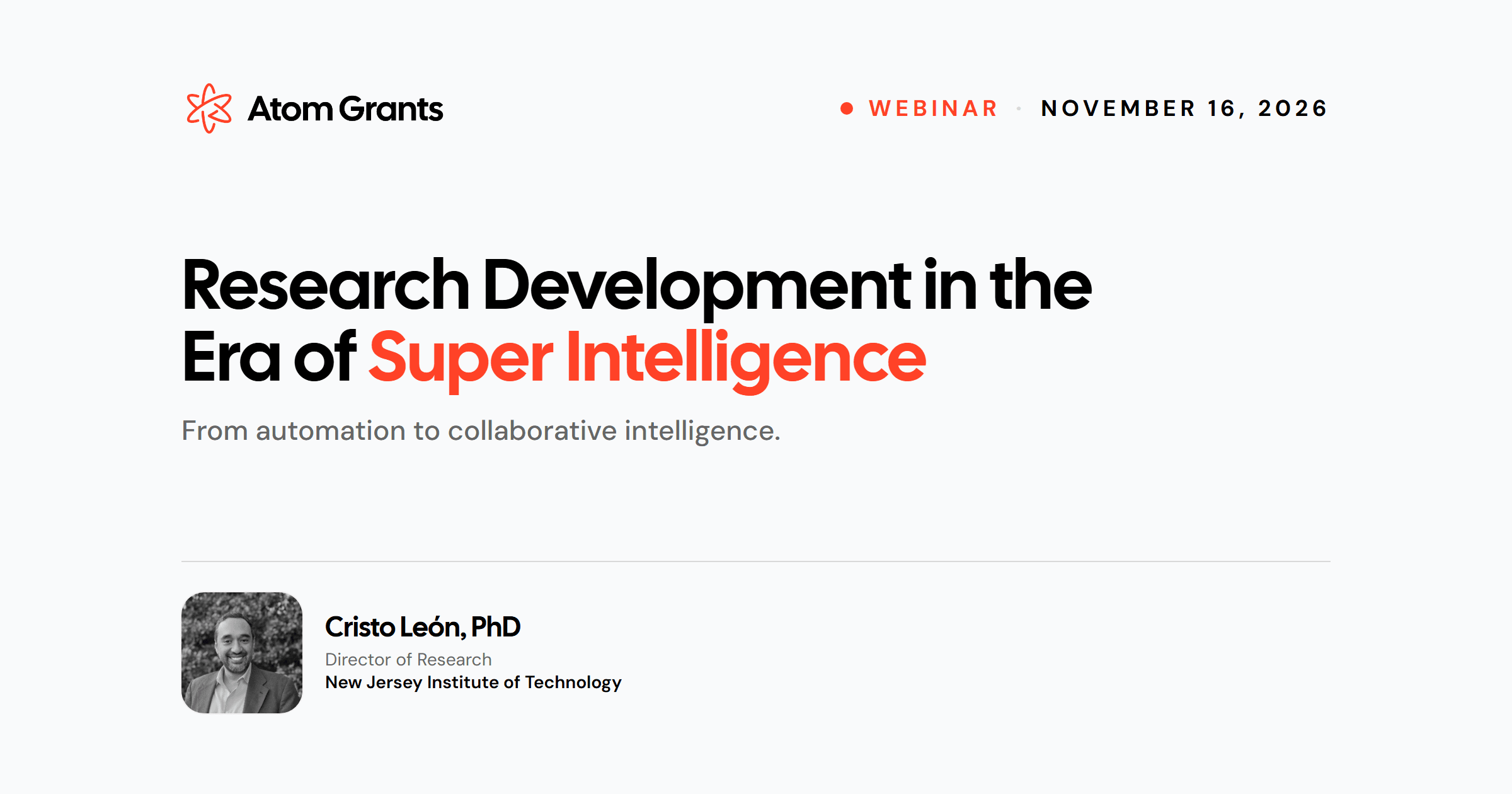
November 16, 2026 at 12:00 PM ET
Research Development in the Era of Super Intelligence
From automation to collaborative intelligence: what research offices should prepare for now.
AI systems are getting more capable, and federal policy now calls them “Super Intelligence.” For research development teams, the hard part isn’t picking up another tool. It’s working out how these systems change research strategy, collaboration, funding intelligence, proposal development, and governance. This session skips the guessing about when Super Intelligence arrives and focuses on what research offices should start preparing for now.
Many grant tasks are already covered by systems institutions have in place. The bigger value may be in less admin friction and better strategic intelligence: spotting sponsor rule changes, mapping where funding is moving, and helping teams from different fields work on the same problem. The session closes with a path from automation to augmentation, orchestration, and collaborative intelligence, and an open exchange of resources for a shared community of practice.
What you’ll learn
- What the new “Super Intelligence” policy language means for research offices
- Why “what can AI automate?” is the wrong first question
- Where advanced AI can cut friction and give researchers time back
- How funding intelligence goes further than grant discovery
- Finding who else is working on a problem, not just who to partner with A four-step path from automation to collaborative intelligence
Who it’s for
- Research Development Professionals
- Research Administrators
- Research Office Leaders
- And interested professionals
Your speaker

Cristo leads research development for NJIT’s Jordan Hu College of Science and Liberal Arts. Since 2015 he has supported 1,937 proposals and helped the college secure more than $123 million across 447 new awards, as its yearly new awards grew from $6 million to a record $27 million.
He brings more than two decades of work in research development, innovation, and institutional collaboration across Mexico, Ecuador, France, and the United States.