The 10 Best Grant Databases for 2026
For universities, researchers, and nonprofits
October 6, 2026
10 grant databases compared on coverage, pricing, and fit, from Pivot-RP and GrantForward to Instrumentl, Candid, Grants.gov, and AI grant finders.
Updated October 2026. We re-checked every tool on this list, removed one that has shut down, and added the databases university research offices actually compare. Disclosure: we make Atom Grants. We've kept the facts about every other tool to what each vendor says on its own site.
Summary
The hard part of grant funding isn't writing the proposal. It's finding the right opportunity before the deadline, and making sure it reaches the person who should apply. This guide compares the 10 grant databases and search engines worth knowing in 2026, split by who they're built for: universities and research offices, individual researchers, and nonprofits.
Key Points
- Best for universities and research offices: Atom Grants. Pivot-RP, GrantForward, and SPIN are the established alternatives.
- Best free option: Grants.gov, for every open US federal opportunity
- Best for nonprofits: Instrumentl, Candid's Foundation Directory, GrantStation
- The big 2026 shift: AI matching. The newer tools read each funding call and match it to a researcher's actual work, instead of waiting for someone to type the right keyword.
The 10 Best Grant Databases at a Glance
For universities and research offices
| Tool | Faculty setup | Eligibility checks | Proposal review | Grant research |
|---|---|---|---|---|
| Atom Grants | None | ✓ | ✓ | Full briefs |
| Pivot-RP | Claim profile | — | — | Summaries |
| GrantForward | Profile + keywords | — | — | Summaries |
| SPIN | Keyword profile | — | — | — |
All four cover federal and foundation funding, flag limited submissions, send branded alerts, and give admins usage reports.
For everyone else
| Tool | Best for | Price |
|---|---|---|
| Grants.gov | Applying for US federal grants | Free |
| Instrumentl | Nonprofits with a grants budget | From $299/mo |
| Candid FDO | Researching foundations | Paid; free at partner libraries |
| GrantStation | Small nonprofits | Annual membership |
| GrantWatch | Nonprofits and small businesses | Weekly to annual plans |
| FundFit | Institutions already on Streamlyne | Quote |
— means not found on the vendor's site or in university documentation, as of October 2026.
Best for Universities and Research Offices
A research office has a different problem from a single grant seeker. You're not finding one grant for one project. You're making sure hundreds of faculty hear about the right opportunities, and that limited submissions don't slip past. These five tools are built for that.
1. Atom Grants
Atom Grants is an AI grant discovery platform built for universities. Instead of asking faculty to search, it builds a profile for every researcher from their publications and prior funding. It then matches each new opportunity to the people it fits and delivers the matches by email.
Trusted by NYU Langone, the University of Memphis, Auburn University, North Dakota State University, and 55+ other institutions. The University of Memphis set a record year for proposal submissions on Atom, and Denver Health increased grant engagement by 800% after switching.
Why Atom Is #1 for Research Offices
What sets Atom apart is doing all three in one platform:
- Matches every researcher with zero setup. Profiles build themselves from publications and prior funding, so matches land even for faculty who never log in.
- Checks eligibility for every researcher. Atom reads each call and checks career stage, citizenship, institution type, and prior awards against each person, so faculty only see grants they can actually apply for.
- Carries the grant through to the proposal. Section-by-section guides and an AI reviewer that critiques drafts against the funder's criteria.
Key Features
- AI matching: Every grant is matched to every researcher's actual body of work, not just their keywords. See how Discovery works.
- Eligibility checks: Atom reads each funding call and checks career stage, citizenship, institution type, and prior awards before a researcher spends time on it.
- Weekly personalized digests: Each faculty member gets their own ranked list, sent in your office's branding. Open rates average 78%.
- Limited submissions: New limited-submission opportunities are flagged as they post, with a daily email to your office. Browse current limited submissions.
- Updated daily: Federal, foundation, and industry sources across 30,000+ funders are re-checked every day.
- Proposal support: Section-by-section guides and an AI reviewer that critiques drafts against the funder's criteria.
What I Like About Atom Grants
Faculty don't have to log in or set anything up for it to work, which is the reason engagement holds up where other databases stall. For a small research development team, it's the difference between a campus-wide email blast and a personal shortlist for every PI.
Things to Consider
Atom is built for research institutions. Nonprofits looking for operating support will get more from Instrumentl or Candid.
My Take
If you run a research office and want faculty to actually use the tool, start here. See how research offices use Atom.
2. Pivot-RP (Clarivate)
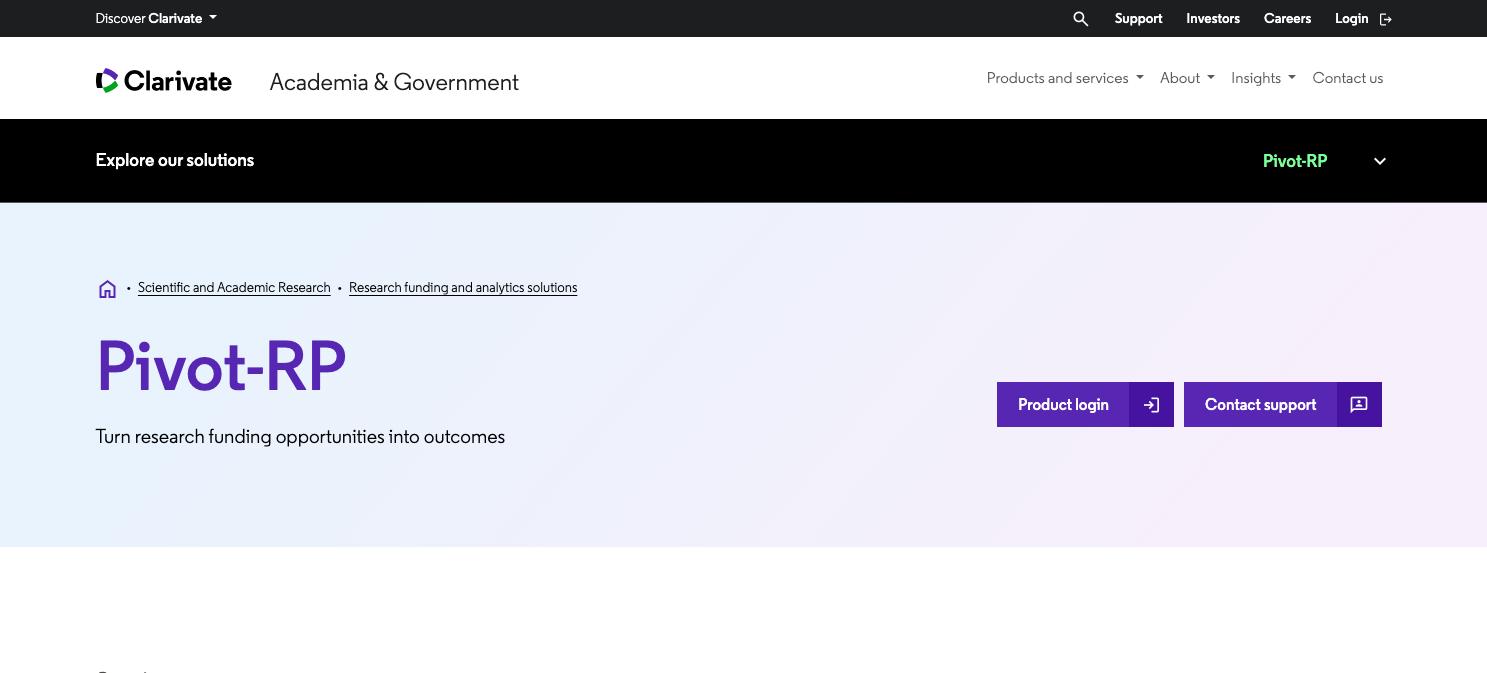
Pivot-RP is one of the longest-running funding databases in higher education, now part of Clarivate. It pairs a large curated database of funding opportunities with researcher profiles that institutions can use to match faculty to funding.
Key Features
- Curated opportunities: A large, editor-maintained database of government, foundation, and corporate funding.
- Funding Advisor: Weekly emails of opportunities matched to a researcher's profile.
- AI summaries and semantic search: Added in 2025.
- Admin tools: Limited-submission and internal opportunities, branded alerts, and usage reports.
What I Like About Pivot-RP
It's familiar to research administrators, and the database is broad.
Things to Consider
Profiles are pre-built, but each researcher has to claim theirs before matched opportunities start arriving, so results depend on how many faculty take that step.
My Take
A solid incumbent. If you're evaluating it, compare how many of your faculty actually log in. Read our full Pivot-RP vs Atom Grants comparison.
3. GrantForward
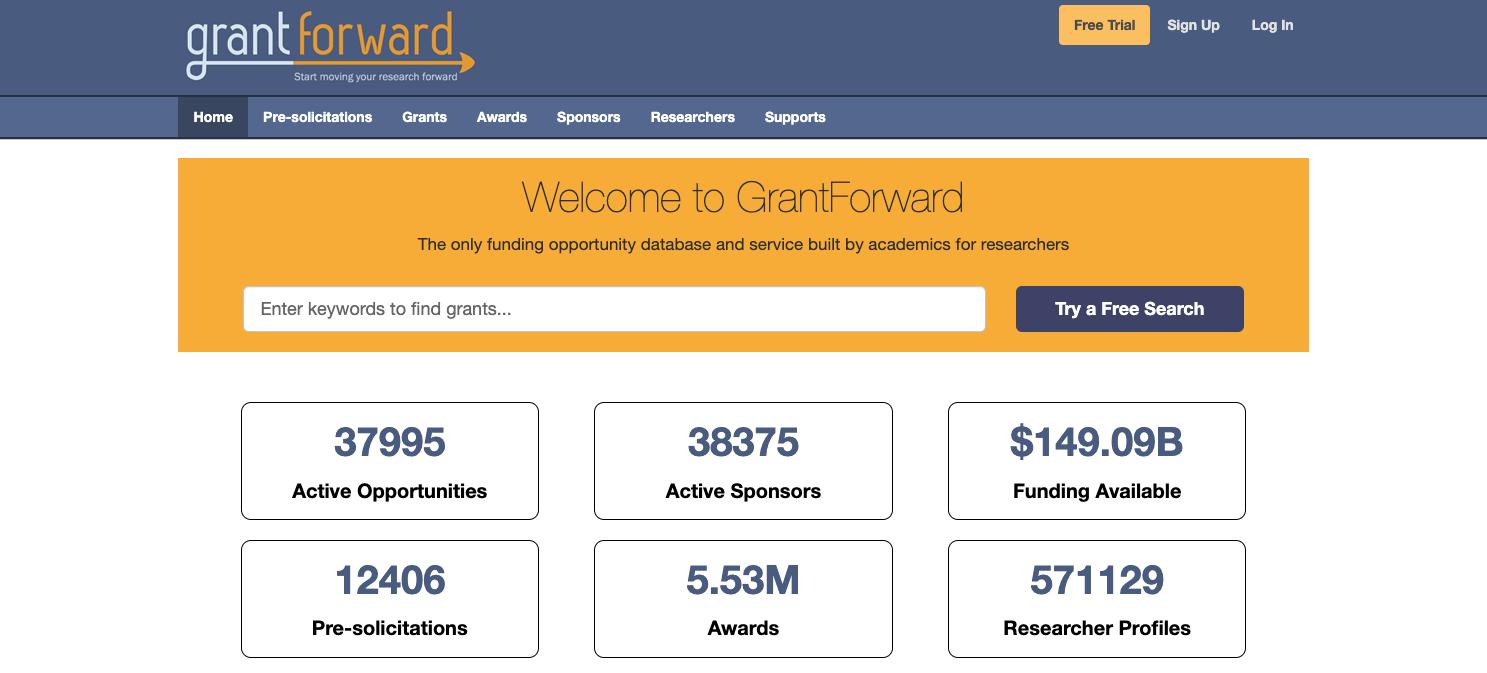
GrantForward is a funding search engine that started in academia. It offers funding opportunity search, researcher profiles, and recommendations for both institutions and individual researchers.
Key Features
- Opportunity search: Federal, foundation, and corporate funding, plus limited-submission opportunities with an internal competition page.
- Recommendations: Daily, weekly, or monthly emails based on a researcher's profile and keywords.
- AI features: AI-generated grant summaries and an AI query assistant for building searches.
- Individual plans: Researchers without an institutional license can subscribe on their own.
What I Like About GrantForward
It's accessible to individual researchers, not only institutions.
Things to Consider
Researchers need to claim a profile and set keywords, so match quality depends on how much setup each person does.
My Take
A reasonable option, especially for individuals. Read our GrantForward vs Atom Grants comparison.
4. SPIN (InfoEd Global)
SPIN is InfoEd Global's funding opportunity database. It's most common at institutions that already run InfoEd for research administration.
Key Features
- Funding database: Opportunities from government, foundation, and corporate sponsors.
- SMARTS alerts: Daily matches emailed against each researcher's keyword profile, with institutional branding.
- Limited submissions: One-click reports for limited-submission opportunities.
- InfoEd integration: Fits alongside InfoEd's proposal and award systems.
What I Like About SPIN
If your office already lives in InfoEd, it keeps everything in one vendor.
Things to Consider
Matching runs on keyword profiles that researchers enter and maintain themselves, and SPIN doesn't advertise AI features.
My Take
Worth a look if you're an InfoEd shop. Less compelling as a standalone discovery tool.
Best Free Option
5. FundFit (Streamlyne)
FundFit is the funding-matching add-on from Streamlyne, a research administration software vendor. It matches researchers to opportunities and suggests teams, and it's mainly relevant to institutions already running Streamlyne.
My Take
If you're not a Streamlyne customer, there's little reason to start here. If you are, compare how much faculty setup each tool needs and what happens after the match. See Streamlyne vs Atom Grants.
6. Grants.gov
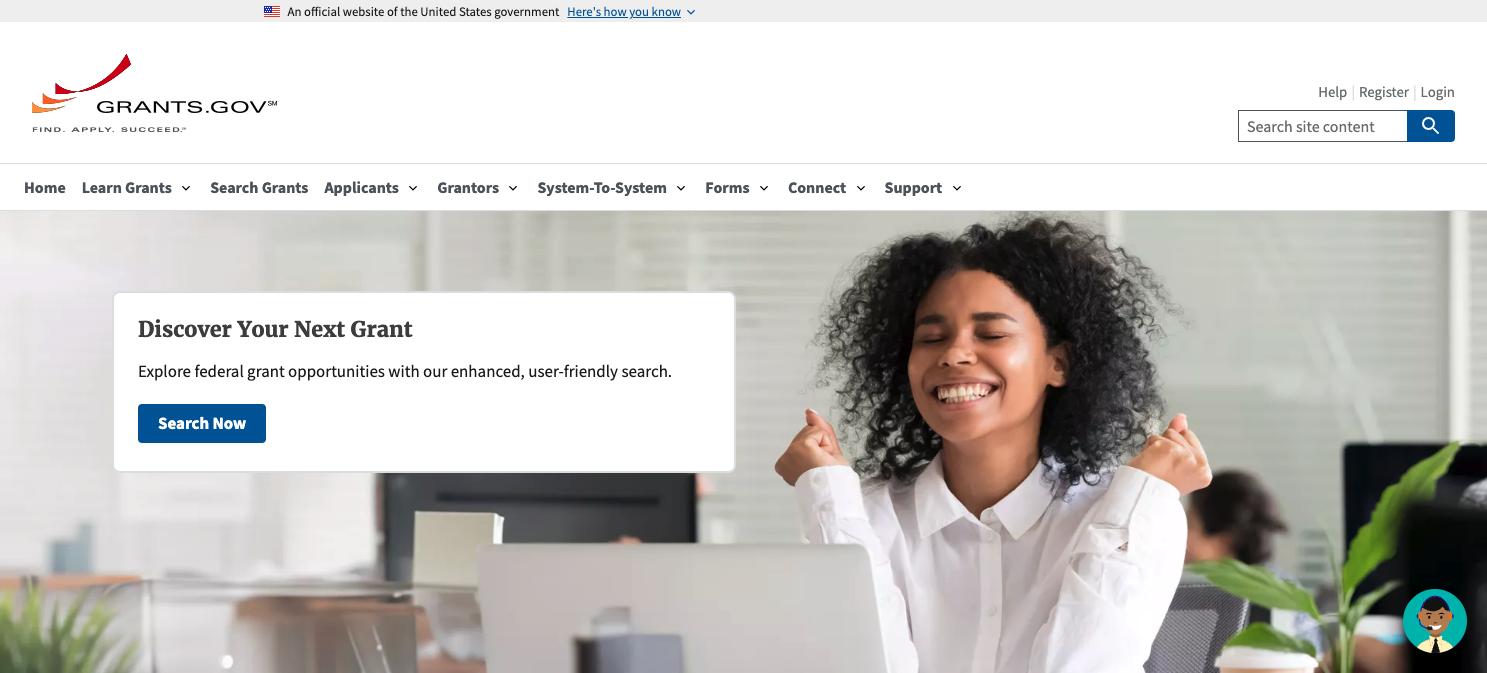
Grants.gov is the official US portal for federal grant opportunities, and the place many federal applications are submitted.
Key Features
- Official source: Every open federal grant opportunity in one place.
- Submission portal: Required for many federal applications.
- Free: No subscription needed.
What I Like About Grants.gov
It's free and authoritative.
Things to Consider
Search is keyword-only, the interface is dated, and it doesn't cover foundations or industry.
My Take
Essential for federal work. Use it to apply, and use a discovery tool to find what to apply for.
Best for Nonprofits and Grant Consultants
7. Instrumentl
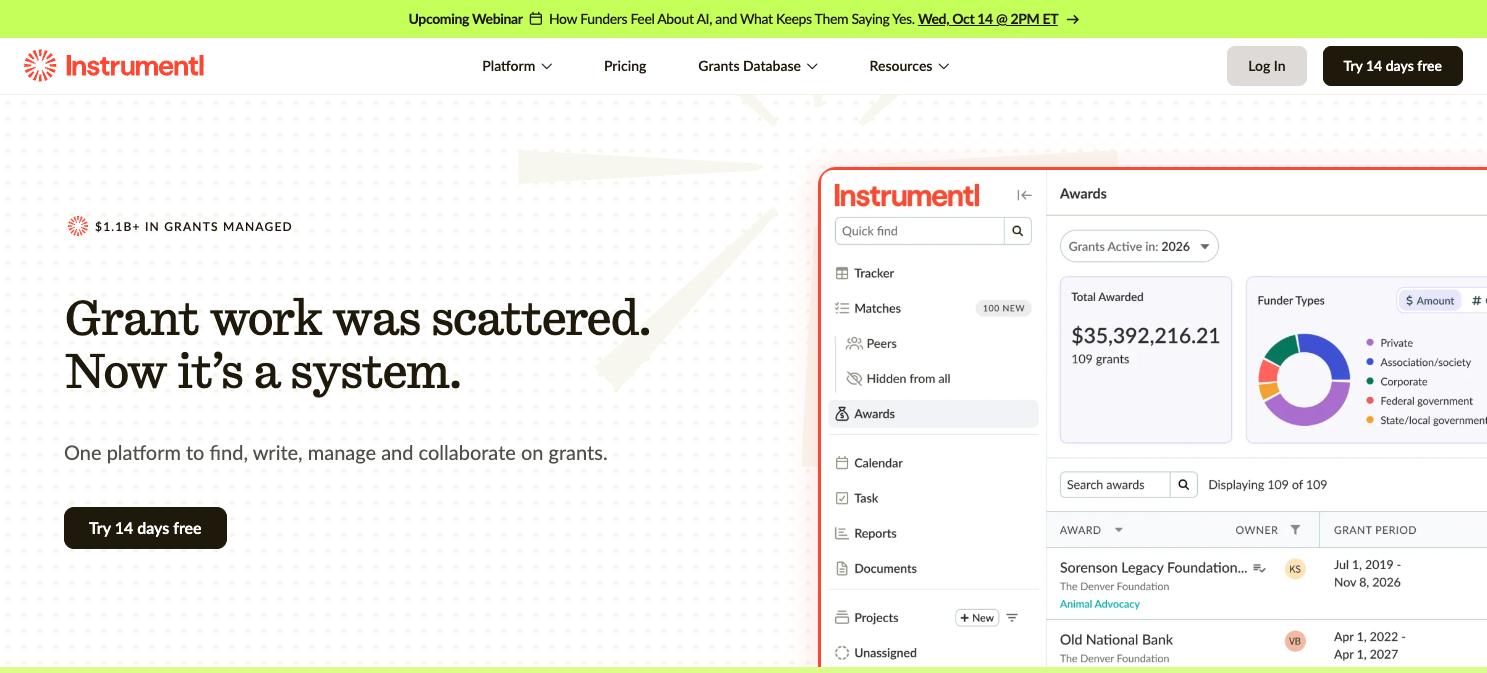
Instrumentl is a polished tool for nonprofits and grant consultants who want discovery and grant tracking in one place.
Key Features
- Project-based matching: Finds grants that fit each project.
- 990 insights: Foundation giving histories.
- Tracking: Deadlines, tasks, and reporting in one workspace.
What I Like About Instrumentl
The interface is clean, and it replaces a lot of spreadsheets.
Things to Consider
Plans start at $299 per month billed annually, which is a lot for a small team. It's built for nonprofits rather than university research.
My Take
The strongest all-rounder for nonprofits with budget.
8. Foundation Directory (Candid)
Candid's Foundation Directory is the long-standing reference for foundation funding research.
Key Features
- Foundation profiles: Hundreds of thousands of grantmakers.
- Giving history: See who received what, and how much.
- Free access points: Available at no cost through Candid's partner libraries.
What I Like About Foundation Directory
The depth of historical giving data is unmatched for foundation research.
Things to Consider
The volume can overwhelm new users, and it's a research library, not a workflow tool.
My Take
The best place to research foundations in depth.
9. GrantStation
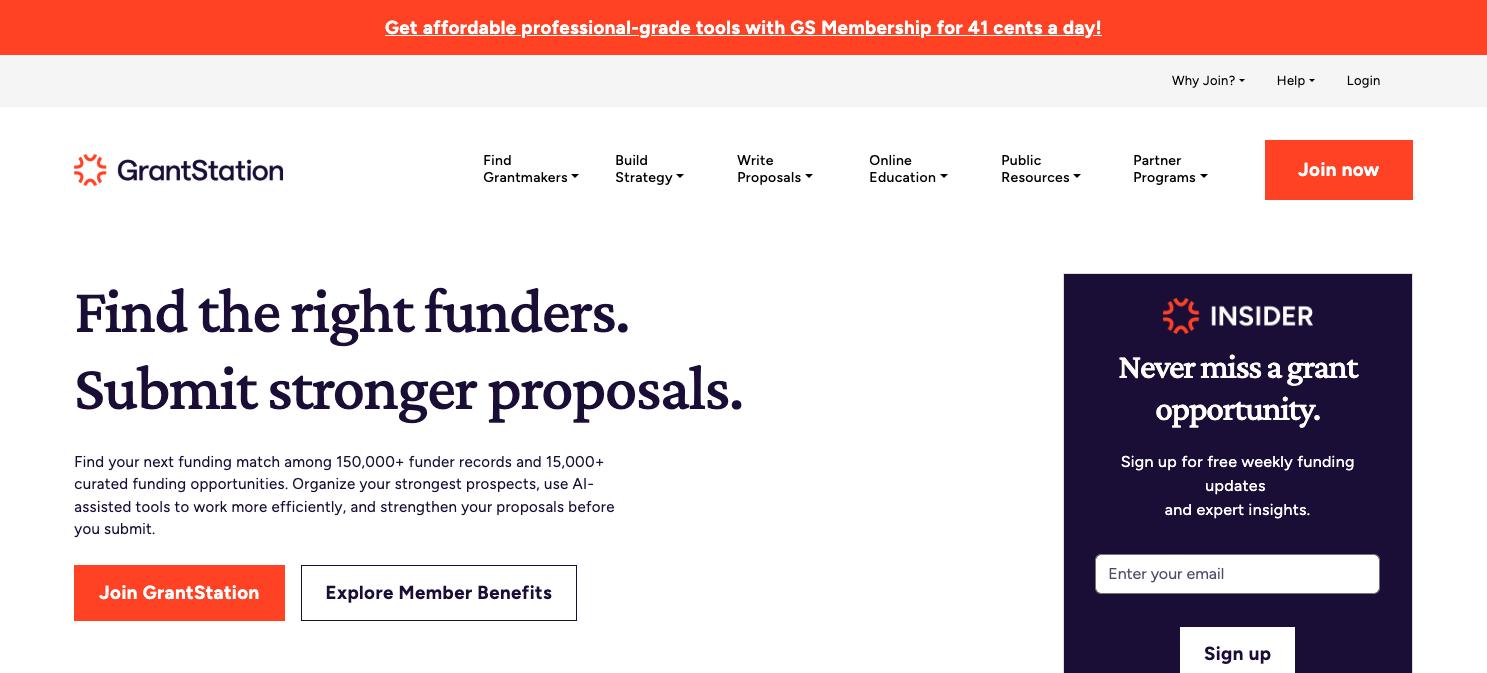
GrantStation combines a database of 150,000+ funder records and 15,000+ curated opportunities with proposal tools and online education.
Key Features
- Funder research: US and international grantmakers.
- AI-assisted tools: Help organizing prospects and strengthening proposals.
- Education: Online courses and guides, plus discounts through many nonprofit associations.
What I Like About GrantStation
Good value if your association offers a discount.
Things to Consider
It's built for nonprofits, so university research offices will find little that fits their workflow.
My Take
A sensible choice for small nonprofits with international needs.
10. GrantWatch
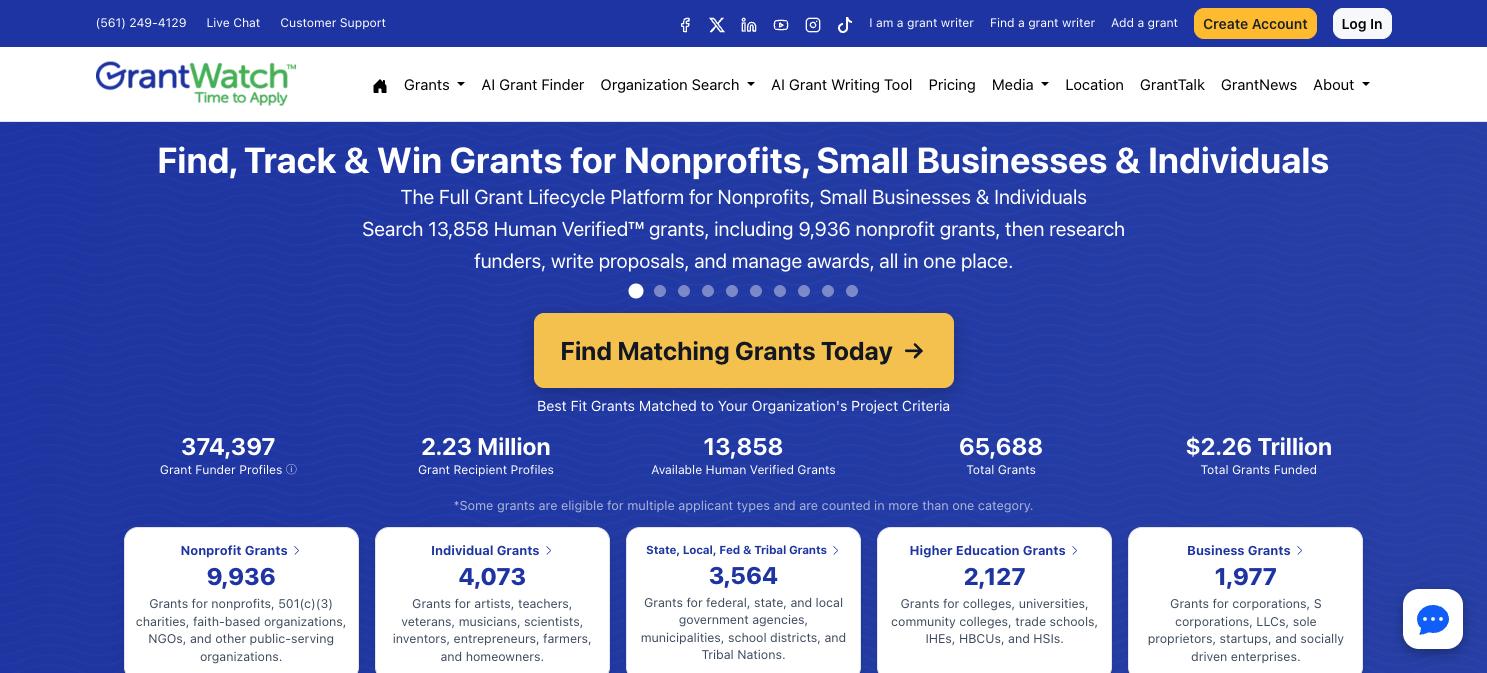
GrantWatch is a subscription grant service for nonprofits, small businesses, and individuals, with human-verified listings and newer AI tools.
Key Features
- Verified listings: Grants checked by GrantWatch's team, searchable by location and interest.
- AI tools: An AI grant finder and an AI writing tool.
- Short plans: Weekly, monthly, or annual options.
What I Like About GrantWatch
Weekly pricing lets you run a quick research sprint without a long commitment.
Things to Consider
It's aimed at nonprofits and small businesses, so research-specific funding is a small slice of it.
My Take
Fine for individuals or small businesses that need short bursts of searching.
AI Grant Finders vs Traditional Grant Databases
A traditional grant database is a searchable list. Someone has to know the right keywords, run the search, and read every funding call to decide whether it fits. That works for one grant writer with one project. It breaks down for a university with hundreds of researchers.
AI grant finders flip the model:
- They read the call for you. Eligibility rules, deadlines, and budget limits are pulled out of the funding call automatically.
- They match on substance, not keywords. A researcher's publications describe their work better than any keyword list.
- They come to the researcher. Matches arrive by email, so faculty who would never log into a database still see what fits them.
If you're choosing for an institution, ask each vendor one question: what share of your faculty use it every month? See how AI grant discovery works at Atom.
How We Picked These Tools
We compared each tool on four things:
- Coverage and freshness: A huge database isn't useful if listings are stale. How often are sources re-checked?
- Matching: Does the tool find relevant grants on its own, or does it depend on users building perfect searches?
- Who it's built for: A university research office, an individual researcher, and a nonprofit need different things.
- Adoption: The best database is the one people actually use.
We removed GrantHub from this list because it has been discontinued.
FAQs
What is the best grant database for universities? For research offices that want faculty to engage, an AI-matching platform like Atom Grants. Pivot-RP, GrantForward, and SPIN are the established alternatives, but each needs faculty to claim a profile or set up keyword searches before matches arrive.
What are the best grant search engines? For open US federal calls, Grants.gov. For federal and foundation research funding together, a dedicated research database such as Atom Grants, Pivot-RP, or GrantForward. For foundations, Candid's Foundation Directory.
What is the best grant database for nonprofits? Instrumentl and Candid's Foundation Directory are the strongest options. GrantStation is a good budget choice, especially through association discounts.
Are there free grant databases? Yes. Grants.gov lists every open US federal opportunity for free, and Candid's Foundation Directory is free at partner libraries.
What is an AI grant finder? A tool that reads funding calls and matches them to your work automatically, instead of relying on keyword searches. Some, like Atom Grants, also check eligibility and deliver matches by email.
What is a good alternative to Pivot-RP? Atom Grants is the most common switch for offices that want higher faculty engagement with less setup. GrantForward is the other common option. See the full comparison.
How do research offices manage limited submissions? They track new limited-submission calls as they post, find the faculty who fit, and run an internal competition. Atom flags these automatically and emails the office daily. See open limited submissions.
Can I use more than one tool? Yes. A common stack is Atom Grants for discovery and proposal support, and Grants.gov for federal submission.
My Final Thoughts
The right grant database depends on who you are:
- A university or research office: choose Atom Grants. It matches every researcher with no setup, tracks limited submissions, and supports the proposal itself, all in one platform. Book a demo.
- An individual researcher with no budget: start with Grants.gov.
- A nonprofit: Instrumentl if you have the budget, Candid or GrantStation if you don't.
Looking for something specific? Browse curated lists like AI research grants and early-career grants.
About the Author
Raphaël Bernier Head of Growth, Atom Grants Helping universities modernize research development with AI to reduce admin burden, increase faculty engagement, and improve proposal success.
LinkedIn: https://www.linkedin.com/in/raph-bernier/ Contact: raphael@atomgrants.com Location: New York
More Blog Posts
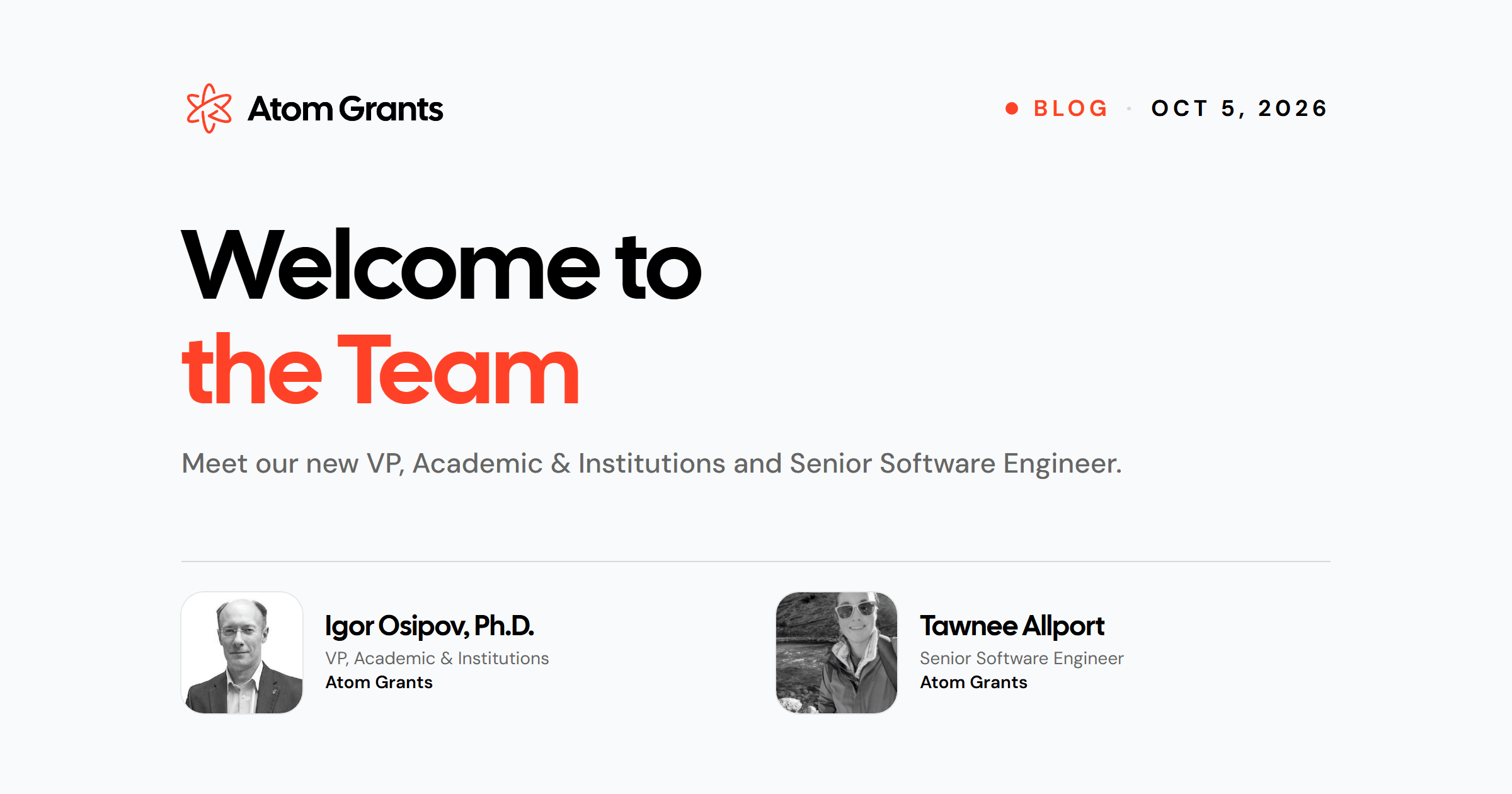
Welcome to the team!
Meet our VP of Academics and Senior Software Engineer
Read post
SRAI Annual Meeting 2026
Leading Research Development in the Age of AI Panel
Read post
Introducing Admin Analytics
The numbers we bring to your check-ins, now in Atom whenever you need them.
Read post
NIH AI Policy: New Rules of AI in Proposal Development
Inside the 2026 NIH policies reshaping how researchers write grants and proposals.
Read post
Budgets, in Atom
A workspace for the whole budget: the spreadsheet, the justification Atom AI can write for you, and the funder rules that grade both.
Read post
Atom AI Reviewer
A funder-grade read of your whole proposal, before anyone else sees the draft.
Read postIntroducing Projects
Organize your funding search into projects, each with its own team, interests, and eligibility, so your matches follow the work you’re actually doing.
Read post