Vision and Structure
Rethinking Leadership in Research Administration
December 10, 2025
I used to think leadership belonged solely to the Visionary in the room, the one with bold ideas and a big voice. But in research administration, I’ve learned that leadership often shows up more quietly. It lives in the people who bring stability, make complex systems work, and turn ambitious research ideas into reality. In our field, vision and execution must meet in the middle. It is not theoretical. It is daily practice.
I recently came across a framework that describes leaders as the ones setting direction and managers as building the systems. In research administration, these distinctions blur quickly. One moment we’re planning a multi-site proposal, and the next we’re interpreting a new compliance requirement or navigating an NIH policy shift. Leadership in our context is rarely about title. It rests in ownership, anticipation, and building structures that allow research to move forward.
Much of that leadership happens through iteration, whether it’s adapting to new systems like SciENcv or refining processes as feedback emerges. None of these changes arrive perfectly formed. We adapt, test, refine, and adjust. Progress often comes not from sweeping transformations, but from steady, thoughtful revision.
That same mindset shapes how we use AI. When used wisely, AI clarifies information, reduces noise, and creates space for real thinking. It doesn’t replace leadership. It enables it.
I’ve seen this in my own work. When I began using AI to summarize NIH notices or pull key elements from foundation guidelines, the mental clutter lifted. Tasks that once required days of sorting through updates now take hours. Last month, I used AI to generate an initial list of foundations for a PI. It allowed us to quickly focus on strategy rather than scanning, resulting in a strong plan in a fraction of the time. AI became a valuable thinking partner, helping refine ideas and make decisions with greater clarity.
For teams and leaders, this clarity matters. When AI clears routine clutter, people have more energy for creativity, problem-solving, and collaboration. It lightens cognitive load, supports well-being, and keeps us present for the work that requires judgment, empathy, and understanding. AI can support that work when used thoughtfully, not by replacing thinking but by clearing the noise that clouds it.
I’m especially grateful for colleagues who model this grounded form of leadership, the kind that moves ideas forward with care and intention. As we head into the holiday season, that gratitude feels even more present.
Leadership in research administration is ultimately about contribution: choosing to move ideas forward responsibly and making systems work more effectively for everyone. That is the quiet power of leadership, the energy created when vision and structure align to create lasting impact.
About Cristina Flowerday
Cristina Flowerday is a research administrator at Northwestern University who specializes in bringing clarity, coordination, and calm to complex academic environments. She supports faculty through proposal development, compliance guidance, and operational planning.
Cristina’s career spans more than 15 years across psychology, small business operations, IT and healthcare administration, corporate project management, and operations and compliance at Goldman Sachs. This breadth has shaped her ability to interpret complex systems while staying grounded in the human experience behind them. She holds a BS and MSc in Psychology, including graduate study at the London School of Economics focused on social and organizational behavior.
Her interest in the human side of research administration led her to develop a “Career Garden” framework, a practical model integrating motivation science, emotional intelligence, and organizational psychology to support sustainable professional growth. She recently presented this framework at the SRAI Annual Meeting.
Cristina also writes about leadership, professional development, workplace well-being, and the thoughtful use of AI in research administration. She collaborates with individuals and teams on questions of workflow, communication, and professional development, and is committed to cultivating research environments where people feel grounded, capable, and connected to what matters.

LinkedIn: https://www.linkedin.com/in/csflowerday
Blog: https://flowerdayco.wixsite.com/insights/blog
More Blog Posts
The 10 Best Grant Databases for 2026
For universities, researchers, and nonprofits
Read post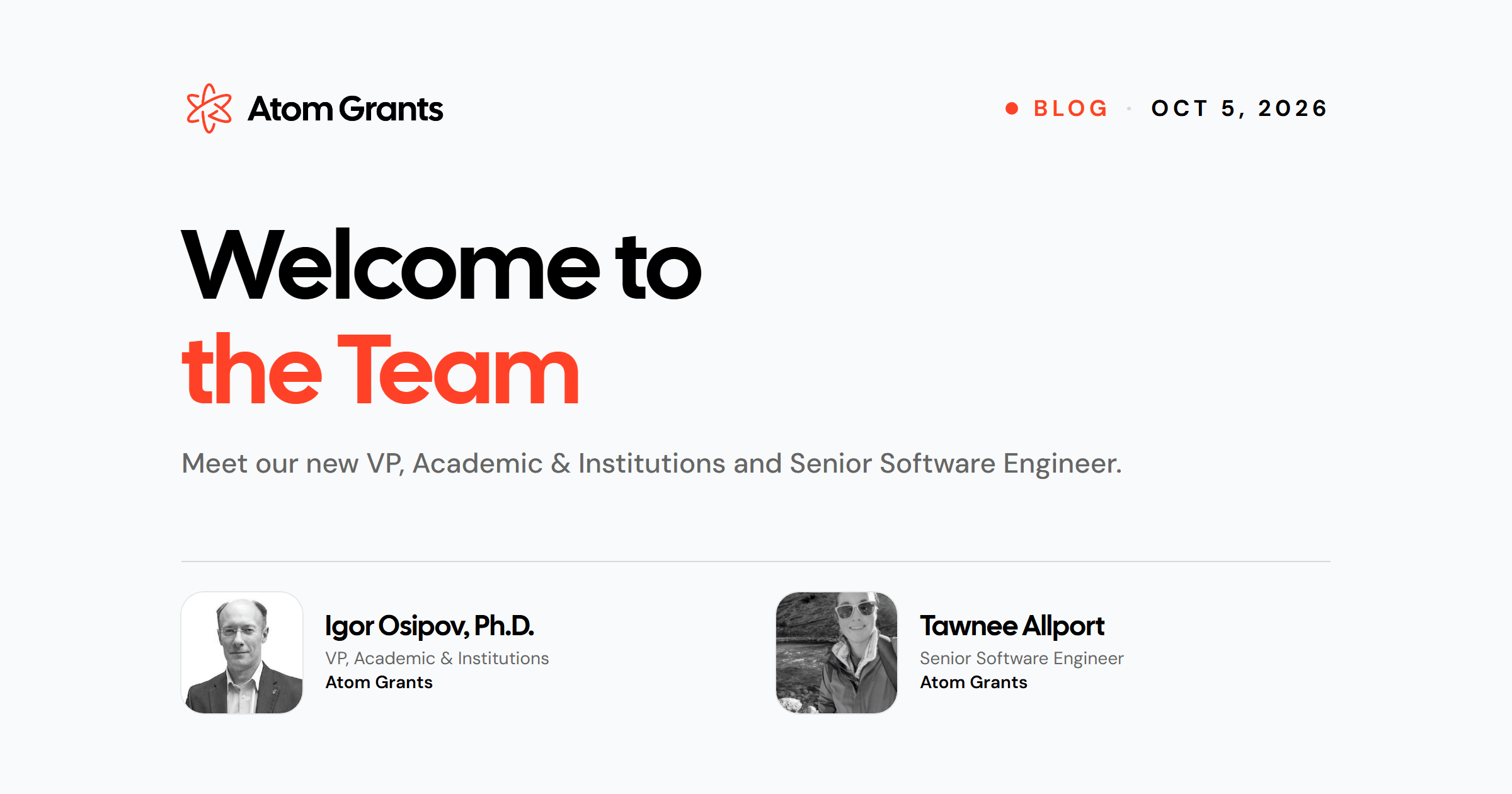
Welcome to the team!
Meet our VP of Academics and Senior Software Engineer
Read post
SRAI Annual Meeting 2026
Leading Research Development in the Age of AI Panel
Read post
Introducing Admin Analytics
The numbers we bring to your check-ins, now in Atom whenever you need them.
Read post
NIH AI Policy: New Rules of AI in Proposal Development
Inside the 2026 NIH policies reshaping how researchers write grants and proposals.
Read post
Budgets, in Atom
A workspace for the whole budget: the spreadsheet, the justification Atom AI can write for you, and the funder rules that grade both.
Read post
Atom AI Reviewer
A funder-grade read of your whole proposal, before anyone else sees the draft.
Read post