What Are Research Grants?
A Simple Guide for Researchers (2025)
December 2, 2025
Summary:
Research grants are the fuel that keeps scientific discovery moving. In this guide, I explain exactly what they are, who gives them out, and how the money actually works. If you are new to research or looking for funding, this is your starting point.
Key points:
Main value: clear definition of research grants and funding structures.
Who this helps: Researchers, academics, and non-profit leaders.
Outcome: You will understand how grants work and how to find them.
Let's get into it.
What Is a Research Grant? (The Simple Explanation)
If you strip away the academic jargon, a research grant is simply an investment in knowledge.
It is money given to a person or an organization to conduct a specific investigation or experiment. Unlike a loan, you do not pay this money back. However, unlike a gift, it comes with strings attached.
In my experience, people often confuse grants with “free money.” It isn’t really free. You are trading your time, your expertise, and your results in exchange for the funding.
The funder has a goal. Maybe they want to cure a disease. Maybe they want to understand climate change. They can’t do the science themselves, so they pay you to do it.
That is the core transaction: Funding for Answers.
The 3 Main Sources of Grant Money

Not all grants come from the same place. Knowing who you are asking is half the battle. Here is how I break it down.
1. Government Agencies (The Big Fish)
This is where the massive checks usually come from. In the US, we are talking about the NIH or the NSF.
These grants are prestigious and incredibly competitive. They are funded by tax dollars, which means the reporting requirements are strict. You have to account for every penny.
2. Private Foundations
Think of the Bill and Melinda Gates Foundation or the Ford Foundation. These are non-profits set up to fund causes.
Private foundations are often more mission-driven, caring less about bureaucracy and more about impact.
3. Corporate Grants
Companies fund research too, usually R&D aligned with their business needs.
For example, a pharmaceutical company might fund university research into a specific molecule. These grants can be faster to get but sometimes limit your publishing freedom.
What Can You Actually Spend the Money On?
This is where new researchers often get tripped up. You get a $100,000 grant. Can you just pocket it?
Absolutely not.
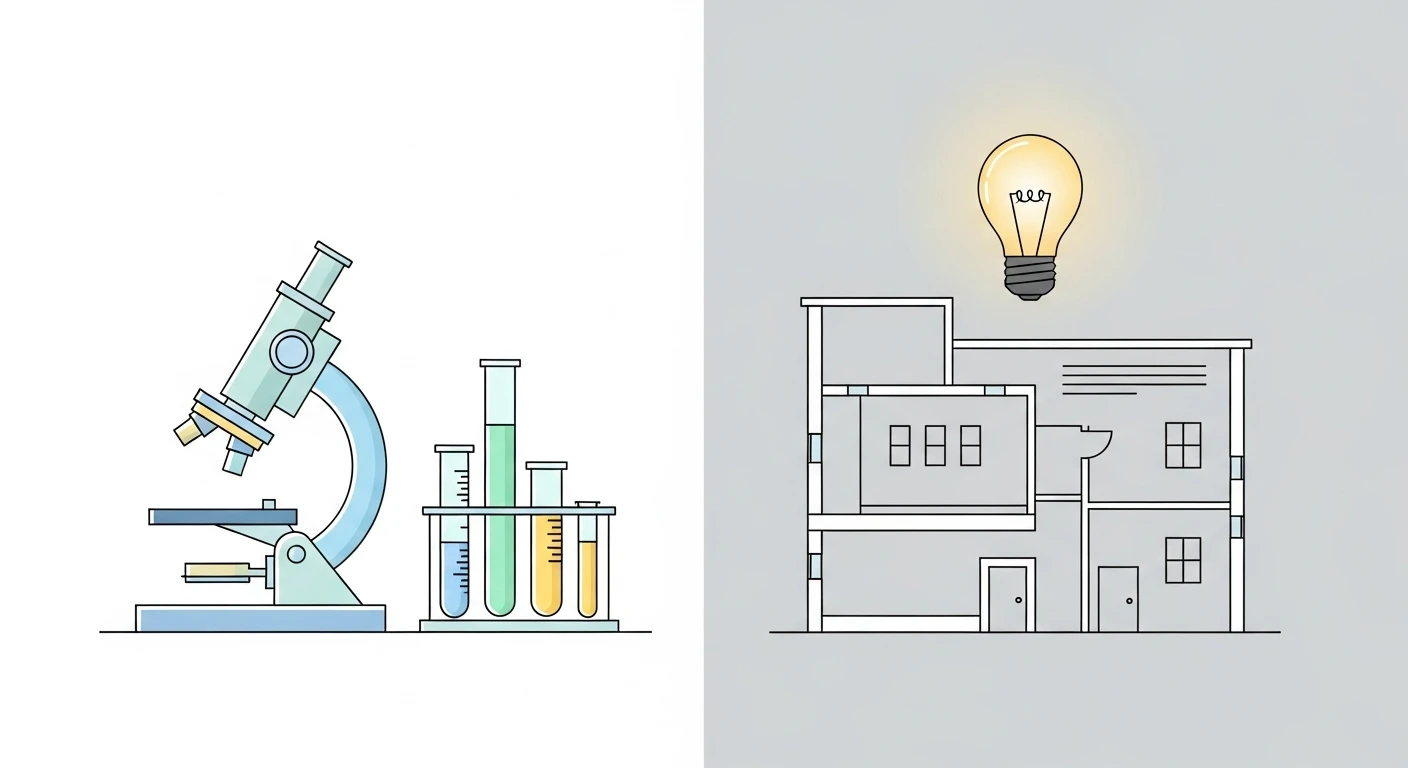
Grant budgets are typically split into two buckets:
- Direct Costs: Lab equipment, chemicals, travel, and salaries for researchers on the project.
- Indirect Costs (F&A): Money that goes to your university or institution to maintain infrastructure.
Indirect costs can be huge. Sometimes 50 percent or more of the grant goes straight to the institution.
The Reality Check: The Application Process

Writing a grant proposal is a grind.
It isn’t just saying “I have a cool idea.” You must prove you can do the work, provide preliminary data, outline a budget, and offer a timeline.
Success rates can be low. For many government grants, fewer than 20 percent of applications are funded. Researchers often spend more time seeking money than doing the science.
A Smarter Way to Find Funding: Atom Grants
Finding the right grant is often harder than writing the proposal. Government databases are messy, and spreadsheets get outdated fast.
That is where Atom Grants comes in.
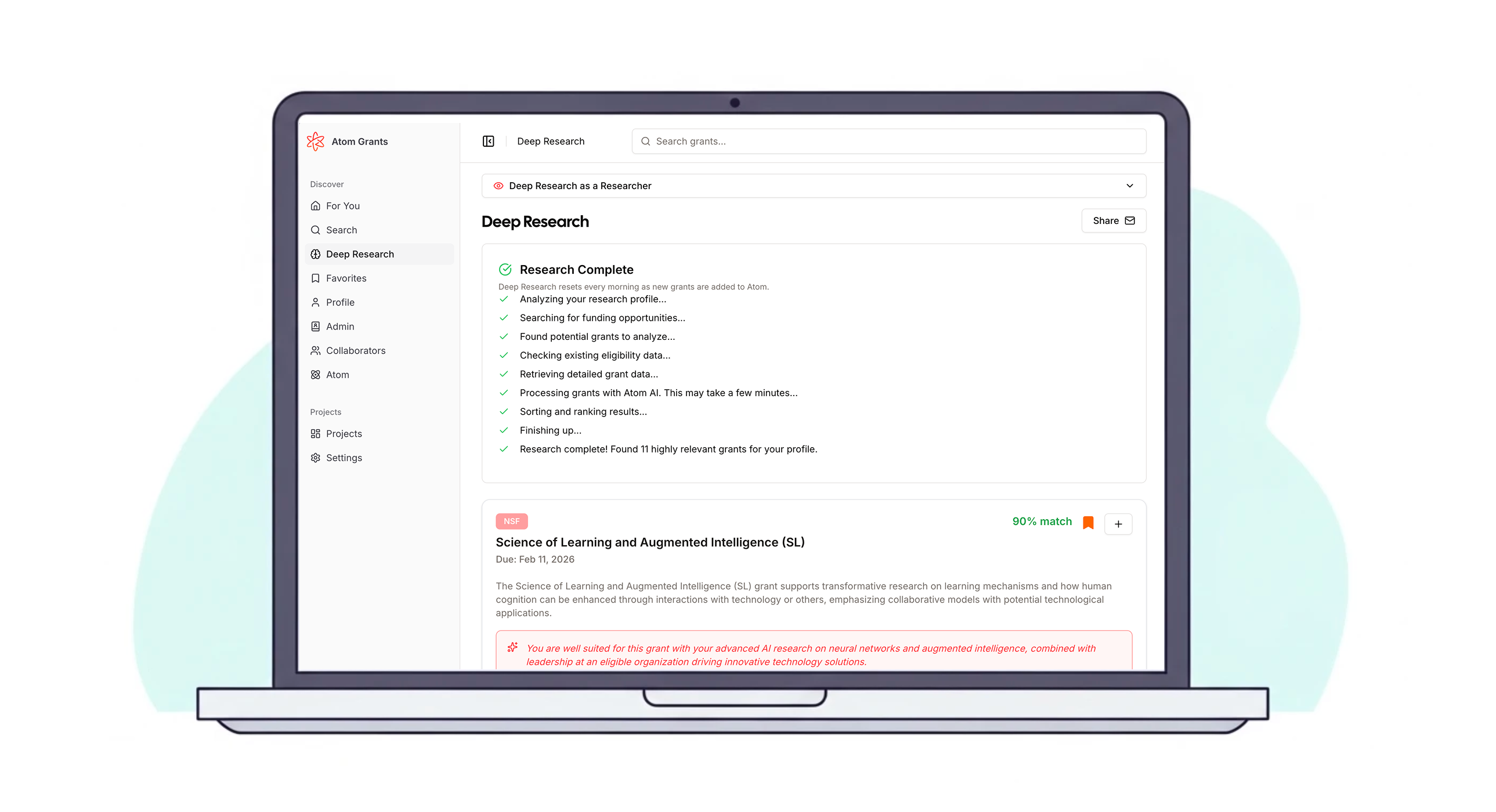
Atom Grants is an AI tool designed to multiply your impact by reducing administrative burden and matching you with the right opportunities.
Why I like it:
- It cuts the noise: You only see grants you qualify for.
- It saves time: Matches are based on your research profile.
- It boosts impact: Less admin work, more science.
If you’re tired of endless searching, Atom Grants is the modern solution.
Common Questions About Research Grants
Do I have to pay a research grant back?
No. A grant is an award, not a loan. Misuse or failure to perform can result in repayment demands.
Can individuals get research grants?
Yes, though it’s harder. Most grants go to institutions on behalf of a researcher. Some fellowships fund individuals directly.
How long does a grant last?
Varies. Some last one year, while major NIH R01 grants can last five or more.
How hard is it to get a research grant?
Very. Success rates often hover between 10 percent and 20 percent.
Can I use grant money to pay my salary?
Usually yes. Personnel costs are a standard budget item.
What happens if my research fails?
That is acceptable. Grants fund discovery, not guaranteed success. Honesty and rigor fulfill your obligation.
How long does the application process take?
Government grants often take six to nine months. Private foundations usually take three to six.
Who decides if I get funded?
A panel of experts through peer review evaluates your proposal.
Can I apply for multiple grants for the same project?
You can apply to many, but you cannot accept duplicate funding for the same work.
Do I need a PhD to apply?
Not always, but often. Students can apply for fellowships, and some industry grants do not require a PhD.
My Final Thoughts
Understanding what research grants are is the first step to building a sustainable research career. It is a system built on trust and results.
The money is out there. Governments and foundations want to give it away. They need people like you to solve problems.
Don’t let the paperwork slow you down. Tools like Atom Grants help you navigate the mess so you can get funded and get to work.
About the Author
Raphaël Bernier
Head of Growth, Atom Grants
Helping universities modernize research development with AI to reduce admin burden, increase faculty engagement, and improve proposal success.
LinkedIn: https://www.linkedin.com/in/raph-bernier/
Contact: raphael@atomgrants.com
Location: New York
More Blog Posts
The 10 Best Grant Databases for 2026
For universities, researchers, and nonprofits
Read post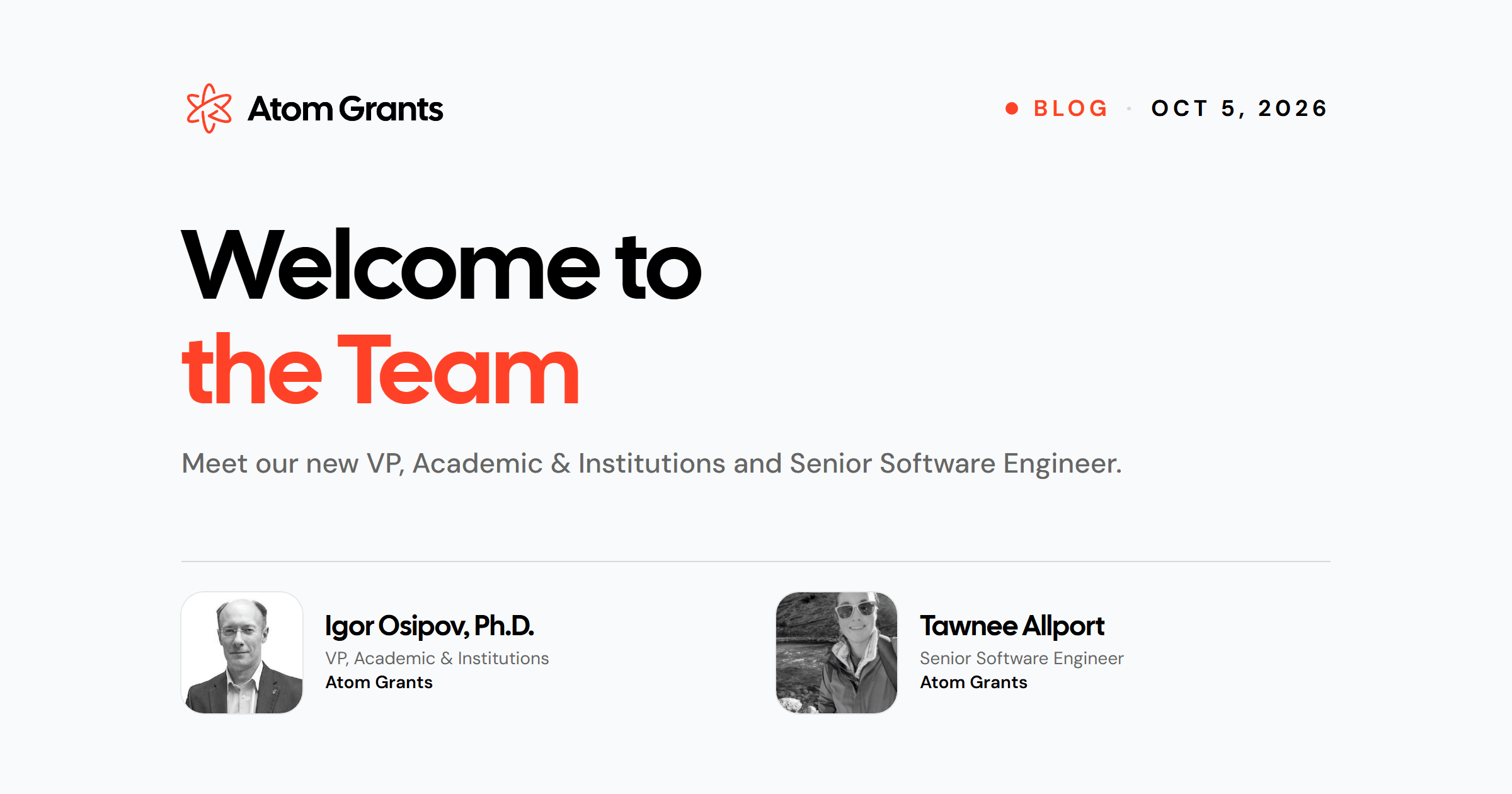
Welcome to the team!
Meet our VP of Academics and Senior Software Engineer
Read post
SRAI Annual Meeting 2026
Leading Research Development in the Age of AI Panel
Read post
Introducing Admin Analytics
The numbers we bring to your check-ins, now in Atom whenever you need them.
Read post
NIH AI Policy: New Rules of AI in Proposal Development
Inside the 2026 NIH policies reshaping how researchers write grants and proposals.
Read post
Budgets, in Atom
A workspace for the whole budget: the spreadsheet, the justification Atom AI can write for you, and the funder rules that grade both.
Read post
Atom AI Reviewer
A funder-grade read of your whole proposal, before anyone else sees the draft.
Read post