November 2, 2026
How Bradley University reduced their grant searching from a day to minutes
Overview
Bradley University, a primarily undergraduate institution in Peoria, Illinois, runs its Office of Sponsored Programs with two people. Before Atom, faculty had a keyword search tool few of them used. Most only heard about funding when the office sent it out, and building a short list of good fits could take the office’s director an entire Saturday. Since rolling out Atom in January 2026, that search takes minutes. Faculty now bring opportunities to the office instead of waiting for them, and grants nobody had found before are turning into submitted proposals. Next, the office is moving into Atom’s proposal tools: checklists built from the NOFO and AI review of drafts against it.
The Challenge
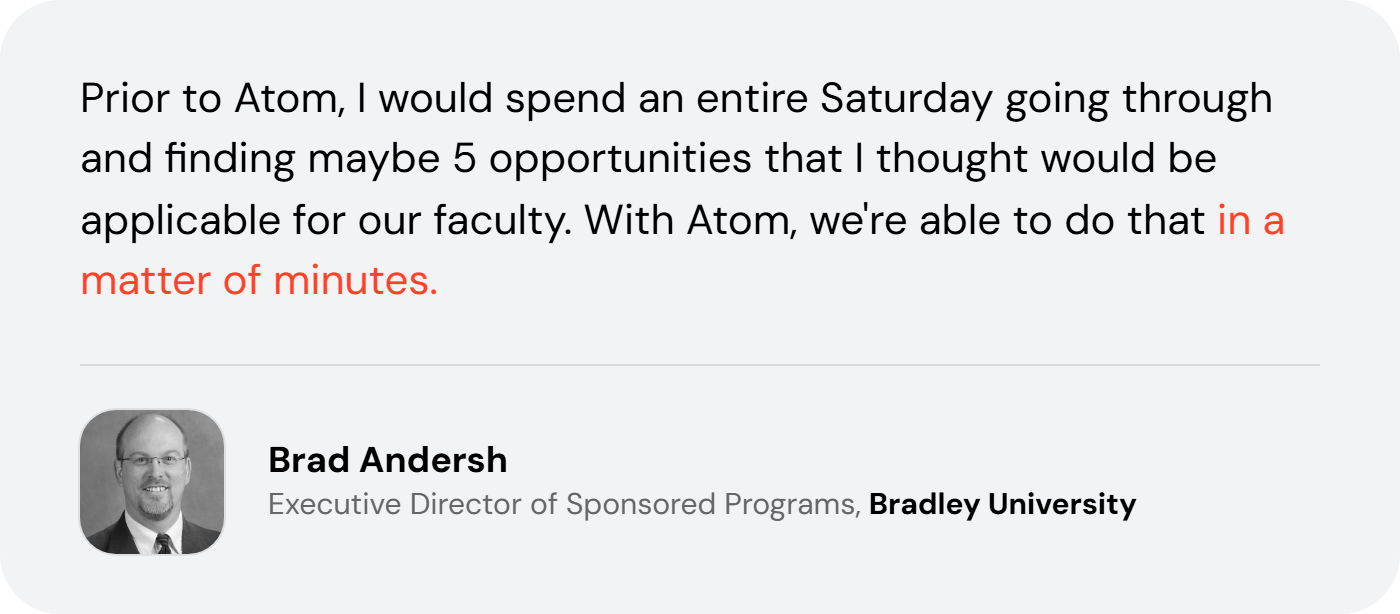
Bradley’s Office of Sponsored Programs went three years without a director. When Brad Andersh, a chemistry professor for 31 years, stepped in as Executive Director with NSF support to rebuild the office, his goal was to get more faculty and staff writing grants. With a staff of two, nobody in the office could spend days searching on faculty’s behalf. As Brad explains:
Several obstacles stood in the way:
- A keyword search tool with little faculty buy-in
- Faculty relying on office notices to hear about funding at all
- Days lost checking whether a single grant was a real fit
- Grants found too late, sometimes two days before the deadline
- Niche research areas with no obvious funder to match
Sometimes you’d spend a day or two going through those details, one grant after the other, and then I have nothing to show for the two days I’ve spent on this grant.
— Anant Deshwal, PhD, Assistant Professor of Biology
Why Atom?
The office compared what it had with what Atom offered, and three things decided it.
1. Search That Reads Research, Not Keywords
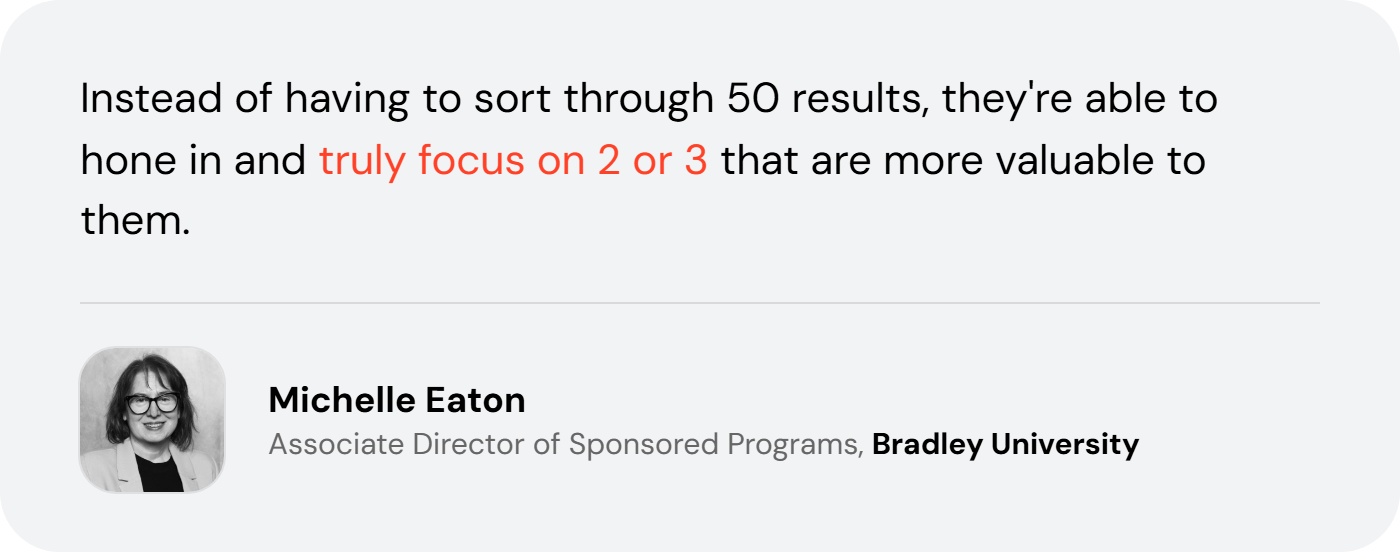
Faculty can drop in an abstract and get back the grants that actually fit their work.
2. A Closed System Faculty Can Trust
It is a closed system, so they don’t have to worry about their intellectual property leaking out, as opposed to AI search tools they may use on their own.
— Michelle Eaton, Associate Director of Sponsored Programs
3. A Fit Score Before the Deep Dive
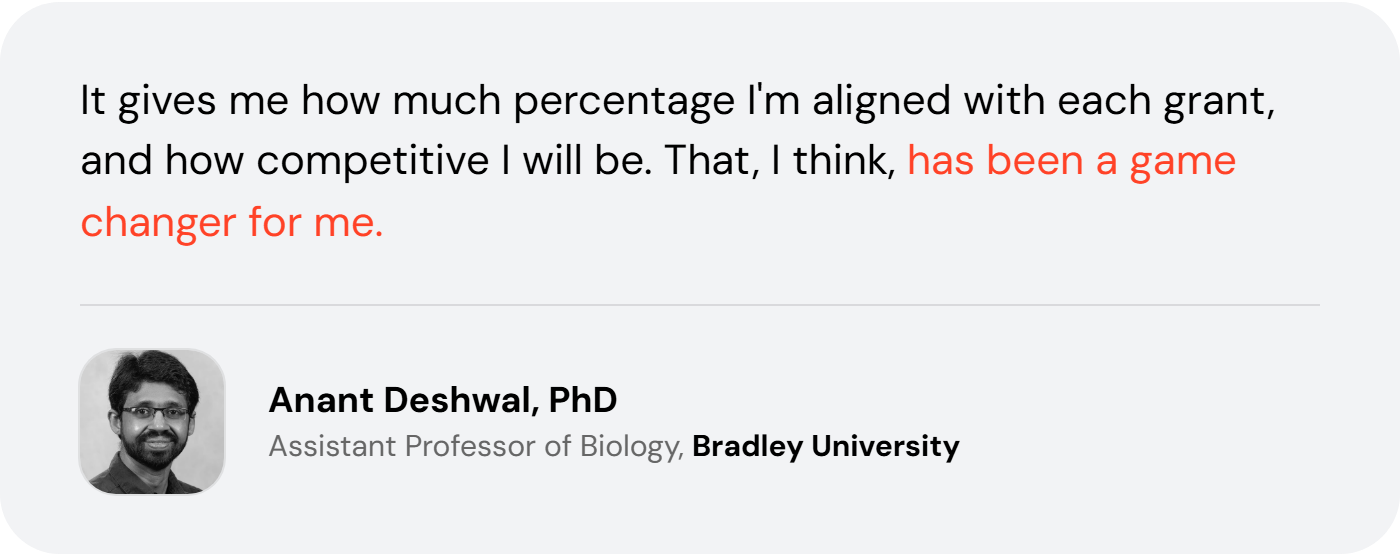
Each match shows how closely a grant aligns with the researcher’s work and how competitive they’re likely to be. Poor fits get ruled out before they cost a day.
Proposal Development
Finding the grant is only the first step. Now that faculty arrive with an opportunity already in hand, the office spends its time where it matters most: getting the proposal out the door.
Many times our faculty are coming to us with an opportunity already identified. It allows us to more quickly transition to project execution, proposal submission, rather than spending a significant amount of time trying to find the right opportunity for them.
— Brad Andersh, Executive Director of Sponsored Programs
More Time for the Work Only the Office Can Do
A two-person office can’t have someone dedicated to a single task. Every hour no longer spent searching goes back into the work only the office can do: reviewing proposals, building budgets and preparing supplemental documents.
Checklists Straight from the NOFO
Bradley is now adding Atom’s proposal tools. Brad Andersh describes the goal as finding a NOFO and quickly generating a checklist of every required material. Faculty, collaborators and the office then share a workspace, and an AI check reviews each draft against the NOFO before submission.
Support After Office Hours
Michelle Eaton points to the hours when the office is closed. If a faculty member is drafting at home on the weekend, Atom can check their language against the funding notice right away, so they don’t have to wait until Monday for feedback.
Implementation Process
Bradley kept the rollout simple and personal:
- Spring forum launch: a live demo in January 2026, with faculty and staff logging in during the session
- College by college: visits to every college and department meeting, plus one-on-one walkthroughs
- Ready-made outreach: emails and texts from Atom, adapted to campus culture
- Champions and refreshers: OSP Fellows in each college, and a new round of training every fall
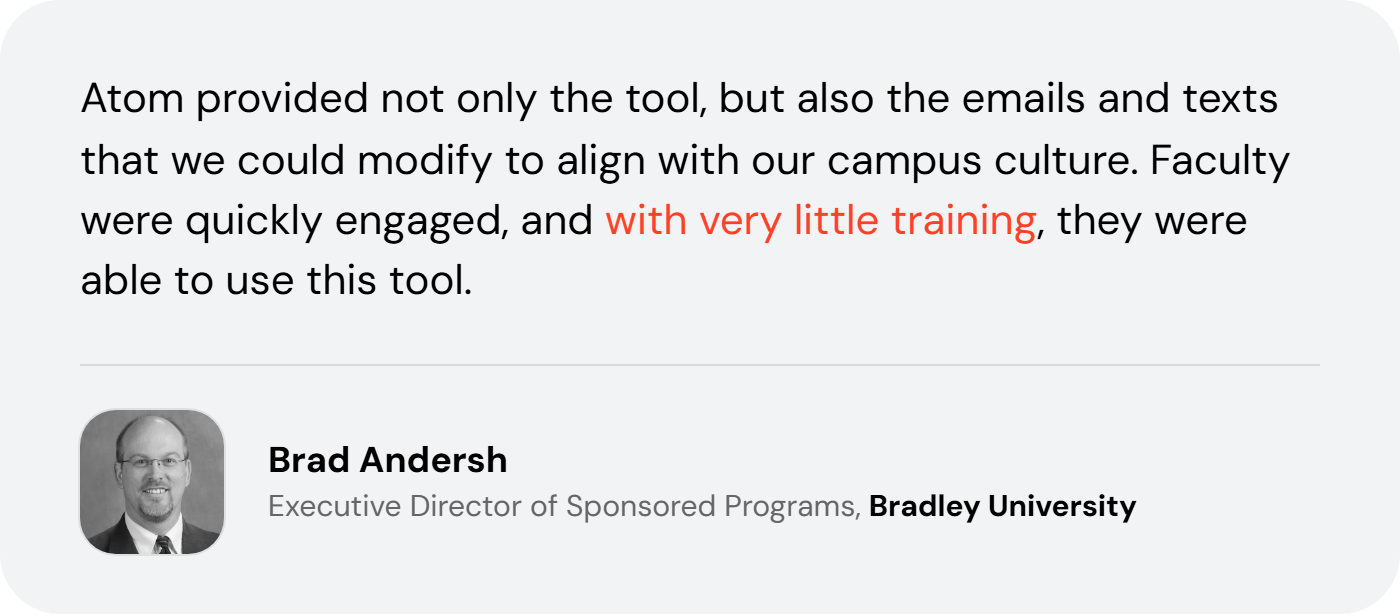
Faculty needed very little training. Sara Erlichman set up her profile at the forum and onboarded a colleague the same day. Even skeptics came around fast:
“Before I started typing my first thing, I had already rejected it. I think it was the first, or second, or third search, I’m talking less than an hour, and I was like, this thing is producing things that are going to be helpful.” Anant Deshwal, PhD, Assistant Professor of Biology
Results and Impact
Since the rollout, Bradley’s grants office has stopped hunting for opportunities. Faculty now bring them to the office.
- A full day became minutes. Building a short list of good fits used to take the office’s director an entire Saturday. It now takes minutes.
- 2 or 3 results instead of 50. Faculty review only the grants that match their research.
- Under an hour to trust it. A professor who had rejected the tool before he opened it was relying on it within his first few searches.
- At least 3 faculty brought in Atom-found grants. Most have already submitted or are writing the application.
Faculty Now Bring the Opportunity
Atom’s weekly email reaches faculty directly, so they no longer wait for the office to send something. They arrive with a grant in hand and ask what to do next. For a two-person office, the time that used to go into searching now goes into proposals.
Grants Nobody Had Found
Atom is surfacing funding nobody at Bradley had been tracking. Sara Erlichman, PhD, studies parasocial relationships, a field she had never been able to match to funders. As her college’s OSP Fellow, she set up alerts for a health communication program her department wanted to build. An Arthur Vining Davis Foundations grant came in, and the college submitted a proposal.
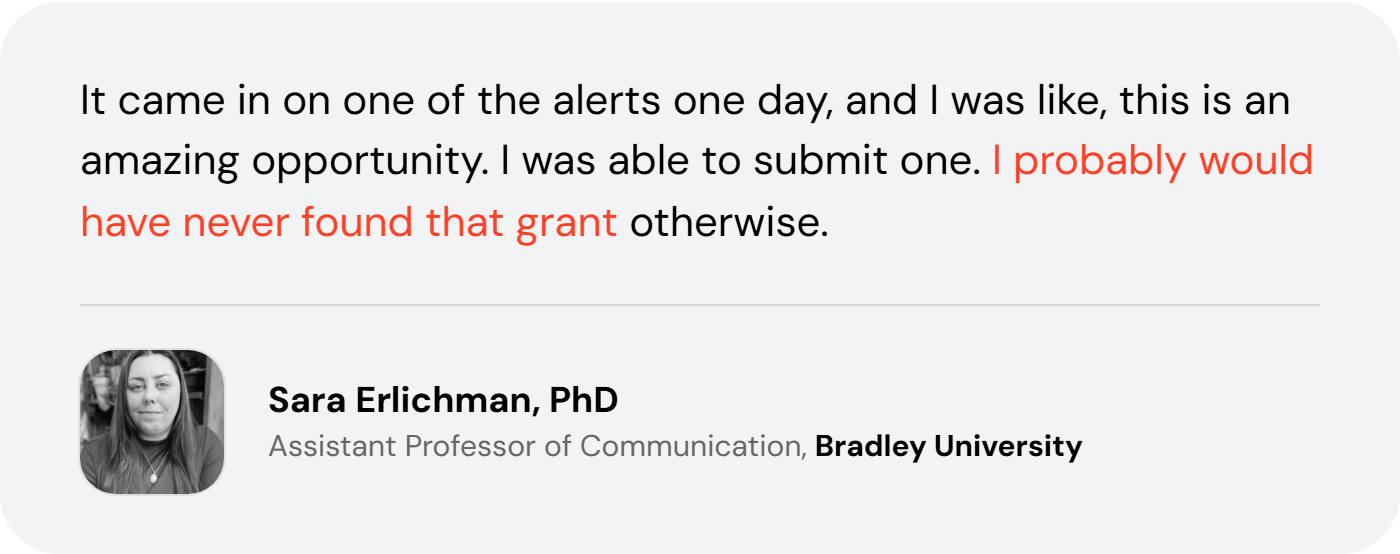
Anant Deshwal, PhD, saw the same thing in his own field. Atom found a U.S. Army Corps of Engineers program he had never been able to track down, the exact programs inside NSF, USGS and U.S. Fish & Wildlife, and several foundations he didn’t know existed.
Key Success Factors
- Relevance: semantic matches close enough to faculty research to earn the click
- Trust: a closed system, and summaries that hold up when checked by hand
- Easy rollout: ready-made outreach and very little training
- Campus champions: OSP Fellows promoting Atom inside each college
- Past discovery: checklists and NOFO checks that carry grants through to submission
Looking Forward
With discovery handled, Bradley is taking Atom into proposal development, from a NOFO checklist to an AI check of the final draft. For a two-person office supporting a whole campus, the aim is the same as the day Brad took the job: get more faculty into grant writing, and make every proposal stronger.
About Bradley University
Bradley University is a private, primarily undergraduate institution in Peoria, Illinois. Its Office of Sponsored Programs, rebuilt with NSF support, is run by a two-person team. It supports faculty applying to federal, state and private funders, with current focus on S-STEM and Bradley’s new AI programs.
About the Interviewees
 Brad Andersh is Executive Director of Sponsored Programs. He spent 31 of his 33 years at Bradley as a chemistry and biochemistry professor before leading the rebuild of the office.
 Michelle Eaton is Associate Director of Sponsored Programs. She has been at Bradley for 19 years and leads faculty training and outreach for Atom.
 Anant Deshwal, PhD is an Assistant Professor of Biology and a conservation biologist studying how urbanization affects bird and insect communities. He runs a lab of 10 to 12 students.
 Sara Erlichman is an Assistant Professor of Communication and her college’s OSP Fellow.
More Customer Stories

How Denver Health Increased Grant Engagement by 800% After Switching to Atom
Read story

How BrainWaves Tripled Grant Output with Atom Grants
Read story
How the University of Arkansas at Little Rock Empowers Faculty with Atom Grants
Natural language grant search helped reduce pre-award workload.
Read story
Efficient Grant Discovery for PUIs: Franklin & Marshall’s Atom Story
Adopted Atom to enable faster opportunity identification, stronger faculty engagement, and scalable support.
Read story
How USF is Scaling Research to $1bn with Atom Grants
Found relevant funding sooner, with smooth implementation and measurable engagement gains across a growing research institution.
Read story
How Memphis Set Records for Grant Submissions with Atom Grants
Increased faculty engagement tenfold and drove record submissions at a newly designated R1 university.
Read story
How NDSU Transformed Grant Discovery with Atom Grants
Helped faculty identify new opportunities in a shifting funding landscape.
Read story