November 8, 2026
How Rush University Medical Center Moved From Searching for Grants to Planning Ahead With Atom
Overview
Rush University Medical Center had a funding search tool on its books, but few investigators used it, so most grant searching fell back on researchers checking agency and foundation websites by hand. With federal funding uncertain and leadership asking for a more diverse research portfolio, Rush brought in Atom. Within months, investigators were getting matches in their inboxes, some were logging in every three days, and study teams had started drafting Aims pages for center grants that hadn't been announced yet.
The Challenge
Rush is a heavily federally funded research institution. As federal rules and funding shifted, its Office of Research Affairs made finding non-federal funding a priority, with more foundation applications and renewed work with industry partners.
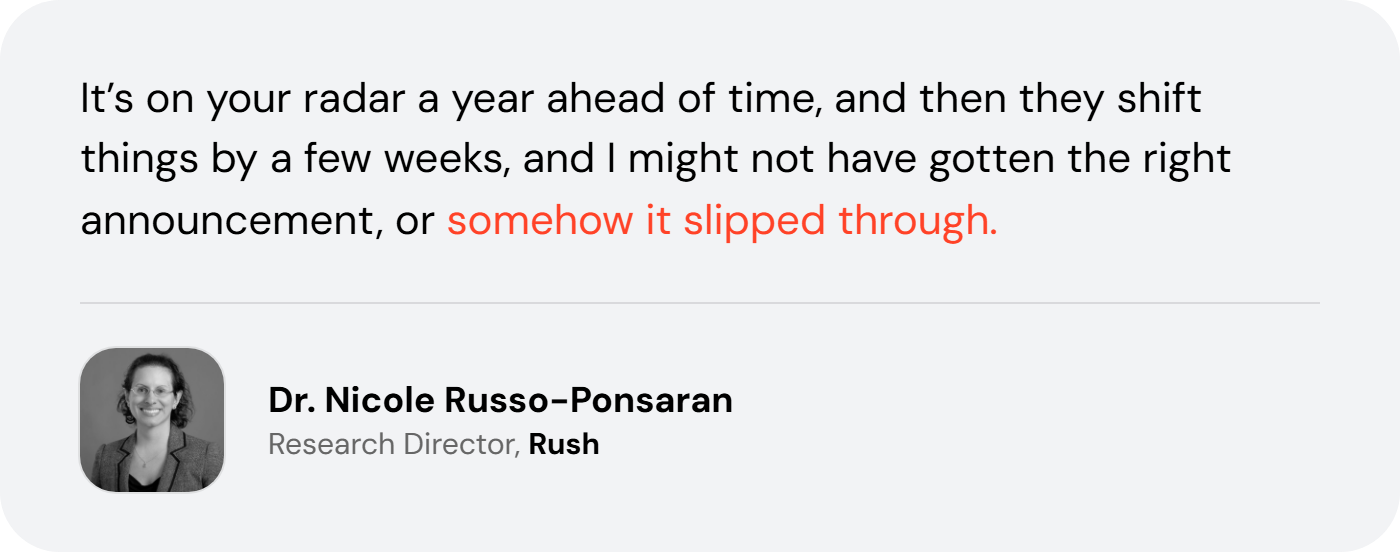
The search process wasn't set up for that. Monica Lacas, a research administrator in the Office of Research Affairs, says finding opportunities was left to investigators and study teams, who watched NIH, Department of Defense and foundation dashboards on their own. Dr. Nicole Russo-Ponsaran, a research director and full-time research faculty member, kept Outlook reminders for the calls she expected, and still missed some.
Several obstacles stood in the way:
- A tool few people used. Jennifer Garcia, Director of Sponsored Programs Administration, could see usage was low. Reminders at every meeting didn't change it.
- Searching by hand. Researchers could spend an entire day tracking down opportunities, roughly once a quarter.
- Missed and late calls. Without constant checking of inboxes and foundation sites, calls were easy to miss, or arrived with very tight turnarounds that stressed study teams and administrators.
- Only the funders they already knew. Researchers were limited to agencies they were already aware of, with no easy way to find new ones.
Why Atom?
1. Easy for researchers at any career stage
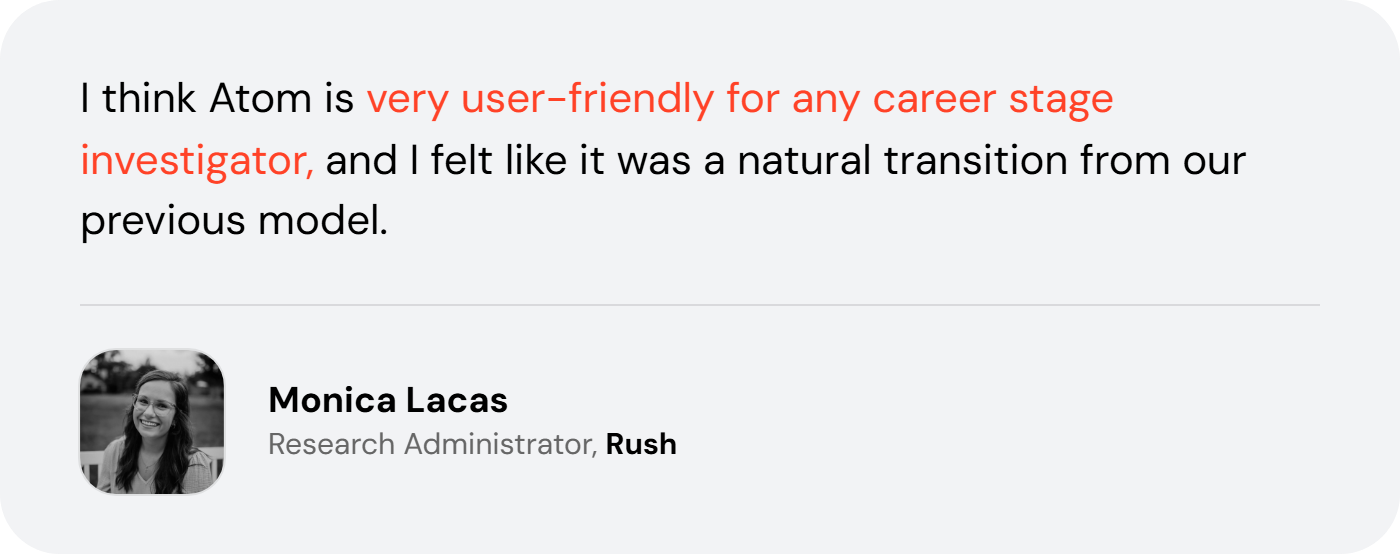
The request came from research leadership: find a tool that was user-friendly, cost-effective and would help diversify Rush's research portfolio. Atom builds each researcher's profile from publicly available information, so investigators don't start from a blank form.
2. Eligibility checked for the researcher and for Rush
Each match shows whether the researcher is a good fit and whether they, and Rush as a nonprofit, meet the eligibility requirements. Jennifer calls that the feature that makes it user-friendly. Nicole likes that she can see right away when she's not eligible and skip reading the call.
3. Alerts for calls that aren't open yet
Researchers can flag a funder or opportunity before a call is released, and Atom emails them when it opens. Nicole says this is the feature she likes most, because those calls are the ones that fall off the radar.
Proposal Development
The biggest change Monica has seen is in how teams prepare proposals. Rush has senior researchers well placed for large center grants, such as cooperative U-mechanism and P50 awards. Atom's forecasted opportunities show those calls before they open.
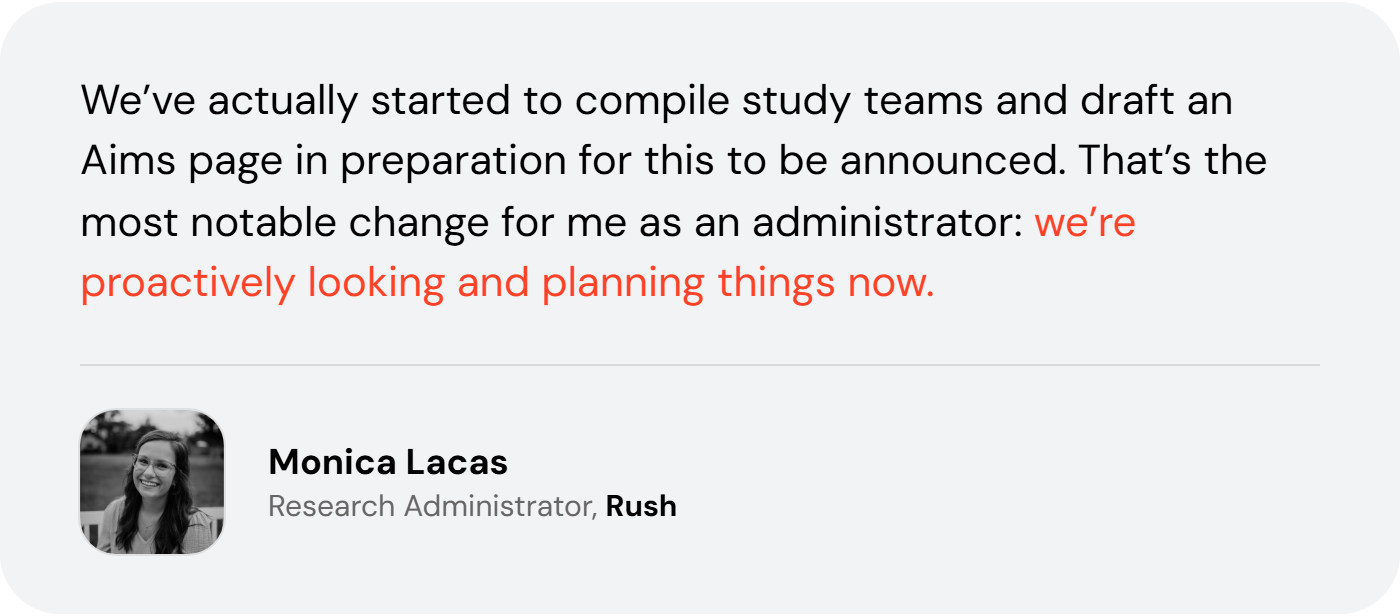
Atom also gives administrators visibility into what their researchers are looking at. Monica uses it to prepare her monthly meetings with researchers ("I see that you saved a few things on Atom recently, are we planning to prepare a submission?") and to give the sponsored programs office an earlier view of what's coming. She says it has helped define her workload.
Researchers are building on it too. Nicole and a colleague in her department are lining up a fall submission from opportunities she opened in Atom.
Implementation Process
Rush kept the rollout simple:
- A kickoff with administrators. The Atom team presented virtually to grant administrators across departments.
- Clear messaging. The main early question from faculty was whether Atom replaced the previous tool, so most of the work was internal communication.
- Faculty presentations. Administrators presented Atom at college faculty meetings.
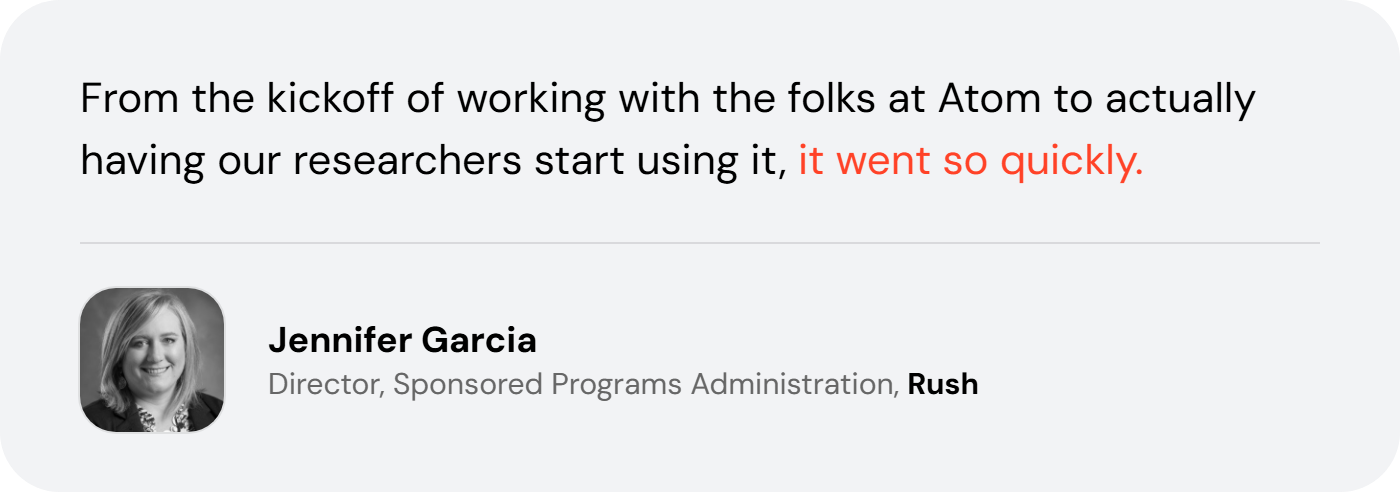
Monica describes the integration as logistically very simple. Investigators who engaged early used Atom for their next grant cycle. Because the launch fell over the holidays, it took about a quarter to six months for everyone at Rush who works on research to know Atom was there.
Jennifer, who was not closely involved in choosing Atom, needed about 10 minutes in Atom before presenting it to the College of Health Sciences faculty.
Results and Impact
From searching to planning
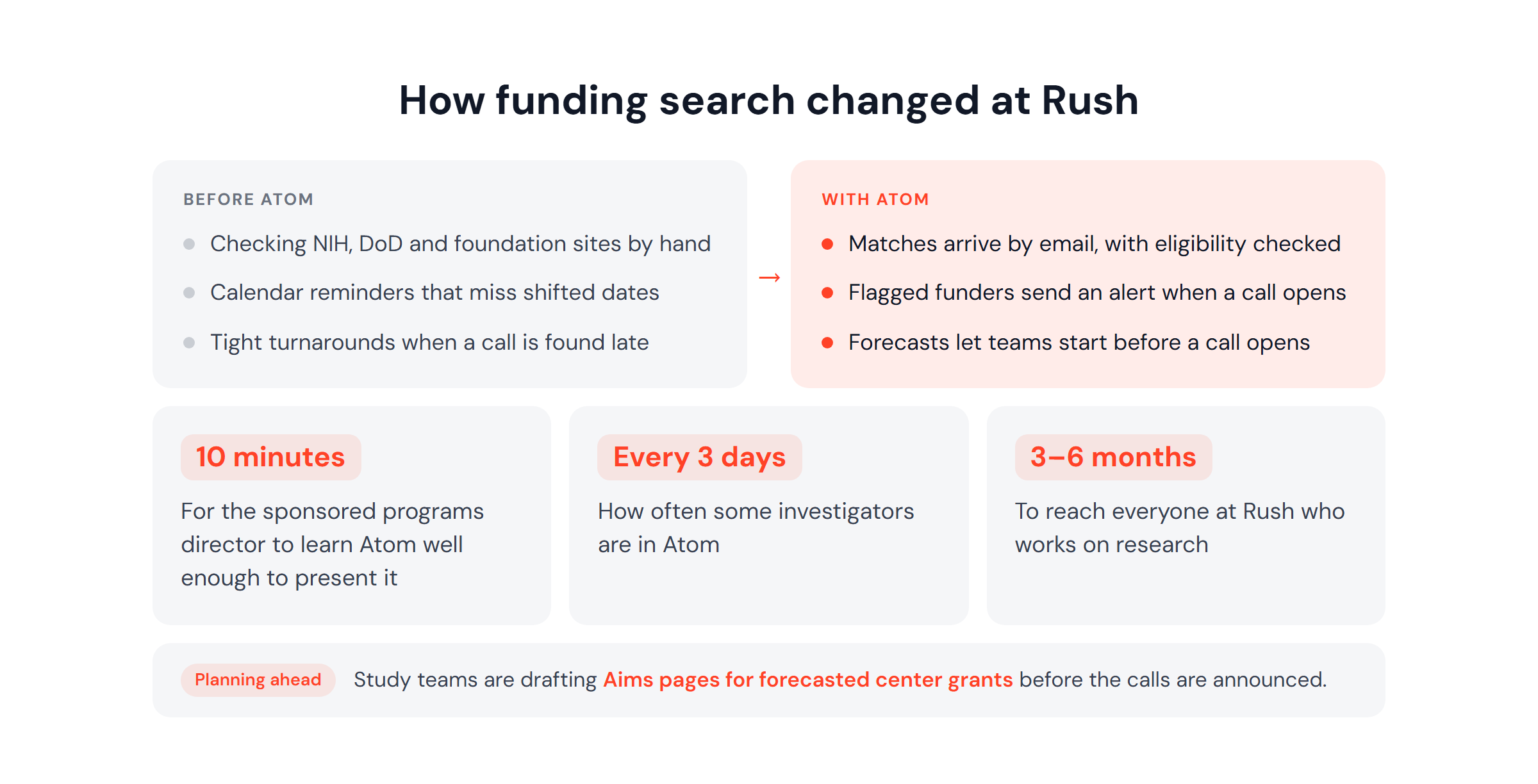
Rush is still early, and Monica expects firmer data as the first grants go to council. What the team sees so far:
- Every 3 days: how often some investigators are in Atom, adding interests and filtering for new opportunities
- 10 minutes: for the sponsored programs director to learn Atom well enough to present it
- A quarter to six months: to reach everyone at Rush who works on research
- Aims pages drafted for forecasted center grants before the calls are announced
- More non-federal applications on the submission board, which Jennifer hopes is partly due to Atom
Value for every kind of user
Some investigators never log in and just act on the emails Atom sends them. Others are in Atom every few days. Monica says it works either way.
Early-career researchers are the biggest fans
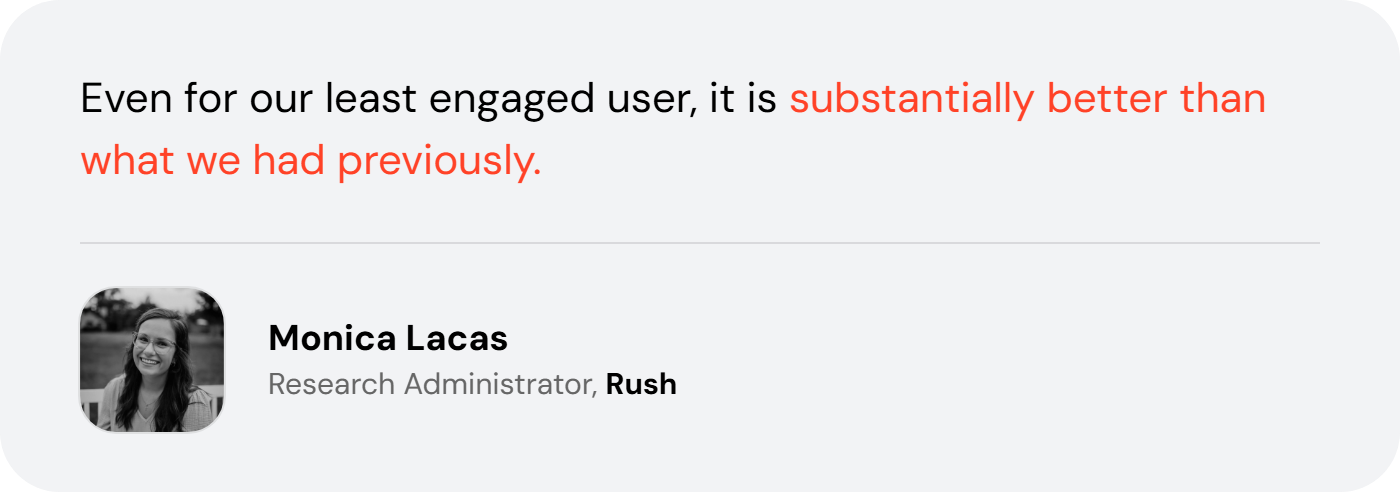
At Rush's Research Week open house this year, young investigators came up to the research team to say how much they liked Atom, especially the fellowship calls sent to their inboxes. Residents said the same. More established faculty told the team they valued having the AI assistant and all the key information in one place.
Matches that keep up with a researcher's direction
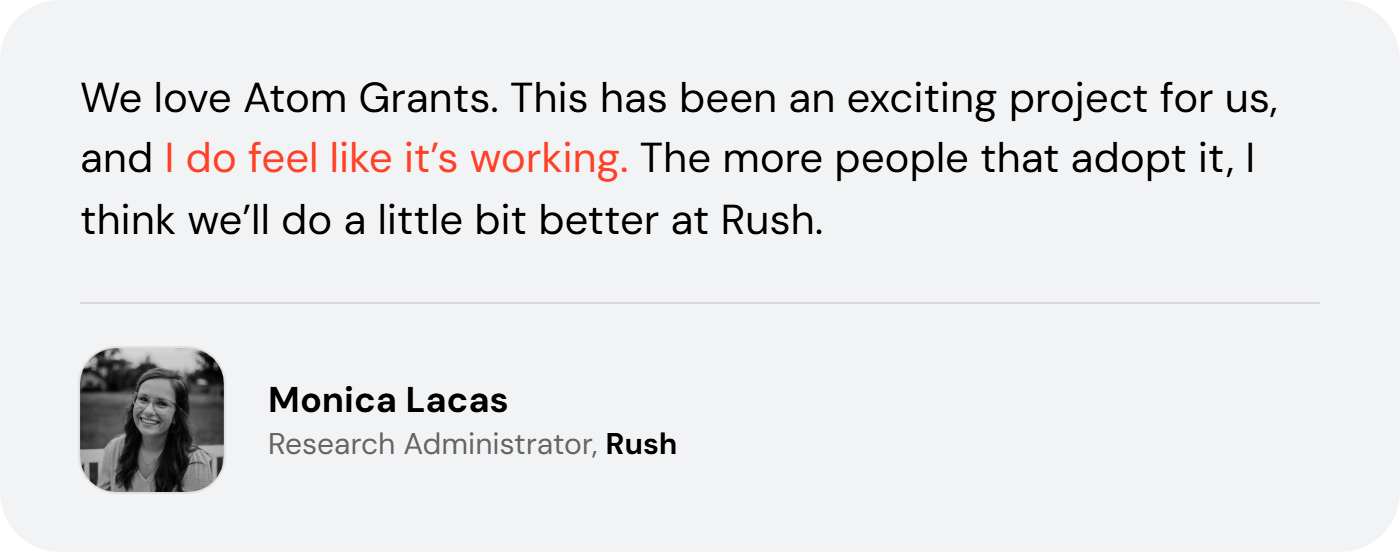
Nicole's research has shifted over the years, and her early matches reflected her older publications. After she edited her interests and expertise in her profile, the results improved. She also found that the funders Atom surfaced matched the ones her team already applied to, which gave her confidence she was looking in the right places.
Advice for Other Institutions
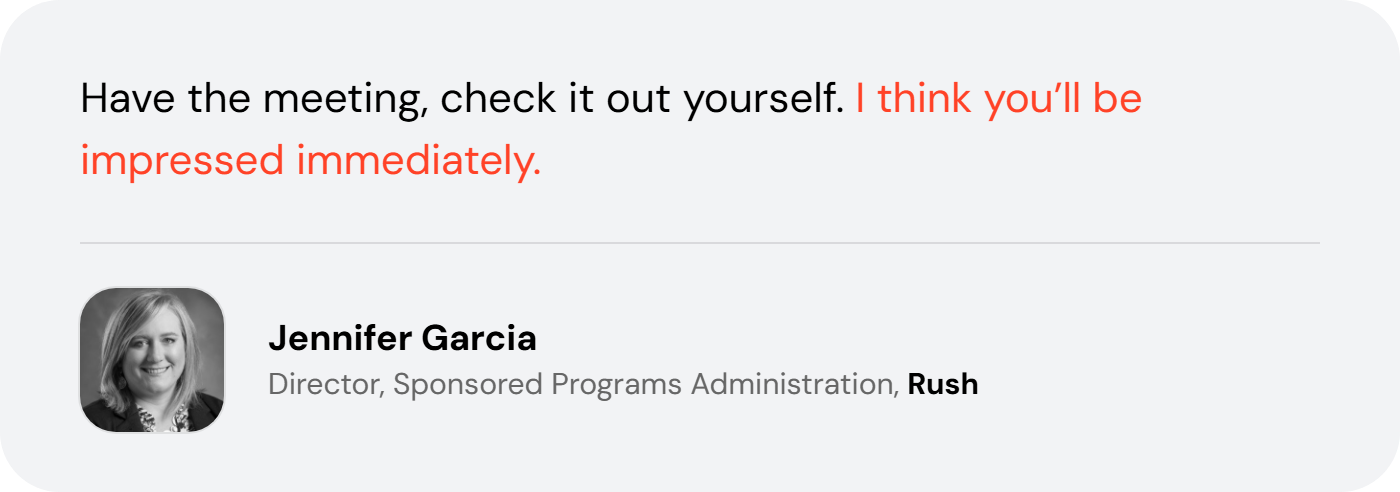
Jennifer's advice for peers weighing whether to build their own system or buy one is short:
Nicole would recommend Atom as a one-stop place to find federal and foundation opportunities together, without a lot of manual searching.
Key Success Factors
- A request from leadership. Rush's research leaders asked for a user-friendly, cost-effective tool to diversify funding.
- Profiles built for researchers. Atom builds them from public information, and researchers can edit their interests at any time.
- Eligibility up front. Every match shows whether the researcher and Rush qualify.
- Forecasts and alerts. Teams hear about calls before they open and can start planning.
- Visibility for administrators. Saved opportunities give department administrators an early view of what's coming.
Looking Forward
Rush plans to keep growing adoption across the institution. Monica would like application checklists that Atom generates, so administrators don't have to walk every researcher through simpler applications. Both she and Nicole are looking forward to collaborator search, which would help researchers find colleagues across departments working on similar opportunities.
About Rush University Medical Center
Rush University Medical Center is an academic medical center with research across basic science, clinical trials and translational medicine. Its Office of Research Affairs and Sponsored Programs Administration support investigators and study teams in finding funding and preparing and submitting grant applications.
About the Interviewees

- Monica Lacas is a Research Administrator in the Office of Research Affairs at Rush, where she has worked for more than seven years across basic science, clinical trials and translational medicine.

- Dr. Nicole Russo-Ponsaran is Research Director of the Rush NeuroBehavioral Center in the Department of Psychiatry and Behavioral Sciences, and has been full-time research faculty at Rush since 2008.

- Jennifer Garcia is Director of Sponsored Programs Administration at Rush, where she has spent more than 20 years in sponsored programs.
Ready to do the same at your institution?
Schedule a demo to see how Atom can help your researchers find and plan for more funding.
More Customer Stories
How Middle Tennessee State University Increased Proposals by 45% After Switching to Atom
Read story
How Bradley University reduced their grant searching from a day to minutes
How a two-person grants office turned a full day of searching into minutes.
Read story
How Denver Health Increased Grant Engagement by 800% After Switching to Atom
Read story

How BrainWaves Tripled Grant Output with Atom Grants
Read story
How the University of Arkansas at Little Rock Empowers Faculty with Atom Grants
Natural language grant search helped reduce pre-award workload.
Read story
Efficient Grant Discovery for PUIs: Franklin & Marshall’s Atom Story
Adopted Atom to enable faster opportunity identification, stronger faculty engagement, and scalable support.
Read story
How USF is Scaling Research to $1bn with Atom Grants
Found relevant funding sooner, with smooth implementation and measurable engagement gains across a growing research institution.
Read story