November 15, 2026
How Middle Tennessee State University Increased Proposals by 45% After Switching to Atom
Overview
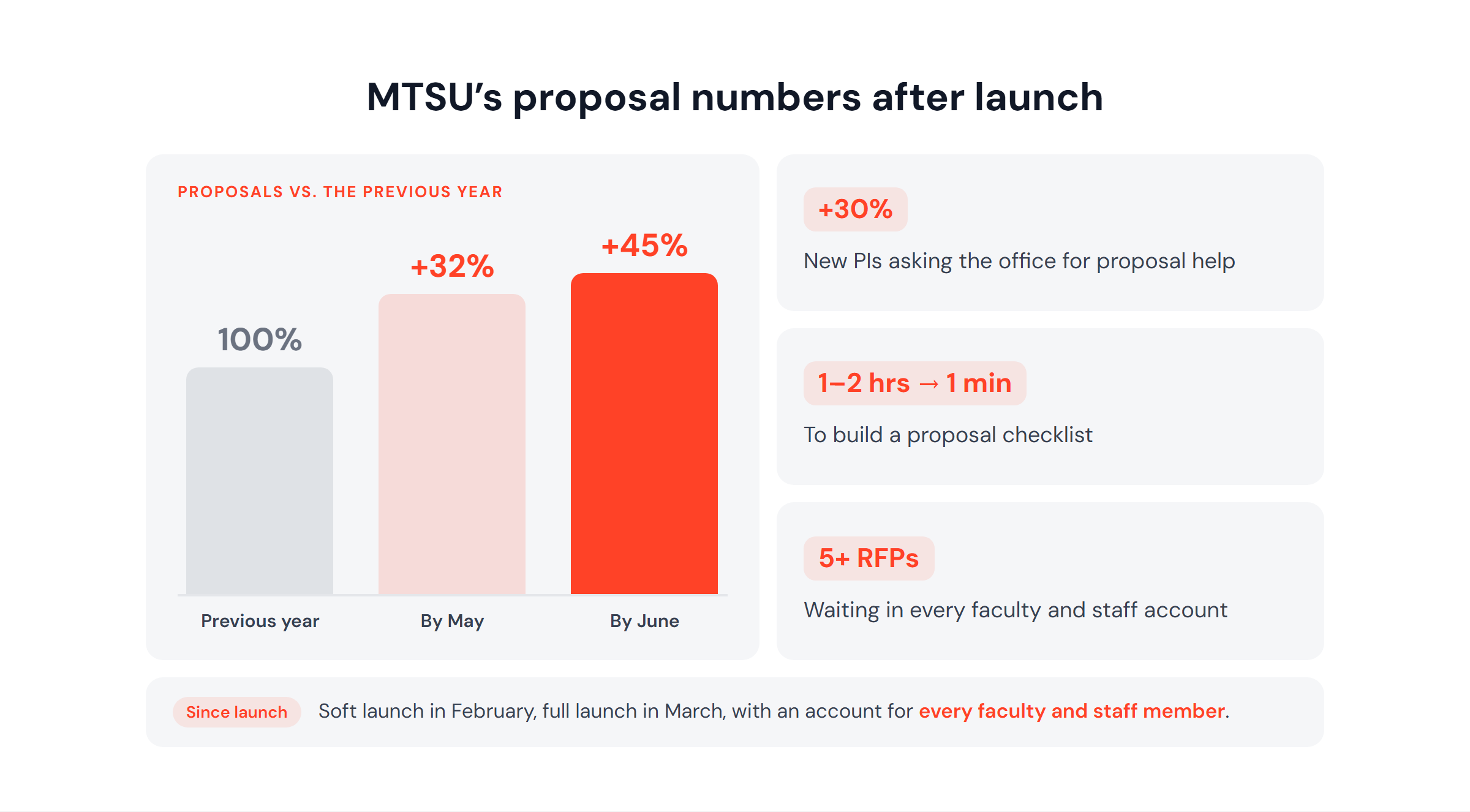
Middle Tennessee State University (MTSU) had a keyword search tool that returned about 50 results for every good fit, and the faculty who most needed funding were the ones least able to find it. MTSU switched to Atom halfway through FY26 and gave every faculty and staff member an account. By June, proposals were up 45% over the previous year, 30% more new PIs were asking the Office of Research and Sponsored Programs for help, and the office was building proposal checklists in a minute instead of an hour or two.
The Challenge
MTSU's chief research officer, David Butler, is measured on one thing: growing grant and contract activity every year. That depends on getting more faculty to apply, and that depends on faculty finding opportunities that fit.
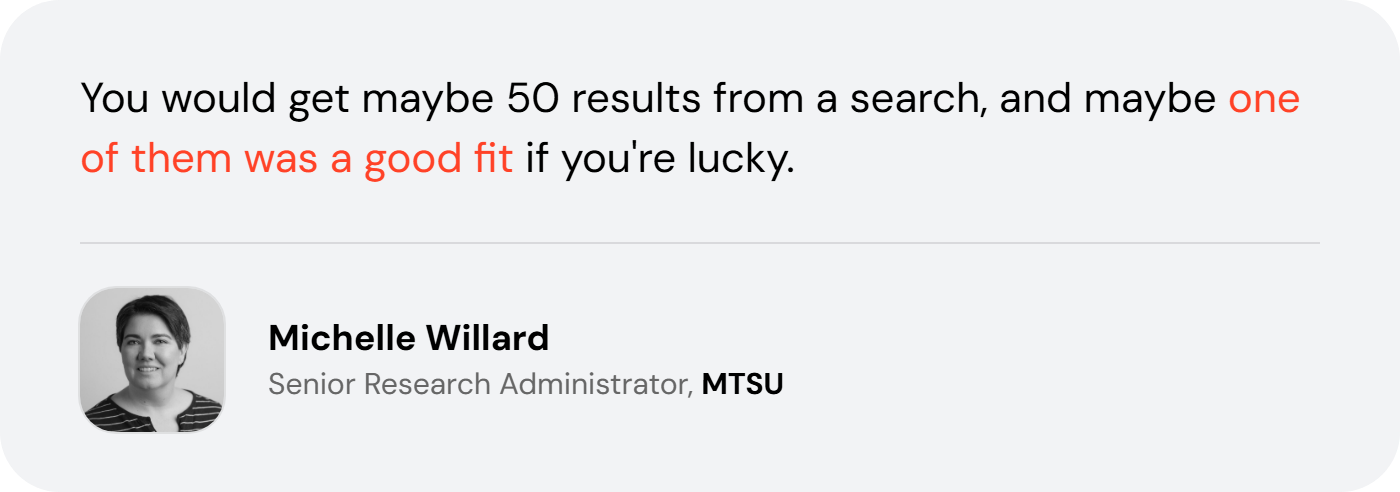
The old tool made that hard. It ran on keyword searches, and faculty had to build and update their own profiles, so results only matched people who were good at maintaining them. As Michelle Willard, Senior Research Administrator, explains:
Several obstacles stood in the way:
- Low accuracy. About 1 good fit in every 50 results.
- Profiles that went stale. Results depended on how well each faculty member kept theirs up to date.
- Missed deadlines. Calls surfaced too late, or after the date had passed.
- No state portal. Tennessee has no central site for state RFPs, so finding them meant checking each agency's site daily.
- Faculty on the sidelines. Many believed there was simply no funding for their work.
Why Atom?
1. It found the funders MTSU already knew were hard to find
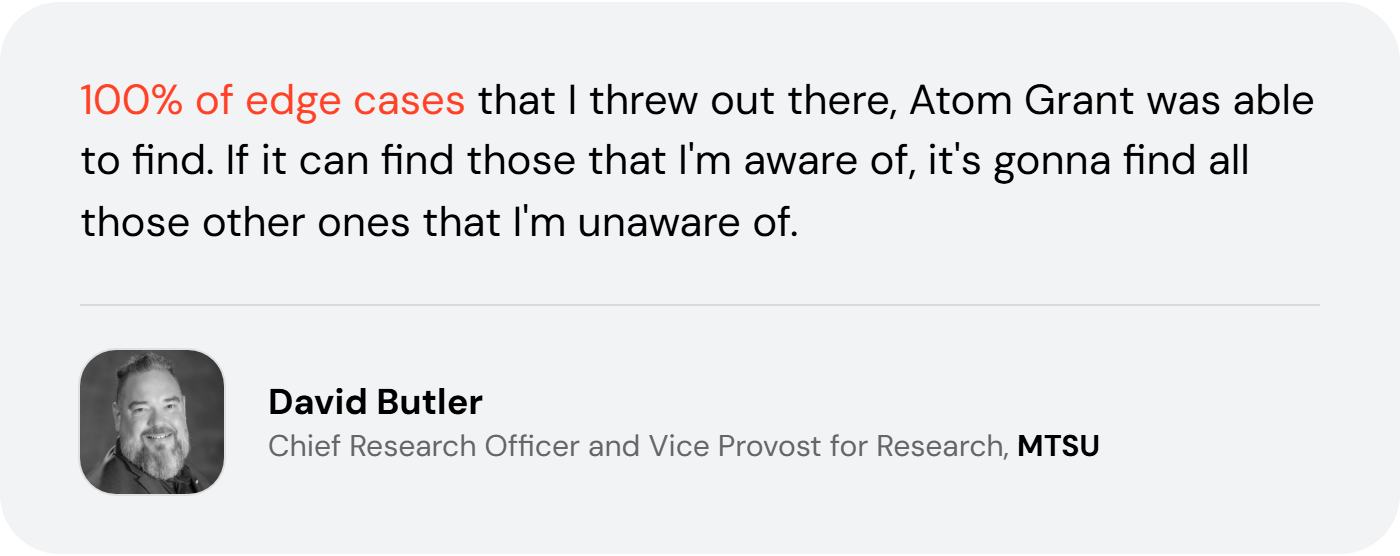
Before signing, David tested Atom with small, niche foundations his team had found over years of searching.
2. An eligibility check and a fit score on every match
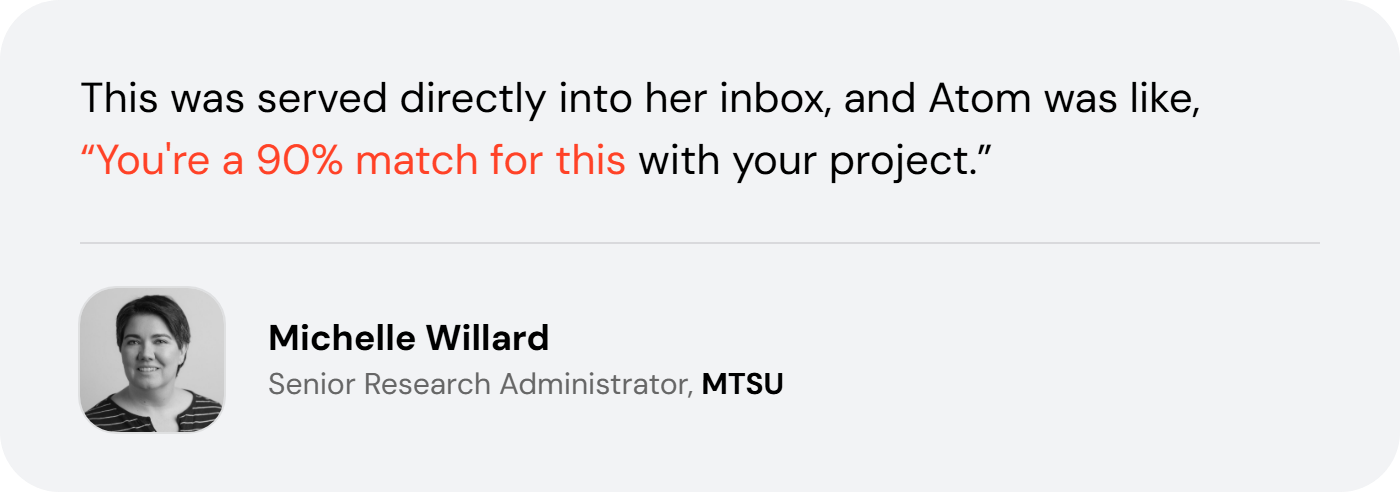
Each opportunity shows whether the researcher is eligible and how closely it fits their work. Michelle calls eligibility "the first thing we were taught as pre-award specialists to look at," and the fit score tells the office what to pass along: a 50% match probably not, a 90% match right away.
3. Reach beyond STEM
Atom covers foundations and other non-federal funders, so MTSU can bring funding opportunities to social sciences, humanities, arts and business faculty, not just the STEM fields that already knew where to look.
Proposal Development
Discovery is only the first step. Once an opportunity is in hand, Michelle's pre-award team has to turn it into a submission, and that is where Atom is already saving hours.
Checklists in a minute
A new pre-award research administrator got her first proposal from a faculty member who had found the opportunity in Atom. Michelle showed her how to ask Atom's assistant for a checklist.
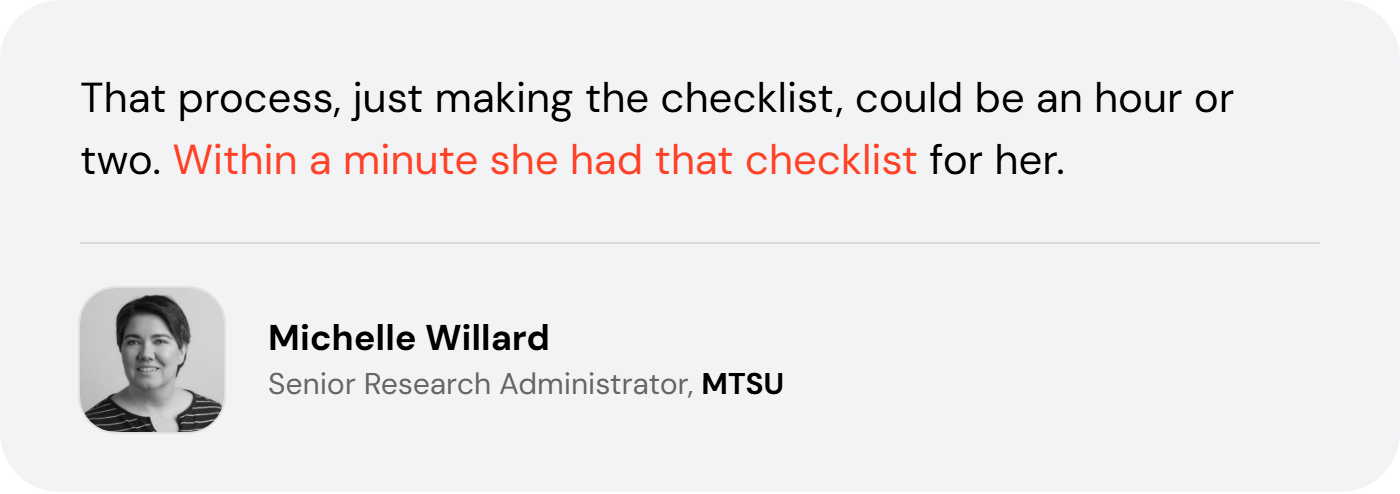
She still reads the full RFP, but she starts from a complete list of what the office and the PI each need to do.
More people, and better proposals
Since launch, 30% more new PIs have come to the office for help with proposals. Michelle says the change she sees is not just in the number of proposals but in their quality, and in the new faces coming in ready to apply.
Every funder's rules, met
Federal agencies share most requirements. Private funders don't: one might want a 1,500-character narrative, no biosketch and its own budget form. Michelle expects research offices to lean on tools like Atom to meet each funder's rules, so a strong proposal isn't rejected over an administrative mistake.
Implementation Process
MTSU kept the rollout simple:
- Soft launch in February, full launch in March.
- Everyone included. Every faculty and staff member got an account, with no selection.
- Word of mouth. David asks everyone he meets whether they've checked their weekly email, and faculty started telling each other.
The response came fast. David says faculty were telling him they had used it and found something, which he rarely hears after a software launch.
Results and Impact
Proposals up 45%
Within months of launch, MTSU's proposal numbers moved:
- 32% more proposals than the previous year by May
- 45% more proposals than the previous year by June
- 30% more new PIs asking the office for proposal help
- An hour or two down to a minute to build a proposal checklist
- At least 5 eligible RFPs waiting in every faculty and staff account
New people walking through the door
David's leading indicator is the number of unique PIs submitting grants: more PIs means more submissions, and more submissions means more awards. Atom puts opportunities in front of everyone, so that number can keep growing. Even MTSU's environmental services staff now submit roughly one grant a month, for projects like adding recycling points and cutting the campus carbon footprint.
A grant found in July and awarded in September
An assistant dean in the College of Liberal Arts wanted funding for a project built on the True Blue Pledge, the commitment every MTSU graduate makes at commencement. Atom sent a private funder to her inbox as a 90% match in July. She applied by the end of the month and was awarded the grant by September.
Atom also found five private funders for a political science professor's documentary on seasonal migration, through a separate project built from his abstract. And state RFPs with two-week turnarounds now reach faculty the day after they post.
Advice for Other Institutions
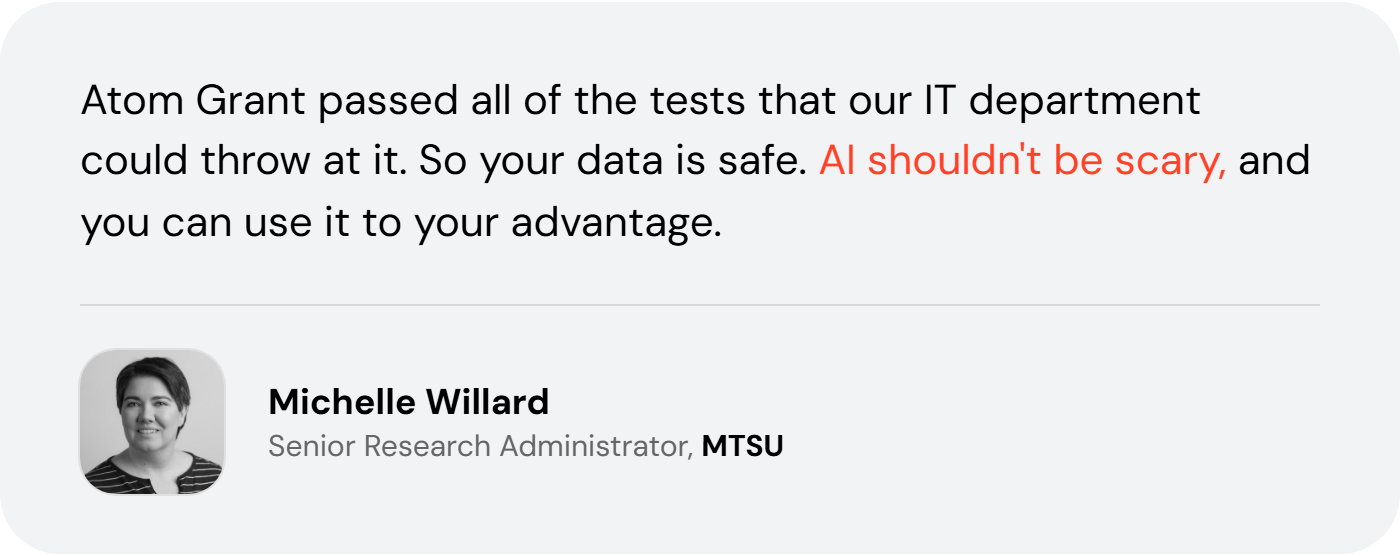
Asked what she tells peers who are wary of AI tools, Michelle points to MTSU's own security review. Tennessee is strict about data security, and the university has dropped vendors that didn't pass.
Key Success Factors
- Accuracy that earns trust. Atom passed David's edge-case test before MTSU signed.
- Everyone on the platform. Accounts for all faculty and staff, not a selected few.
- A clear first filter. Eligibility and fit scores on every opportunity.
- Security that passed IT review. Atom cleared every test MTSU's IT department ran, including FERPA and HIPAA requirements.
- Support past discovery. Checklists today, and proposal development next.
Looking Forward
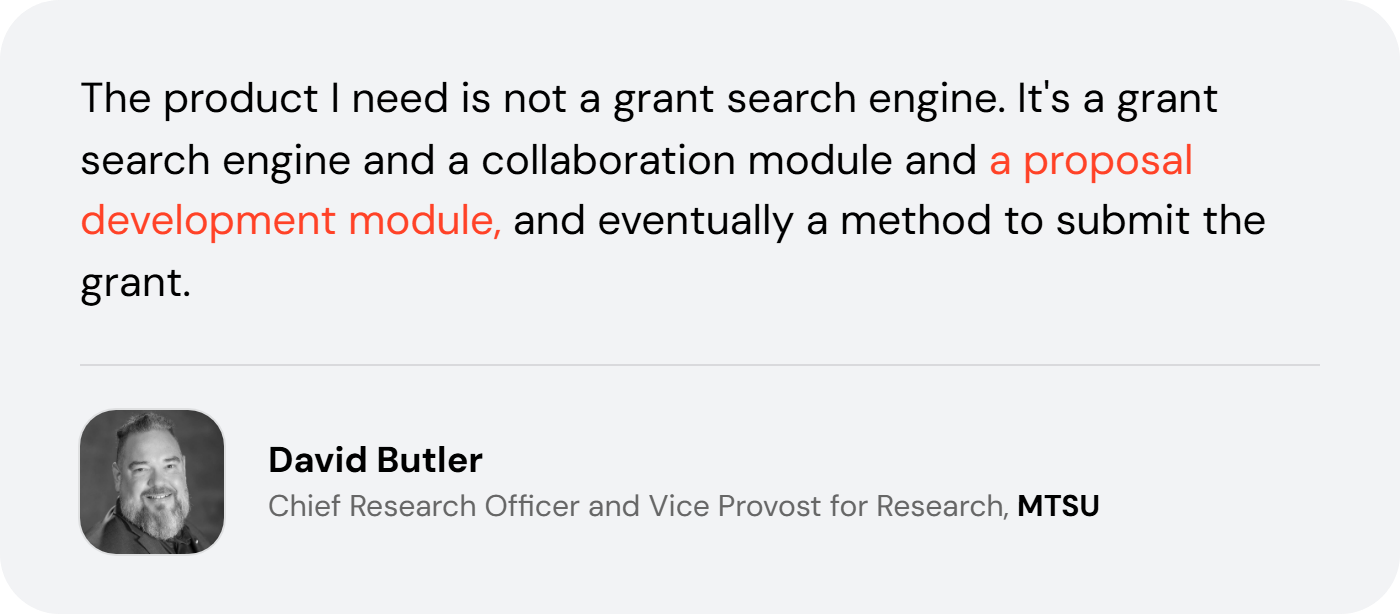
MTSU is moving with Atom from discovery into proposal development and collaboration across institutions. For a regional comprehensive university, David sees Atom as a way to compete with the top research universities that funders already come to.
About Middle Tennessee State University
Middle Tennessee State University is a regional comprehensive state university that earned R2 status in 2022. Its Office of Research and Sponsored Programs supports faculty and staff across every discipline in finding, developing and submitting grant proposals.
About the Interviewees
 David Butler is Chief Research Officer and Vice Provost for Research at MTSU, now in his 10th year in the role.
 Michelle Willard is Senior Research Administrator in the Office of Research and Sponsored Programs, where she oversees pre-award staff and leads research development.
Ready to do the same at your institution?
Schedule a demo to see how Atom can help your faculty find and win more funding.
More Customer Stories
How Rush University Medical Center Moved From Searching for Grants to Planning Ahead With Atom
Read story
How Bradley University reduced their grant searching from a day to minutes
How a two-person grants office turned a full day of searching into minutes.
Read story
How Denver Health Increased Grant Engagement by 800% After Switching to Atom
Read story

How BrainWaves Tripled Grant Output with Atom Grants
Read story
How the University of Arkansas at Little Rock Empowers Faculty with Atom Grants
Natural language grant search helped reduce pre-award workload.
Read story
Efficient Grant Discovery for PUIs: Franklin & Marshall’s Atom Story
Adopted Atom to enable faster opportunity identification, stronger faculty engagement, and scalable support.
Read story
How USF is Scaling Research to $1bn with Atom Grants
Found relevant funding sooner, with smooth implementation and measurable engagement gains across a growing research institution.
Read story