Grant Writing and Atomized Labor
Bridging the Grant Office and Gig Work Divide
July 28, 2026
What I have to say is best told in a two-part story. The first is a vocational coming-of-age story set at the dawn of the Era of the Gig Economy. The second is a more traditional tale of atomized work, one that includes long-term technical skill development and internal promotion but excludes intermittent education to accompany those promotions and/or assist with program management skill development.
Part 1: Gig Economy Labor
I was hired as a grant writer for a public health and hospital system in March 2022. Dress code when I started still included a surgical mask.
I started my MA program in 2018. Classes moved online as COVID spread across the country, and I graduated (without ceremony) with a degree in literature in May 2020. I spent the intervening years job hopping and hunting. I worked as a barista, took up a landscaping gig in the summer, taught two sections of freshman English online, tried my hand teaching ELA to middle schoolers, and racked up the miles on my little red Corolla driving for Instacart.
This pace was relatively normal for me. Before college, I had similar gig jobs—landscaper, pizza delivery driver, waiter, library assistant, wine tasting room associate, and part-time bookkeeper. For perspective, from the time I started undergrad (2015) to when I was hired for my grant writing job, a span of only seven years, I held 11 jobs. To be clear, this was not a reflection on my work ethic. I worked my way from landscaper at a winery to wine tasting associate. I was promoted to Crew Leader at another landscaping company. I made Shift Supervisor within four months working at Starbucks. I was a Graduate Assistant in my MA program where I finished with a 4.0. I studied on my own time after grad school to pass the Indiana teacher’s certification so I could qualify to teach middle school.
This is just what it is like to be a part of the labor market at this moment in history. Gig workers like me are the new normal. They run the spectrum on education levels and skew young (millennials and younger). They are often contract laborers paid by the hour with no option for healthcare benefits. They require two to three jobs to afford rent, food, childcare, healthcare, etc. As a result, the number of Americans that identify as working class has increased since the early- to mid-2000s [1]. In 2014, as many as 60% of millennials (my generation) identified as working class, more than any other group surveyed by the University of Chicago in their biennial General Social Survey [2]. This trend of identification with the working class happens despite the fact that many gig jobs are not in traditionally working-class coded fields, AND it is happening at the same time that workers with college degrees experience increased underemployment (meaning they find themselves working in jobs unrelated to their degree field or that does not require a college education to begin with)[3].
When I showed up for my first day of work, like the old cliché goes, I felt like I was drinking from a firehose. Sure, I had a master’s degree now. Supposedly, that “made up” for my other experiences (or lack).
But the information flood was relentless. Thankfully, one of the central skills of the gig worker was ready at my disposal—adaptability. We learn quickly and have a plethora of experiences to lean on when facing adversity. A few months into the job, my confidence built up, and I felt more comfortable in my role.
Then I was given the “problem children.”
These were the program managers who had been labeled “difficult,” “unresponsive,” or “uncooperative.” In the middle of one of these particularly frustrating applications, the department ordered pizza. I saw the open boxes sitting on the counter. The smell of the cheese and red sauce hit my brain. And I was instantly taken back eight years to a tiny pizza shop in a strip mall in rural Virginia. What the hell was I doing here?
Part 2: Traditionally Atomized Labor
I sit in a room with my PM (program manager). Across the conference room table, she’s trying not to show that she’s angry. Her frustration bubbles to the surface despite her best efforts to stay professional. The tops of her cheeks tighten and her eyebrows pinch together.
I’m frustrated too. We’ve been in the same room for close to three hours. I’ve tried as many ways as I know how to explain what I need from her (a more robust list of goals and objectives, if I recall correctly here). Somehow there is a communication barrier.
I am relying too much on prior knowledge, assuming that the language I use with other grant writers is optimal in this setting as well. This makes my co-applicant feel unsure of herself. She falls back on what she knows, which is another set of words and phrases unique to her field that I do not understand. The back and forth has been cordial, but we are both feeling fatigued.
While this is a more extreme example, I encounter PMs like this regularly and have tried to qualify, as best as I can, what their experience must be like.
People like the PMs I am describing are incredibly competent in the jobs. They have decades of experience in their field and, often, have some standing within their professional community. In many cases, these individuals are driven by both personal achievement and a spirit of inquiry that has invested itself fully into a particular knowledge base. These are content experts who quickly reach the limits of their earning potential inside their particular field of knowledge.
In this more traditional labor route, the individual’s skill set is highly specialized and, often, replicable. The purpose of a specialized workforce is twofold: One, to increase efficiency. When ten people are doing the job that one person may have done before the event of specialization, it means those tasks can be done more quickly and with higher skill [4]. Two, to free the organization from dependence on any one individual worker’s skills [5]. In the healthcare industry, for example, there are over 100 recognized nursing specialties alone. Nursing is a unique field where many skills are transferable from one specialization to another, but there are still certain roles that require additional certifications and qualifications (Forensic Nursing, Lactation Nursing, etc.) that can be seen as barriers to entry. The result is a narrow labor market that gives the appearance of being a large labor market, keeping the cost of labor down and worker competition up.
A perhaps unintended result of this type of arrangement is the “deskilling” of the worker. Instead of recognizing the overarching shape of the product of their labor, which affords the ability to see all aspects of their work and to take ownership over its crafting, the worker is atomized—carrying out very particular functions that do not encourage or sometimes do not even allow them to engage in macro-level creative problem solving [4].
On top of this, it is often the case that the organization for whom these individuals perform labor recognize the skill level of their employee but are limited in their ability to provide upskilling education. This is a central conflict in a traditionally atomized workplace. A highly skilled worker in this scenario faces the choice of remaining in their role at a reduced wage, starting over at another organization, or accepting promotions that put them out of their comfort zone. Many of the PMs I work with have chosen the latter. On the other side of this promotion, however, is a world of project development and task delegation/oversight they do not feel prepared to enter.
So a new grant writer with imposter syndrome and a distressed, overworked, self-conscious PM walk into a bar…
Part 3: Uncertain Resolution
My story is not unlike many others. The grant field is full of people who have degrees in fields that are only tangentially related to what we do on a day-to-day basis. We encounter other people like us frequently, but we also encounter the traditional atomized coworker as well. In my estimation, there are four practical suggestions for reaching “across the divide” where grant writing is concerned:
-
Have Compassion. There is nothing more important than recognizing another person’s journey when handling conflict. These are highly trained professionals who are suddenly placed in a context where they are not always going to be the expert. Deadlines come up quickly for everyone, and PMs/PIs deal with hundreds of pressures from their regular daily tasks before they ever decide to submit an application. These stresses can factor into the application process in different and unpredictable ways. When they do, come back to the shared goal and find ways to acknowledge each other’s efforts and knowledge bases.
-
Be Conscious of Specialized Knowledge/Language Divides (and be quick to resolve them). When you feel like you and your PM/PI are speaking a different language, don’t worry—you are! Again, this is not something to worry about. It is something to navigate. It is useful to establish a shared language to set the tone for an application. For instance, you can provide detailed preliminary application materials prior to meeting with your PM that include terms from a NOFO (Notice of Funding Opportunity) and spell out the requirements and expectations for completing the application successfully. Try to use as accessible a medium as possible. Return to these materials and their contents frequently.
-
Provide Formal Instruction When Possible. For PMs/PIs who are unfamiliar with the grant application process, it is important to make them feel as comfortable as possible with every step of the process. This can be very difficult to manage while in the middle of an application with looming deadlines. Setting up a formal instruction opportunity can be a way to introduce PMs/PIs to the process and, hopefully, make their first few application experiences less daunting. I am working on material for this myself and hope to see positive results.
-
Rebuild Structures that Cause Division. Both the gig worker and the traditionally atomized worker deal with degrees of alienation unique to their situation. In the current state of things, many of us cannot take true ownership over our work. Our working lives are largely dictated by the rhythms of an ever-changing socioeconomic landscape. Both the gig economy and the atomized worker exist in a state of professional isolation. These are structural issues that cannot be solved by individual acts of debugging. And contrary to the popular mythos, we cannot all be successful entrepreneurs. The solution has to be some reparation of the divide itself. Perhaps this looks like implementing more retraining programs that include a global vision of organizational structure. Maybe it looks like advocacy for more robust regulatory policies and bodies tasked with worker safety and wellbeing. Or maybe it means reassessing the worker’s relationship to the labor market and moving to the next stage of development.
-
Draut, Tamara. “Understanding the Working Class.” Demos. Chart 6. Subjective Class Identification, 1980 -2016. April 16, 2018. (Demos.org)
-
Guastella, Dustin. “Class Is in Session.” Jacobin. July 2016. (Jacobin.com)
-
Roth, Gary. “Higher Education and the Remaking of the Working Class.” The Brooklyn Rail. June 2020. (Brooklynrail.org)
-
Chibber, Vivek and Naschek, Melissa. “How work Got so Bad: An Interview with Vivek Chibber.” Jacobin. March 12, 2026. (Jacobin.com)
-
Ibid
 Shawn Sumrall is a grant writer located in Indianapolis, Indiana. He has been working in grants for 4 years.
For Further Reading:
- Hannah Arendt - The Human Condition
- Harry Braverman - Labor and Monopoly: The Degradation of Work in the Twentieth Century
More Blog Posts
The 10 Best Grant Databases for 2026
For universities, researchers, and nonprofits
Read post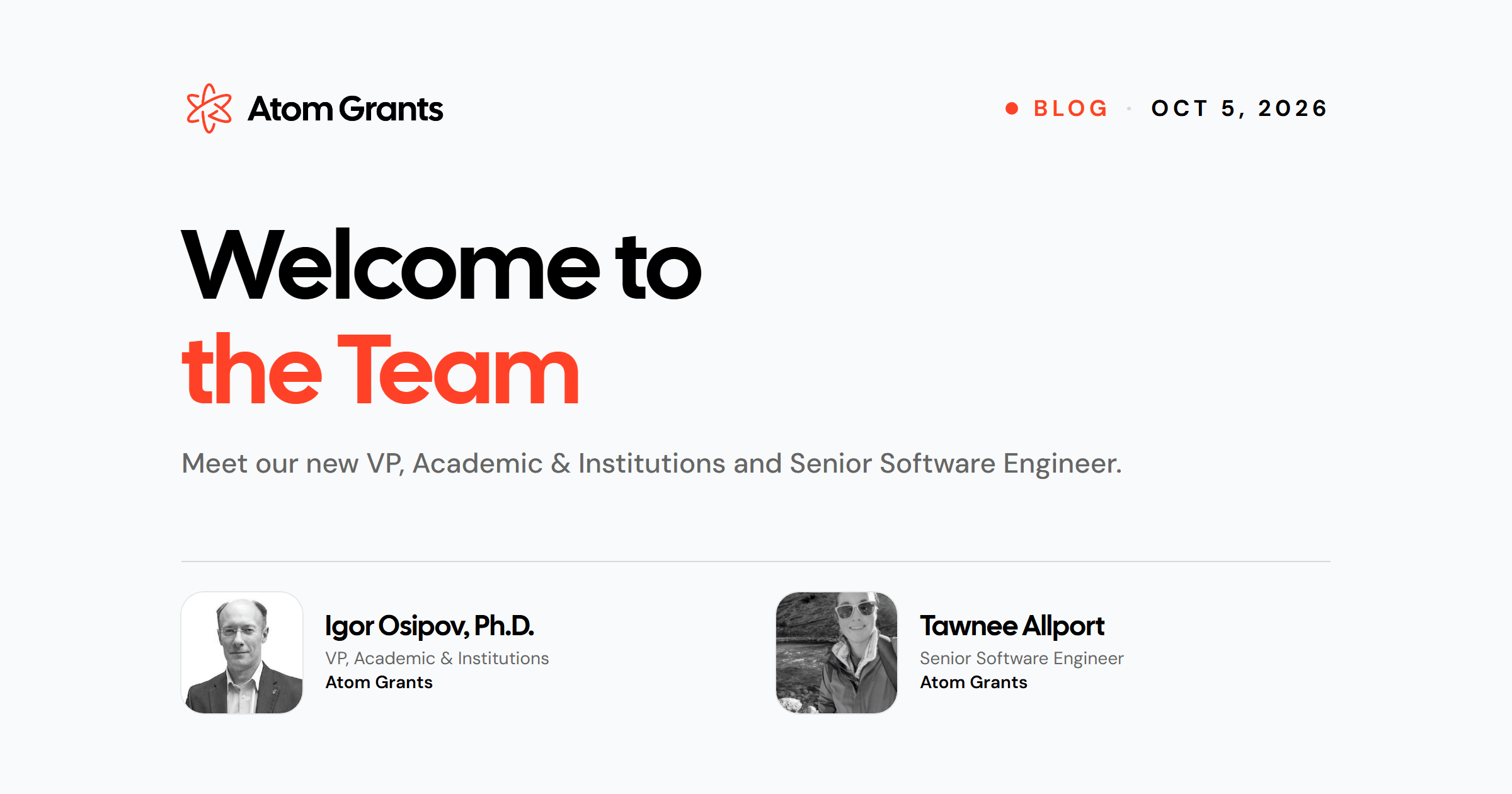
Welcome to the team!
Meet our VP of Academics and Senior Software Engineer
Read post
SRAI Annual Meeting 2026
Leading Research Development in the Age of AI Panel
Read post
Introducing Admin Analytics
The numbers we bring to your check-ins, now in Atom whenever you need them.
Read post
NIH AI Policy: New Rules of AI in Proposal Development
Inside the 2026 NIH policies reshaping how researchers write grants and proposals.
Read post
Budgets, in Atom
A workspace for the whole budget: the spreadsheet, the justification Atom AI can write for you, and the funder rules that grade both.
Read post
Atom AI Reviewer
A funder-grade read of your whole proposal, before anyone else sees the draft.
Read post