The White House’s New Science Report: AI Won’t Fix Research on Its Own
White House Office of Science and Technology Policy Report
November 2, 2026
In July 2026, the White House Office of Science and Technology Policy published Science: A New Golden Age. It’s a 123-page report meant to follow Vannevar Bush’s 1945 Science: The Endless Frontier, the document that shaped American research funding for 80 years.
Most of the report is about how research gets funded and organized. The final chapter is about AI, and its argument isn’t the one you’d expect. It doesn’t say AI will fix science, but that AI could make science’s existing problems worse unless the system around it changes.
The scale is new
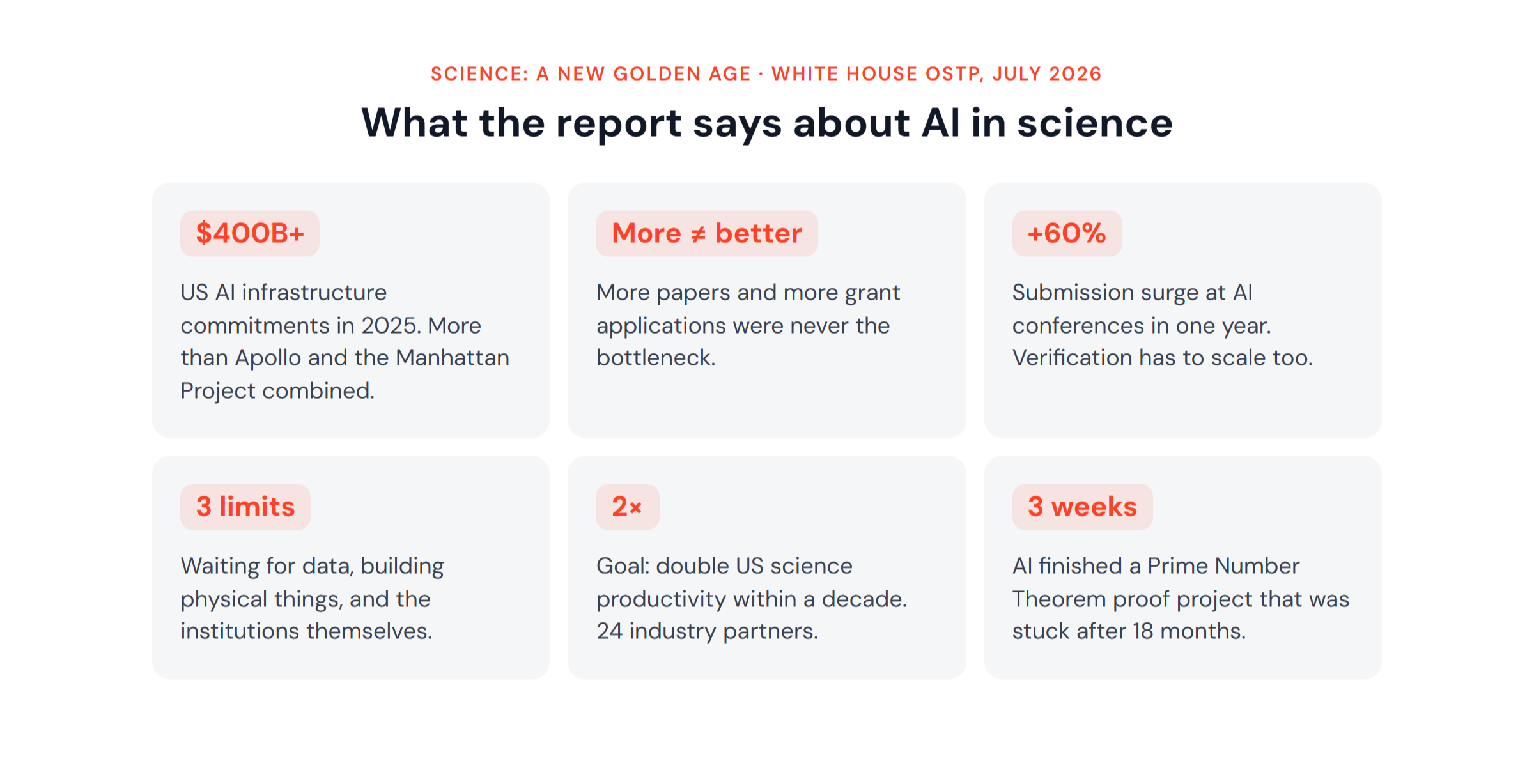
In 2025, American companies committed more than $400 billion to AI infrastructure. That’s “more than the inflation-adjusted cost of the Apollo Program and Manhattan Project combined.”
It says the capabilities have moved just as fast: “In 2026, AI agents can write entire software applications, analyze experimental data, and operate laboratory equipment without human intervention.” It lists early results: protein structures predicted with atomic accuracy, new proteins designed from scratch, and plasma control for fusion research.
More output isn’t more progress
We should harbor no illusions that AI will repair our scientific enterprise by default. Even if every scientist benefits from adopting AI, it does not follow that science as a whole will advance.
The report compares this to a century of forest-fire suppression in the US. Each fire put out looked like a success, while dead wood built up until the fires that came were much worse. AI could do the same thing to science, the report says, making each researcher look more productive while the system underneath gets weaker.
For anyone who works in research administration, one line stands out:
AI tools will make it trivial to generate more papers, more grant applications, and more submissions to peer review. But if the obstacle to scientific progress were simply the production of these artifacts, we would already be living in a scientific golden age. We are not.
The report points out that publications, researchers and funding have all grown hugely over the past 50 years, and discovery hasn’t sped up to match. Writing more proposals faster doesn’t fix that.
Easy to generate, hard to check
While the cost of generation has decreased exponentially, the cost of verification has not.
AI research is already showing what happens next. Leading AI conferences saw submissions jump 60% in a single year. “Researchers are now burdened with reviewing nonsensical AI-generated submissions while rebutting low-quality AI-generated reviews of their own work.” The report expects other fields to follow.
That matters because science already has a reproducibility problem. The report cites failed replications in psychology and economics, and an estimated $28 billion a year in preclinical biomedical research spent on findings that don’t hold up. If AI systems learn from that body of work, the errors spread. In the report’s words: “Increased scientific productivity will not mean anything if the underlying findings are false.”
Its answer is to build verification at the same scale as generation: AI systems that rerun analyses, standard replication packages that machines can audit, and prizes for replicating or disproving influential results.
Three things intelligence can’t speed up
There are three main limits the report outlines that that no amount of AI will likely remove:
- Waiting for data. “No amount of intelligence can conjure observations that do not yet exist.”
- Building physical things. “No cognitive power can alone make a rocket or a semiconductor fab build itself overnight.”
- The institutions themselves. Publishing systems, funding structures, regulation and culture still decide how research happens.
The third one is where the report says the effects will show up first.
The Genesis Mission
The federal government’s main AI-for-science effort is the Genesis Mission, launched in November 2025. It will connect the national labs’ supercomputers, AI systems, instruments and datasets into “a single discovery engine designed to double the productivity and impact of American science and engineering within a decade.”
The Department of Energy has signed agreements with 24 organizations, including AI companies, chipmakers and cloud providers. The mission includes an American Science Cloud for sharing AI-ready data, new funding for curating datasets, and 14 projects on robotics and automated labs.
The report also says what the government’s role in AI should and shouldn’t be: “In a world where AI research is flush with capital, the Federal Government’s value-add is not funding AI in the abstract, but directing it toward problems where breakthroughs could unlock entire branches of downstream discovery.”
A proof point from math
The report’s clearest example comes from mathematics. In early 2024, a project set out to formally verify the Prime Number Theorem with a proof assistant. After 18 months and more than 20 contributors, it was stuck. In September 2025, a startup using AI finished it in three weeks, covering 1,100 formally verified theorems and definitions.
Math works well for AI because checking a proof is easier than finding one. The report thinks that pattern will spread: “Wherever checking an answer is easier than finding one, AI stands to reorganize not just scientific discovery, but the social structures that govern who does it and how.”
What this means for research offices
The report’s budget guidance for FY2028 makes this practical. It tells agencies to fund research “that uses AI as a new instrument of scientific discovery, not merely as a tool to augment existing capabilities.” Proposals that add AI for small gains, or without explaining why the problem needs it, are exactly what agencies are told to avoid.
The takeaway for research offices: the edge won’t come from producing more. It will come from aiming better, meaning matching the right researchers to the right opportunities and putting effort into the proposals most likely to matter. The report says the same about national science policy. In an age of cheap output, the scarce things are judgment and focus.
Read the full report: Science: A New Golden Age (White House OSTP, July 2026).
More Blog Posts
Proposals: A more intuitive workspace and inline editor
Proposals has been updated with intuitive navigation for each step, from guide to submission. You can also write documents and build the budget right in Atom instead of only uploading files.
Read postThe 10 Best Grant Databases and Funding Data Tools for 2026
Ranked for universities, research offices, and nonprofits. Updated November 2026.
Read post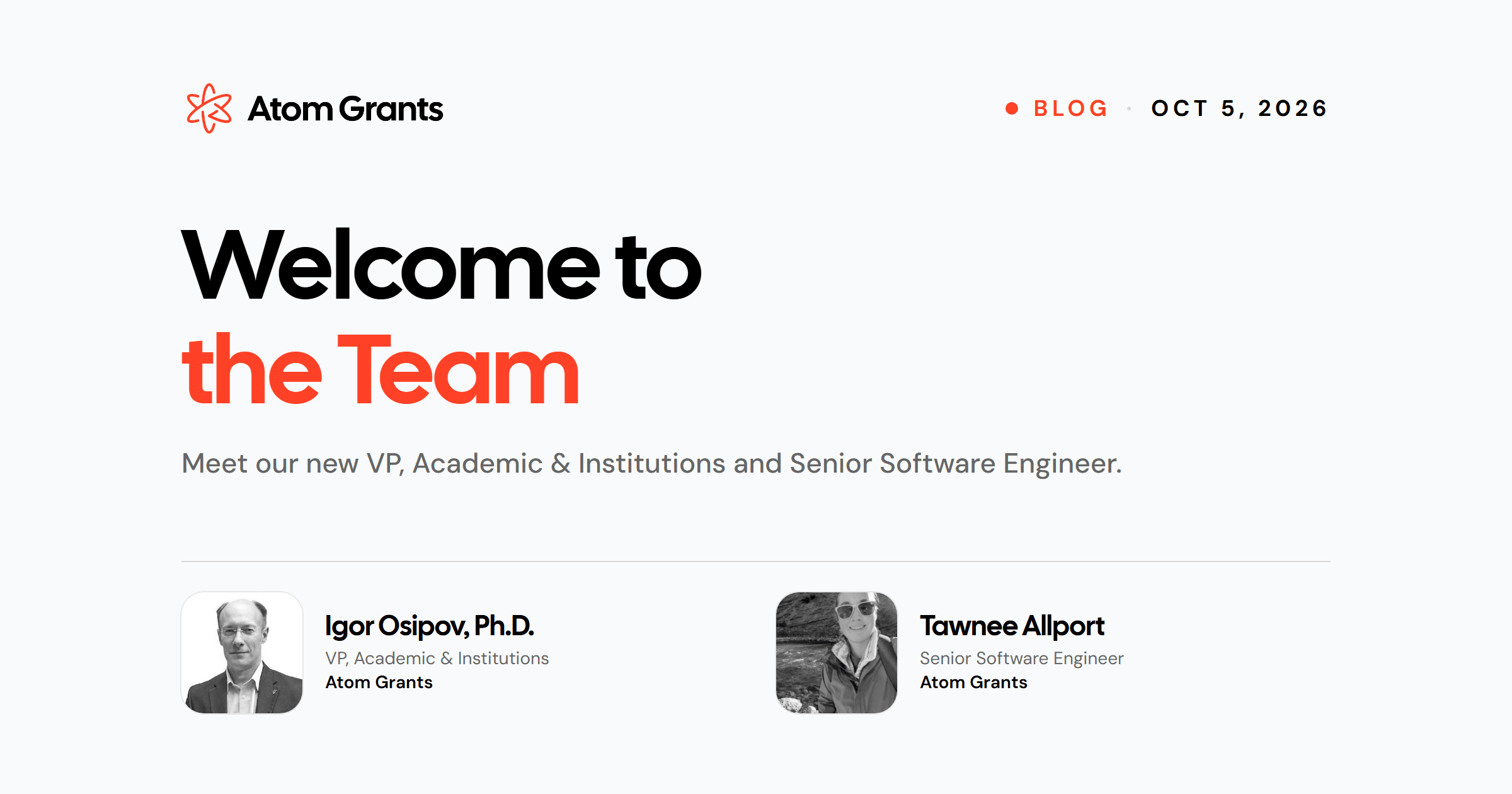
Welcome to the team!
Meet our VP of Academics and Senior Software Engineer
Read post
SRAI Annual Meeting 2026
Leading Research Development in the Age of AI Panel
Read post
Introducing Admin Analytics
The numbers we bring to your check-ins, now in Atom whenever you need them.
Read post
NIH AI Policy: New Rules of AI in Proposal Development
Inside the 2026 NIH policies reshaping how researchers write grants and proposals.
Read post
Budgets, in Atom
A workspace for the whole budget: the spreadsheet, the justification Atom AI can write for you, and the funder rules that grade both.
Read post