NIH AI Policy: New Rules of AI in Proposal Development
Inside the 2026 NIH policies reshaping how researchers write grants and proposals.
September 2, 2026
AI Has Moved Into Grant Writing
Over the past three years, generative AI has moved from a novelty that researchers experimented with on the side to a tool that sits in the middle of the daily scientific workflow, used to summarize literature, draft and edit manuscripts, generate and debug analysis code, clean and label datasets, and prepare the administrative scaffolding around a grant application.
Surveys of academic researchers across 2025 and 2026 consistently show that a majority now use AI tools in some part of their work, and that grant writing, one of the most time-consuming and highest-stakes tasks in a scientific career, is among the most common places they reach for help. That rapid adoption created two very different pressures on the agencies that fund American science:
-
On one hand, AI use rises concerns about originality, authorship, and fairness as it lowers the barrier to producing polished, well-structured text, which allows applicants to generate proposals at industrial scale;
-
On the other, AI has become essential infrastructure for the science itself, and the institutions with the best access to computing power and high-quality data are pulling ahead in fields from drug discovery to climate modeling, leaving researchers without serious compute at a disadvantage that looks less like a software gap than the old divide between labs with modern instruments and labs without.e old divide between labs that had modern instruments and labs that did not.
Federal policy in 2025 and 2026 is a direct response to both pressures at once, and it is being shaped by a broader national agenda. The National Institutes of Health (NIH) does not forbid AI in grant writing, but it draws a firm line between using AI to help you express your science and using it to produce the science itself, and every researcher preparing an NIH application now needs to understand exactly where that line sits.
Guardrails Around Originality and Review
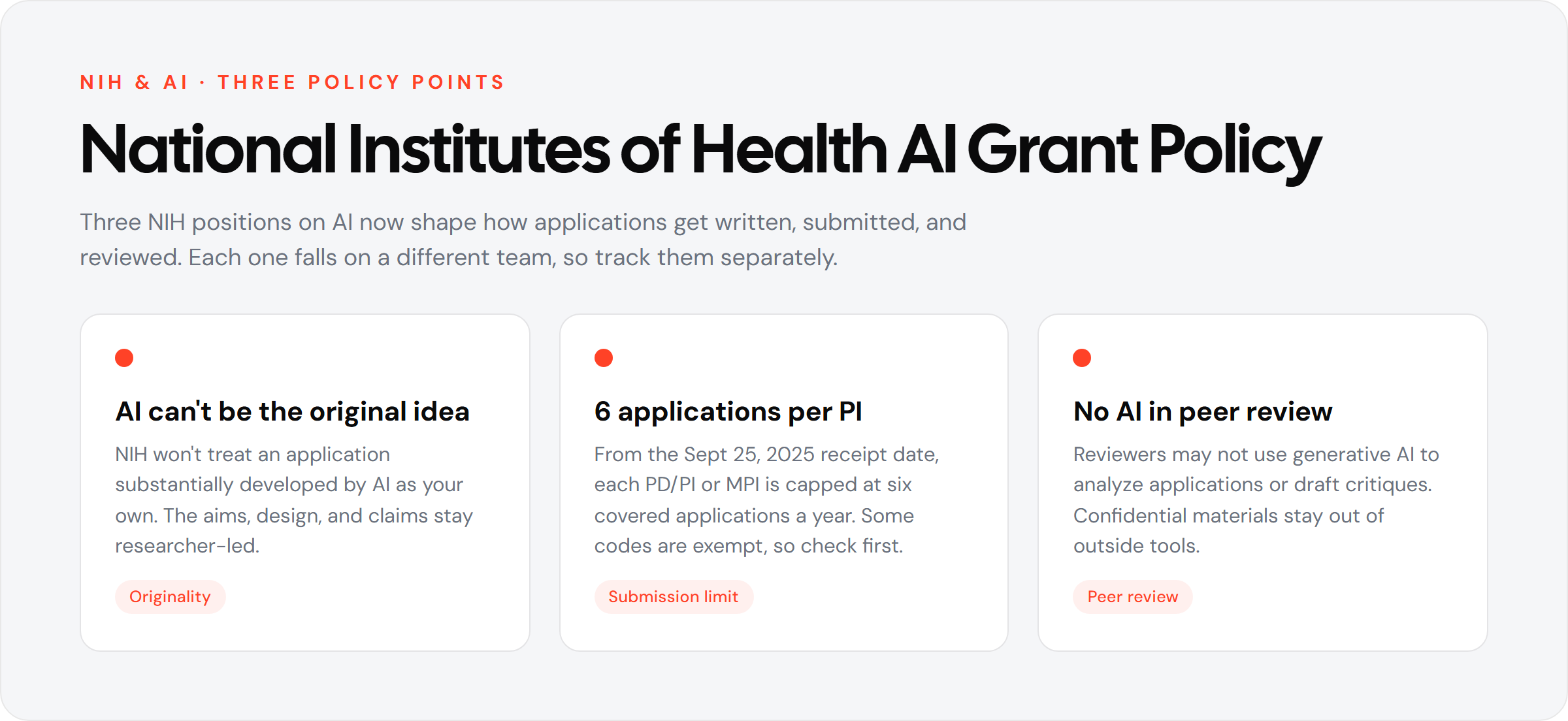
Where NSF is opening doors, NIH is tightening them, and its guidance is where the day-to-day practice of grant writing actually changes. The agency has moved on several fronts at once, and each one reflects a concern about protecting the integrity of a peer review system that AI made suddenly easy to overwhelm.
1. A cap of 6 applications per investigator each year
NIH issued notice NOT-OD-25-132 on July 17, 2025, with an effective date of September 25, 2025, and its most concrete provision is a limit on submission volume. Beginning with that effective date, an individual Principal Investigator or a Multiple-PI team may submit no more than six applications in a single calendar year across all activity codes, subject to a few narrow exceptions such as training grants in the T-series and conference grants under R13.
The reason for the cap is worth understanding, because it explains the tone of everything else NIH has said about AI. The policy was triggered by a very small group of investigators, a fraction of a percent of all applicants, who had begun using AI to generate proposals in extraordinary numbers, with some individuals submitting more than forty applications in a single council round. That behavior threatened to flood the review system and crowd out other researchers, and NIH described the cap as a way to preserve the integrity of the peer review process, ensure fairness in the competition for funding, and maintain high standards of originality, which places the volume limit and the AI-authorship rules squarely in the same conversation.
2. A new standard for applications "substantially developed by AI"
The provision that most directly reshapes how proposals get written is NIH's statement that applications, or even individual sections of applications, that are substantially developed by AI will not be treated as the original ideas of the applicants and will not receive favorable consideration in review. This turns originality from an implicit expectation into an explicit condition of funding, and it puts the burden on the applicant to be able to stand behind the intellectual content of what they submit.
The important nuance: NIH deliberately did not define a threshold. There is no percentage, word count, prompt count, or section-by-section rule. That ambiguity is the point. It shifts responsibility back to the applicant to keep intellectual ownership of the aims, rationale, study design, evidence, and claims. Using AI to check grammar or tighten readability on text you wrote is low-risk. Using it to generate your Specific Aims, significance argument, methods, or literature synthesis is where you get into trouble.
3. A continued and clarified ban on AI in peer review
In a May 2026 Extramural Nexus article, NIH restated, in more direct language than it had used before, that scientific peer reviewers are prohibited from using natural language processors, large language models, or any other generative AI technology to analyze applications or to formulate their critiques, a rule the agency first established in notice NOT-OD-23-149. The clarification also underscored a point that reviewers sometimes overlook, which is that the prohibition is not only about whether AI influenced a score but also about confidentiality, because uploading or sharing any portion of a grant application or contract proposal to an online AI tool is itself a violation of NIH's confidentiality requirements and can lead to disqualification from the review process regardless of intent.
4. Where AI use crosses the line into research misconduct
In a May 2026 Extramural Nexus article, NIH restated its position more directly than before. Reviewers may not use large language models or other generative AI to analyze applications or formulate critiques (a rule first set in NOT-OD-23-149). Critically, uploading any part of an application or contract proposal into an online AI tool is a confidentiality violation on its own, and can lead to disqualification from peer review, whether or not the tool influenced the score.
NIH highlights the three main AI misconduct scenarios:
- Fabrication: presenting AI-generated, non-existent references as if they were real can constitute data fabrication.
- Plagiarism: copying substantial AI-generated text without disclosure can constitute plagiarism.
- Disclosure: researchers should clearly describe in applications, manuscripts, and presentations how AI tools were used in developing the work, the research itself, and any data analysis.
Post-award discovery that a funded application was substantially developed by AI can lead to cost disallowance, award suspension, or termination, plus referral to the HHS Office of Research Integrity. In all cases the agency expects researchers to clearly describe in their applications, manuscripts, and presentations how AI tools were used in developing the work, conducting the research, and analyzing the resulting data.
What This Means for Researchers and Research Offices
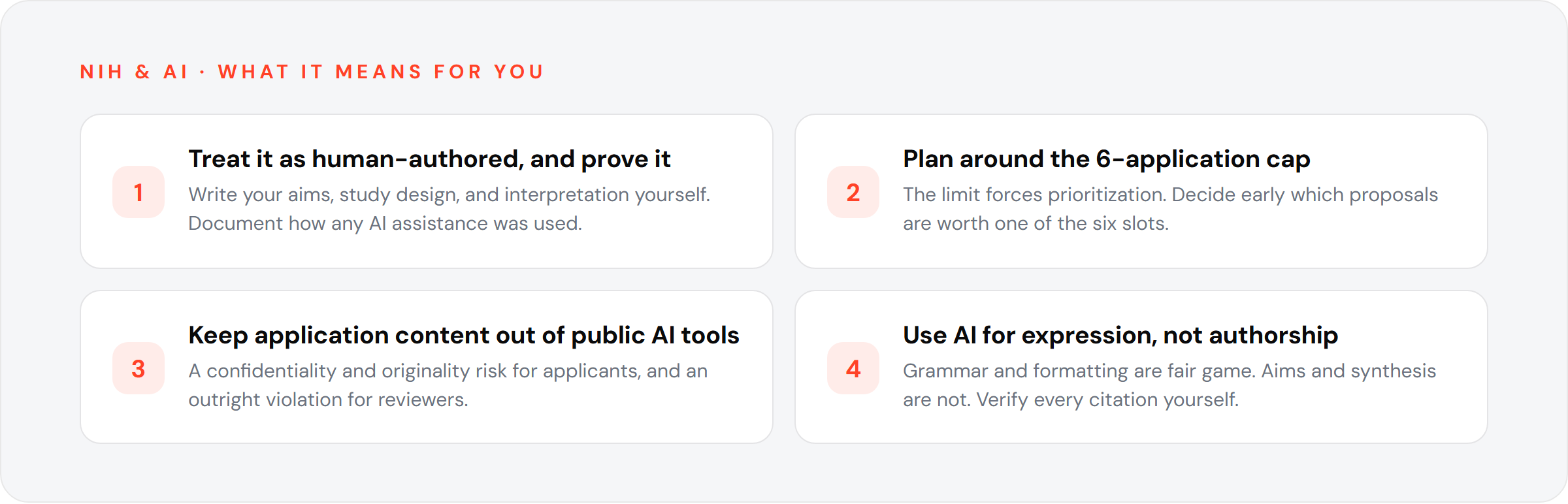
- Treat the proposal as human-authored, and be able to prove it. With NIH declining to set a numeric threshold for what counts as "substantially developed by AI," the safe posture is to keep AI out of the scientific substance entirely and to document how any AI assistance was used. Write your aims, your study design, and your interpretation of the evidence yourself.
- Plan submissions against the 6-application cap. The limit forces prioritization. Investigators and their offices should decide early in the year which proposals are worth one of the six slots, rather than submitting broadly and hoping something lands.
- Do not put application content into a public AI tool. For applicants this risks both originality and confidentiality problems; for anyone who also reviews, it is an outright violation that can lead to disqualification. Confidential proposal text stays out of external models, without exception.
- Use AI for expression, not authorship, and verify everything yourself. Grammar, readability, and formatting are fair game; generating your Specific Aims, significance argument, or literature synthesis is not. Check every citation, figure, and claim before the application goes out, because the responsibility for accuracy rests with you rather than with the tool.
The common thread running through all of it is trust. NIH is protecting the integrity of what gets submitted and reviewed, insisting that the ideas in a proposal, and the work behind them, remain unmistakably the applicant's own. That is not a restriction on good researchers so much as a defense of them, since it keeps the competition fair for everyone who does original work. For anyone writing proposals in 2026, the winning move is the same one it has always been: do original work, own your ideas, and use AI to support your judgment rather than to replace it.
At Atom Grants, we build AI tools for research teams that keep humans in control of the science. If you want to see how responsible AI fits into your grant-writing workflow under the new NIH rules, book a demo.
More Blog Posts
The 10 Best Grant Databases for 2026
For universities, researchers, and nonprofits
Read post
Welcome to the team!
Meet our VP of Academics and Senior Software Engineer
Read post
SRAI Annual Meeting 2026
Leading Research Development in the Age of AI Panel
Read post
Introducing Admin Analytics
The numbers we bring to your check-ins, now in Atom whenever you need them.
Read post
Budgets, in Atom
A workspace for the whole budget: the spreadsheet, the justification Atom AI can write for you, and the funder rules that grade both.
Read post
Atom AI Reviewer
A funder-grade read of your whole proposal, before anyone else sees the draft.
Read postIntroducing Projects
Organize your funding search into projects, each with its own team, interests, and eligibility, so your matches follow the work you’re actually doing.
Read post