Making the Invisible Work Visible
Research Administration is the Infrastructure Holding Research Together
July 9, 2026
Research administration may be the only profession where success is measured by the things that never happen: the grant that was not lost, the audit finding that never came, the compliance problem caught before it became a headline. That value is real, and it is almost entirely invisible. Dr. Rashonda Harris has spent 28 years inside that work, and her mission now is simple: make the invisible visible.
Dr. Harris is the founder and CEO of Purple Sheep Consulting and has worked in research administration since 1998, across pre-award, post-award, compliance, finance, and institutional leadership in higher education and academic health systems. Her argument is direct: research administration is not a support function. It is the infrastructure that enables research, protects funding, and mitigates risk.
A profession measured by what never goes wrong
Research administration sits at the intersection of research, finance, compliance, and strategy. On any given day, administrators are helping faculty pursue funding, negotiating agreements, reviewing budgets, monitoring expenditures, and keeping reporting on track, all while solving problems before they become a crisis. Stakeholders see only the outcome: the funded grant, the successful trial, the report submitted on time. What they miss are the hundreds of decisions and controls running behind the scenes that made it possible.
Research administration isn't simply supporting research. It's enabling research.
— Dr. Rashonda Harris, Purple Sheep Consulting
Infrastructure, not a support function
The distinction between supporting and enabling research is not semantics. Support reads as optional. Infrastructure is something an institution cannot operate without, and Dr. Harris argues that is exactly what research administration is. If it disappeared tomorrow, awards could not be established, contracts could not be executed, reports would go unfiled, and funding would be jeopardized. Faculty create knowledge; research administrators create the environment that lets that knowledge be funded, managed, and protected. That framing lands with leaders, because they already understand infrastructure, risk, and sustainability. They just rarely see how much of it research administration quietly holds together.
Why titles decide what gets valued
Language shapes perception, and titles are where it hardens. Call someone a grant processor or back-office employee and the work reads as transactional, even when that same person is managing institutional risk, stewarding millions of dollars, and advising leadership. A modest-sounding title might sit over a program project spanning more than 250 sites. Recognition, Dr. Harris says, starts with consistent titles and clear advancement paths. Most people assume there are only a handful of research administrators. There are thousands, worldwide, and the profession will not gain visibility until its structure reflects that.
Stop measuring volume. Start measuring impact.
Historically the field has counted volume: proposals submitted, awards received, agreements processed. Those numbers are easy to tally and hard to tie to anything leadership cares about. The better question, Dr. Harris says, is not how much work was done but what institutional outcomes it made possible, which points to different metrics: proposal success rates, time to award setup, delinquent reports reduced, audit findings prevented, compliance risk mitigated, and research continuity.
Nobody cares that we submitted 500 reports on time. What did that equate to in institutional outcomes? That's what is valued.
— Dr. Rashonda Harris
The visibility gap, and what it costs
Why are those metrics so rarely reported? The data is scattered across proposal, award, financial, HR, and compliance systems, so teams default to the easy counts. And the highest-value work, the audit finding that never happened or the sub-award error caught before funds were spent, leaves no natural footprint. That invisibility carries real cost. Dr. Harris points to the recent cap on facilities and administrative (F&A) rates, which fell at some universities from 70 percent or higher to 15 percent. F&A funds the people who do the work, so when leaders do not understand it, they under-invest in staffing, technology, and succession planning. The most expensive consequence is not a bruised reputation but lost expertise: downsizing usually starts with the longest-tenured staff, and decades of institutional knowledge walk out the door with no way to transfer it.
The most expensive consequence isn't recognition. It's losing critical expertise that protects the funding, reputation, and operational stability.
— Dr. Rashonda Harris
Six new hires, and the metrics that won them
The clearest proof that visibility pays came from a state school where leadership kept asking why the team needed another position. So Dr. Harris turned her own department into an MBA capstone case study, handing over her org chart, FTE count, and portfolio to benchmark her team against peer institutions with similar funding. The metrics did not lie: each of her post-award staff carried three times the portfolio of their counterparts. The result was six new FTEs and two new offices, one for cash management and one for reporting. Reporting delinquencies fell by nearly 50 percent, receivables came down, and because reports went out on time, the institution won more funding.
Where AI fits, and where it never will
Dr. Harris draws a firm line on automation: automate the repetitive tasks, never the judgment. AI can summarize a policy but cannot hold accountability; it can surface patterns but cannot make an ethical call. Used well, it captures and analyzes metrics more accurately and shows a team where to improve. With 28 years of depth, she can tell when the model is wrong and push back, which is the point: the expertise stays in the loop.
AI is not replacing us. But a person who knows AI will replace you. AI should enhance stewardship, not replace it.
— Dr. Rashonda Harris
Takeaways for research administration leaders
- Reframe the work as infrastructure, not support. Support reads as optional. Infrastructure is something the institution cannot function without.
- Fix the titles first. Consistent titles and clear career pathways are where visibility begins. A transactional title hides strategic work.
- Report outcomes, not activities. Trade "500 proposals submitted" for funding enabled, risk mitigated, and capacity created.
- Use metrics to make the case for people. Benchmarking her team one-to-one against peers won six new FTEs and cut reporting delinquencies nearly in half.
- Automate tasks, never judgment. Let AI capture and analyze the metrics. Keep accountability and ethical decisions human.
Looking forward
Closing the gap, Dr. Harris says, comes down to changing what we measure, how we communicate it, and what we celebrate: fewer activity counts, more impact stories, and more of the professional scaffolding, consistent titles, career pathways, continuing education, and degree programs like those at Johns Hopkins and CUNY, that makes the work legible. Her through line is simple. Research administration is not overhead. It is infrastructure. And when the invisible work becomes visible, the entire research enterprise gets stronger.
About the speakers

Dr. Rashonda Harris — Founder & CEO, Purple Sheep Consulting
A research administration leader with 28 years in the field spanning pre-award, post-award, compliance, finance, and institutional leadership, Dr. Harris founded Purple Sheep Consulting and Purple Sheep CPE to elevate the profession through consulting, interim staffing, and continuing professional education. Her work centers on making the invisible work of research administration visible and helping institutions build stronger, more sustainable research enterprises.
 Raphaël Bernier — Head of Growth, Atom Grants
Raphaël leads partnerships at Atom Grants and hosts the interview series, connecting research development and administration teams with the people doing the most innovative work in the field.
LinkedIn: https://www.linkedin.com/in/raph-bernier/
Contact: raphael@atomgrants.com
Location: New York
More Blog Posts
The 10 Best Grant Databases for 2026
For universities, researchers, and nonprofits
Read post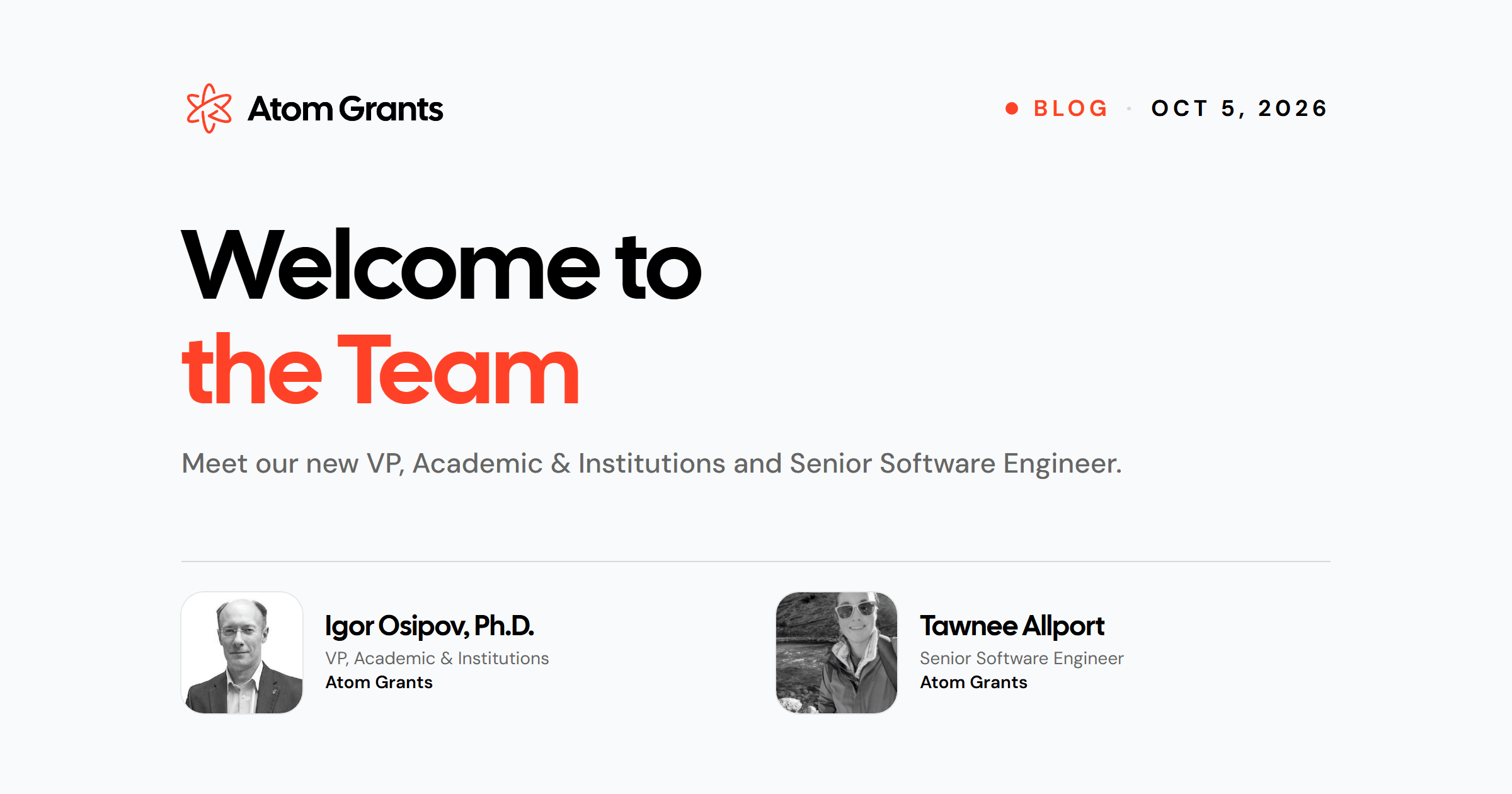
Welcome to the team!
Meet our VP of Academics and Senior Software Engineer
Read post
SRAI Annual Meeting 2026
Leading Research Development in the Age of AI Panel
Read post
Introducing Admin Analytics
The numbers we bring to your check-ins, now in Atom whenever you need them.
Read post
NIH AI Policy: New Rules of AI in Proposal Development
Inside the 2026 NIH policies reshaping how researchers write grants and proposals.
Read post
Budgets, in Atom
A workspace for the whole budget: the spreadsheet, the justification Atom AI can write for you, and the funder rules that grade both.
Read post
Atom AI Reviewer
A funder-grade read of your whole proposal, before anyone else sees the draft.
Read post