Springer Nature and Google DeepMind Bring AI to Peer Revie
What the new AI reviewer assistant does, and where peer review goes next
November 13, 2026
Peer review is the part of research that almost everyone depends on and almost no one is paid for. It runs on the spare hours of experts who are already stretched, and the volume of work they are asked to check keeps climbing. On October 26, one of the world's largest publishers and one of the world's leading AI labs said they want to change how that work gets done.
Springer Nature and Google DeepMind announced a research partnership to co-design an AI assistant for peer reviewers. A prototype is already being tested. It is an early project with few public details, but it is worth paying attention to, because peer review is not only how papers get published. It is also how grants get funded.
What was announced
Springer Nature, which publishes Nature and thousands of other journals, brings its experience running peer review at scale. Google DeepMind brings its Gemini models and lessons from two earlier agentic research tools it built, ScholarPeer and Deep Review.
The assistant is meant to help reviewers:
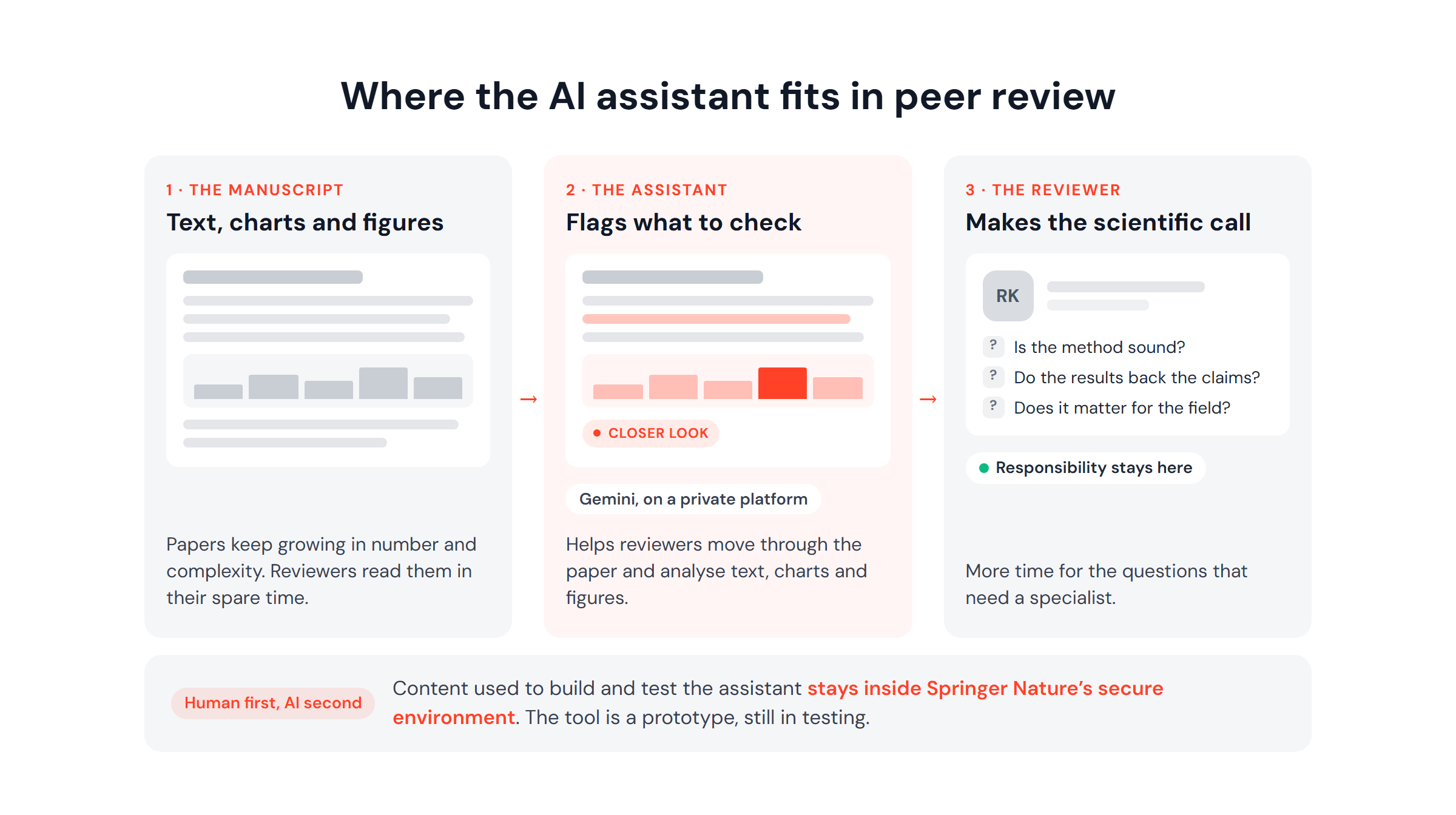
- Find their way through a manuscript, including long methods sections and supplementary material.
- Analyse large amounts of text, charts and figures that a reviewer would otherwise work through by hand.
- Spot areas that may need closer attention, so the reviewer can spend more of their time on the questions that need specialist scientific judgement.
The partners describe the goal as turning peer review into an interactive experience while keeping expert human judgement at the centre of the process. Springer Nature sums up its approach as "human first, AI second."
How the partners are handling trust
Confidentiality is the obvious worry with any AI tool that reads unpublished work, and the announcement addresses it directly:
- The assistant is built with Google's open-source Agent Development Kit (ADK). The kit is open source; the assistant and the Gemini models are not.
- It runs only inside Springer Nature's private, secure Gemini Enterprise platform.
- Content used to build and test the assistant stays inside Springer Nature's environment, so author and reviewer confidentiality is kept.
Saskia Steinacker, Springer Nature's Chief Product Officer, said innovation and trust have to go hand in hand, and that part of earning trust is being clear about where responsibility stays. Seshu Ajjarapu, Senior Director of Applied AI at Google DeepMind, framed the project as a way to relieve the strain of growing submission volumes while keeping the editorial standards of leading journals.
The project also fits Springer Nature's existing rules for reviewers. Its current guidance allows reviewers to use secure or institutionally approved tools, tells them not to upload manuscripts to public AI systems, and keeps handing a review over to AI off the table.
What we still don't know
The announcement is a statement of intent, not a set of results. A few things are missing, and they are the things that will decide whether this works:
- No numbers yet. There is no data on accuracy, time saved, or review quality, and no independent evaluation.
- No named journals or pilots. It isn't clear who is testing the prototype, in which fields, or how.
- No launch date. Springer Nature says it will share updates as testing continues.
- The line between "helping" and "steering" is open. A tool that flags what to look at also shapes what a reviewer does not look at. How reviewers can see why something was flagged, and how easily they can ignore it, will matter.
- "Faster" is not the same as "better." Time saved is easy to measure. Fewer missed errors, fairer treatment of authors writing in a second language, and consistent quality across disciplines are harder, and more important.
Why this matters beyond journals
Peer review is under pressure everywhere for the same reason. AI has made it much cheaper to produce a manuscript or a proposal, but checking one still takes the same expert hours it always did.
Grant funders are feeling this too. In July 2025, after seeing some investigators submit large numbers of applications, some possibly written with AI, NIH capped each principal investigator at six applications per calendar year. It also said it will not accept applications substantially developed by AI. On the review side, NIH has barred its peer reviewers since 2023 from using generative AI to analyse applications or write critiques, because there is no guarantee where uploaded content ends up.
That is the tension this partnership is trying to resolve: reviewers need help, but the help can't leak confidential work or replace their judgement. If a major publisher can show that a secure, reviewer-controlled assistant works, funders will have a model to look at.
A look ahead: what this could mean for peer review
Here is how we expect this to play out, based on where the project is today and the pressures on the system. These are our predictions, not announced plans.
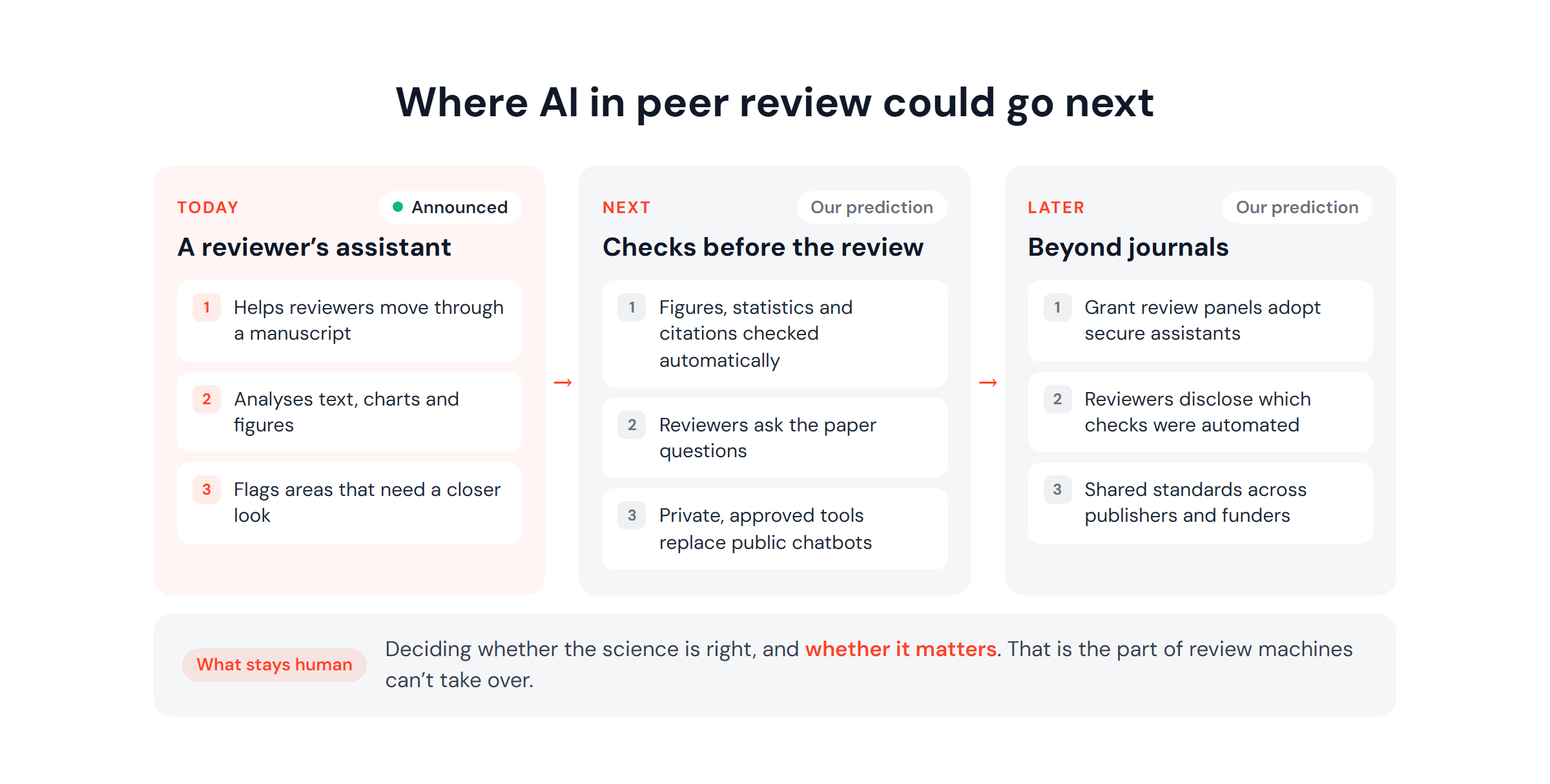 1. Routine checks move to machines first. The easiest wins are the checks nobody enjoys and everyone skips when they're tired: do the figures match the text, do the statistics add up, do the citations exist and say what the paper claims. Expect these to become standard pre-review steps, so the reviewer starts with a short list of things worth a closer look.
2. Review becomes a conversation with the paper. Interactive is the key word in the announcement. Instead of reading a PDF start to finish, a reviewer could ask the manuscript questions: where is the control group described, what was the sample size in this figure, how does this compare with the authors' earlier work.
3. Secure, approved tools win over public chatbots. Without a sanctioned option, some reviewers will be tempted to paste manuscripts into public AI tools, against the rules. Publishers and funders that offer a sanctioned, private alternative make it easier for reviewers to do the right thing. Expect more institutions to build or license their own.
4. Grant review follows, with more caution. Funding panels face the same volume problem with higher stakes and stricter confidentiality. Agencies have so far said no to AI in review. A working journal model, with clear audit trails and data that never leaves the funder's environment, is what could change that.
5. Disclosure becomes routine. Authors are already asked to disclose AI use. Reviewers and editors will be too, and review reports may start noting which checks were automated.
6. The human part of review gets more valuable, not less. If machines handle the checking, what's left is the judgement: is this the right question, is the method sound for this field, does the result matter. That is the part of review that can't be automated, and it is the part reviewers and editors will be valued for.
What this means for research offices
For research development and sponsored programs teams, a few practical points:
- Track AI policies on both sides of review. Publisher and funder rules on AI use by authors and reviewers are changing quickly, and they don't always match.
- Help faculty write for a reviewer who has help. If routine checks get automated, sloppy figures, mismatched numbers, and padded citations will be caught faster. Clean, internally consistent proposals will stand out more.
- Point reviewers to approved tools. Faculty who serve on review panels need clear guidance on what they can and can't put into an AI tool.
- Lead with the question. As checking gets easier, the case for why a project matters carries more weight.
Springer Nature and Google DeepMind haven't shown results yet. But the direction is clear: AI in peer review is moving from something reviewers are told to avoid to something publishers build, secure, and stand behind. Funders are unlikely to be far behind.
Sources
- Springer Nature, "Springer Nature and Google DeepMind collaborate to enhance the peer review experience", October 26, 2026
- SciCampus, "Springer Nature and Google DeepMind AI peer review", October 29, 2026
- NIH, "The Use of Generative Artificial Intelligence Technologies is Prohibited for the NIH Peer Review Process" (NOT-OD-23-149), June 23, 2023
- NIH, "Supporting Fairness and Originality in NIH Research Applications" (NOT-OD-25-132), July 17, 2025
More Blog Posts
The White House’s New Science Report: AI Won’t Fix Research on Its Own
White House Office of Science and Technology Policy Report
Read post
Proposals: A more intuitive workspace and inline editor
Proposals has been updated with intuitive navigation for each step, from guide to submission. You can also write documents and build the budget right in Atom instead of only uploading files.
Read postThe 10 Best Grant Databases and Funding Data Tools for 2026
Ranked for universities, research offices, and nonprofits. Updated November 2026.
Read post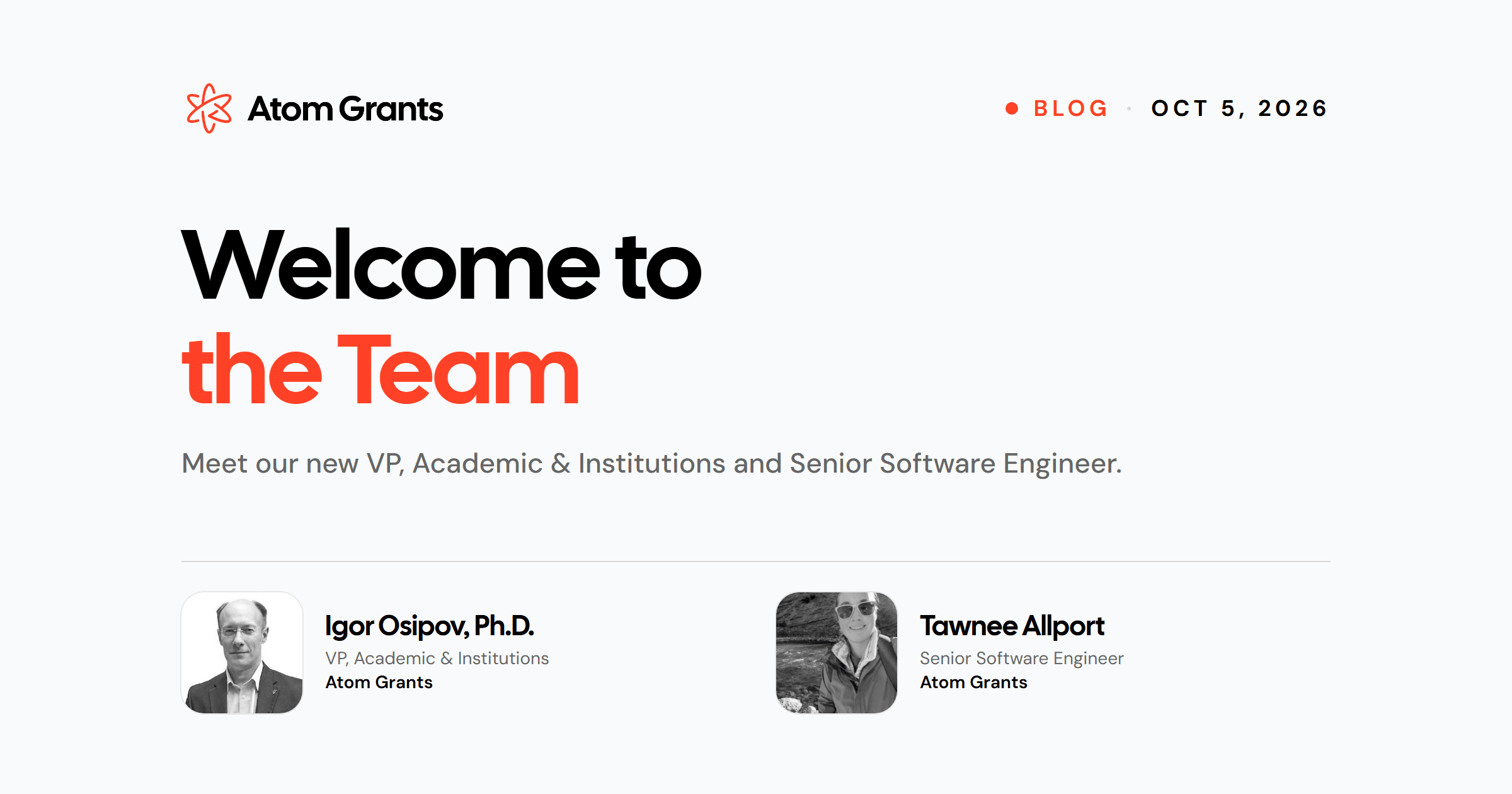
Welcome to the team!
Meet our VP of Academics and Senior Software Engineer
Read post
SRAI Annual Meeting 2026
Leading Research Development in the Age of AI Panel
Read post
Introducing Admin Analytics
The numbers we bring to your check-ins, now in Atom whenever you need them.
Read post
NIH AI Policy: New Rules of AI in Proposal Development
Inside the 2026 NIH policies reshaping how researchers write grants and proposals.
Read post