Research Administration for Everyone
Thinking About Career Paths in the Profession
May 14, 2026
When Tomer du Sautoy and Raphael Bernier of Atom Grants approached me to collaborate on an activity, the first thing that came to mind was putting "pen to paper" to write this blog post. I was not sure what I would end up sharing but I knew that writing about a research administration (RA) related topic was in order, of course. Given that a focus of Atom Grants is the use of artificial intelligence (AI) in their work, and given that as a practitioner I am still wrestling with the use, utility, and application of AI in the profession, I decided to share my thoughts on how expansive I believe the profession is and furthermore how I highly doubt, AI will replace the need for human researchers and RAs (at least in the near future!). Right? Surely, AI can be used as a tool to facilitate activities within research and the research grant life cycle but not replace the depth, breadth, and adaptability required of RAs in the profession. Right? If yes, that would mean a lot of people!
Expanding Research Administration
Thinking of the research enterprise and research administration, and using an expansive view of the profession, a case can be made that everyone in the research enterprise is in one way or another a "research administrator" of sorts. Thinking of the apex in the research enterprise, the researcher, with the stereotypical white lab coat, wet lab, in charge of lab staff and working for a research university, college, or research center, producing basic, foundational, and new knowledge, is involved in the "administration" of their lab, how it runs, and what it produces. He or she is a researcher but an "administrator" as well, ultimately responsible for the lab's operation and outputs. Sure, there might be a lab manager but ultimately the researcher is the one responsible for leading and managing the lab.
The researcher will not be a certified research administrator (CRA) most likely but nonetheless will be involved in administering some aspect of the lab in terms of compliance, lab maintenance, ordering supplies, etc. Turning to the lab staff, some will likewise be involved in aspects of the research enterprise and research administration. One can envision lab personnel writing parts of the next funding grant, reporting of data that supports the project narrative, or providing insight in some portion of the methods section. They may also work closely with the researcher to put the grant application together to send to the appropriate offices, and given the institutional processes involved in the pre-award stage of the grant life cycle.
Various Disciplines Can Benefit RA
The researcher and lab personnel described in the scenario above could have degrees in the basic sciences, life sciences, health sciences, engineering, or any other major suited for the lab environment. Extending the scenario above and adding time in years and experience, could the people in the scenario end up being directors of research administration, deans of research, directors of research compliance, vice presidents of research or any other title one can think of that leans more towards "the administration" of research? If so, would they describe themselves as "accidental research administrators"? Accidental research administrators are people in the profession who say they "just fell into" research administration without knowing what it was yet end up having long and successful careers in the field (for a related piece see Alcaine, 2024).
Turning now to computer science (CS), information systems (IS), information technology (IT), cloud computing, mobile technology, and yes, even AI, could the Director of IT, along with their staff, or whoever "runs" the pre-award and post-award grants systems, compliance systems, research training systems, etc., at your institutions be considered a vital part of the research enterprise and "research administrators" of sorts? Could your research enterprise function without this personnel trained in the technology fields? Could your grants be submitted (pre-award) or managed (post-award) without these systems working and without these trained IT personnel? Would they describe themselves as "accidental research administrators"?
Thinking of the arts, humanities, and social sciences, and the many majors housed in these areas, graphic design, visual arts, psychology, English, philosophy, education, sociology, public policy, etc., and the many skills and proficiencies learned through these disciplines, how can they inform the practice of RA and the research enterprise? One can envision an English major who is a good writer helping in the writing and development of a successful grant proposal that is clear, easy to read, has good logic and can get the point across no matter who reads it. This good writer could also help in developing copy for disseminating research findings and translating the impact of the research to the general public. Would the English major describe themselves as an "accidental research administrator"?
Vast Research Enterprise
A point of the discussion above is that the field of research administration and by extension the research enterprise is a vast space in need of professionals who have varied knowledge and skills from all disciplines, majors, and degrees.
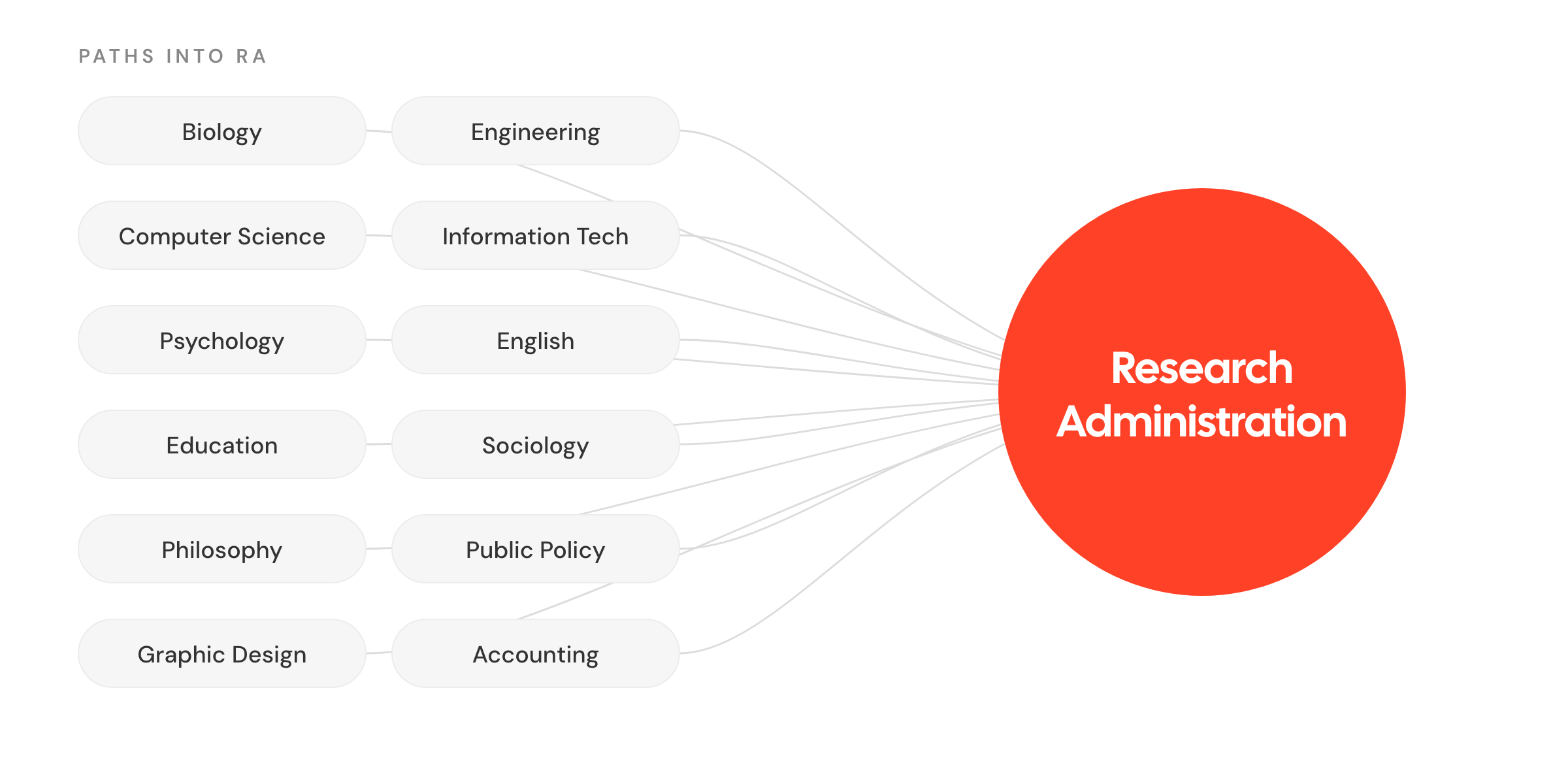
These varied skills can plug well into many different areas of the grant life cycle, pre-, post-, and beyond. Given the needs of the profession and standard recruitment practices, hiring managers, human resource departments, and career service professionals would do well in attracting a pool of applicants with these diverse perspectives to jobs all across the field. Job descriptions for RA positions (specially entry level) should reflect more open requirements when it comes to degree, majors, and disciplines. Whereas traditional disciplines like business administration, accounting, management, etc., may be an obvious fit for a lot of research administration jobs, other majors and degrees discussed can equally succeed and inform the RA profession. Spreading the word with current students about the many opportunities and career paths available in research administration should also be a priority for the field.
What is clear is that the research enterprise has the need and capacity to benefit from professionals from all backgrounds, disciplines, and majors. Plugging these varied skills and perspectives can only strengthen the profession. Will AI replace RAs in the research enterprise? Tomer and Raphael may have some ideas!
Building on Jose's Vision: Where AI Fits in the Expansive Research Administration Profession
By Raphael Bernier and Tomer du Sautoy, Atom Grants
When Jose sent us his piece, he closed with a friendly nudge in our direction: "Will AI replace RAs in the research enterprise? Tomer and Raphael may have some ideas!"
We do, and the short version is that we agree with him completely. No, AI is not going to replace research administrators. What we want to do here is pick up where Jose left off and add a few thoughts on how the role is evolving, and what that means for the people who do this work every day.
The Accidental Profession Is the Point
Jose's framing of the "accidental research administrator" resonated with us deeply. The English major who makes proposal narratives sing. The IT director who becomes indispensable to pre-award without ever intending to. The lab tech who ends up drafting half the next R01. This accidental quality is not a bug of the field. It's the source of its strength, because the work itself genuinely requires every discipline: writing, numeracy, systems thinking, regulatory fluency, and a tolerance for ambiguity that few other professions demand in combination.
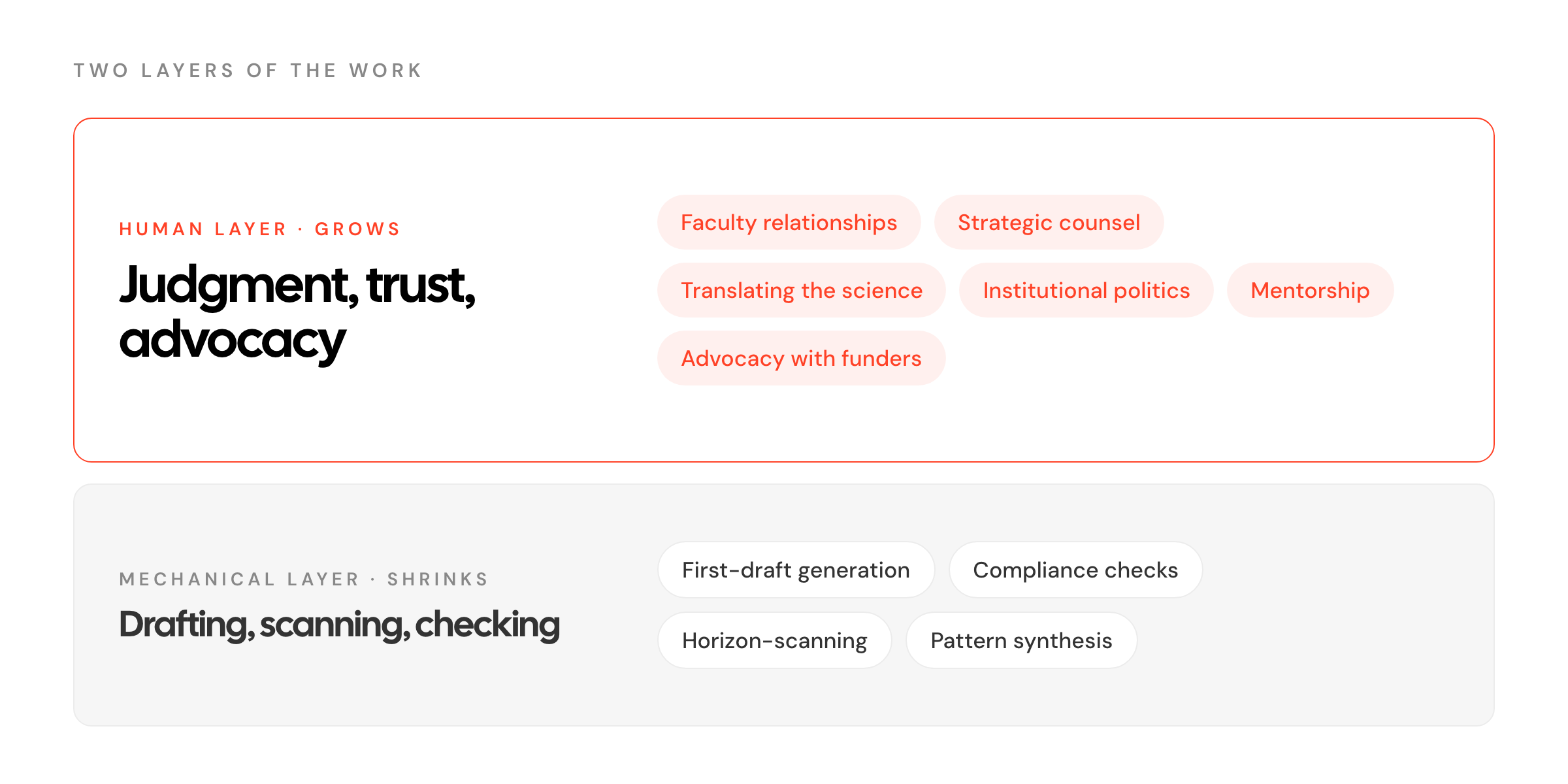
Here's what we'd add: we think AI is going to make the profession more accidental, not less. When the mechanical parts of the work get easier, the premium on distinctively human skills (writing with voice, reading institutional politics, building trust with faculty, understanding the science well enough to advocate for it) goes up. Those skills come from everywhere, and the field is going to need them from everywhere.
What AI Actually Does to This Work
Spending our days building AI tools for this profession has given us a pretty concrete view. AI is genuinely good at pattern-matching, synthesis, and first-draft generation. Budget justifications, biosketches, data management plans, and facilities descriptions can now be drafted in minutes. Routine compliance checks are becoming automatable. Horizon-scanning for funding opportunities, historically the privilege of well-resourced offices, is becoming accessible to everyone.
AI is mediocre-to-poor at judgment under uncertainty, relationship management, and contextual awareness. It cannot tell that this PI needs the deadline reminder three weeks early while that one will resent it. It cannot have the conversation with a PI about why they're 40% underspent in month nine. It cannot, crucially, build trust.
So the vast, human, multidisciplinary research enterprise Jose describes is exactly the part of the work that doesn't automate. The mechanical layer underneath it is changing, but the layer Jose writes about is, if anything, becoming more central to what RAs actually do.
Where the Role Is Heading
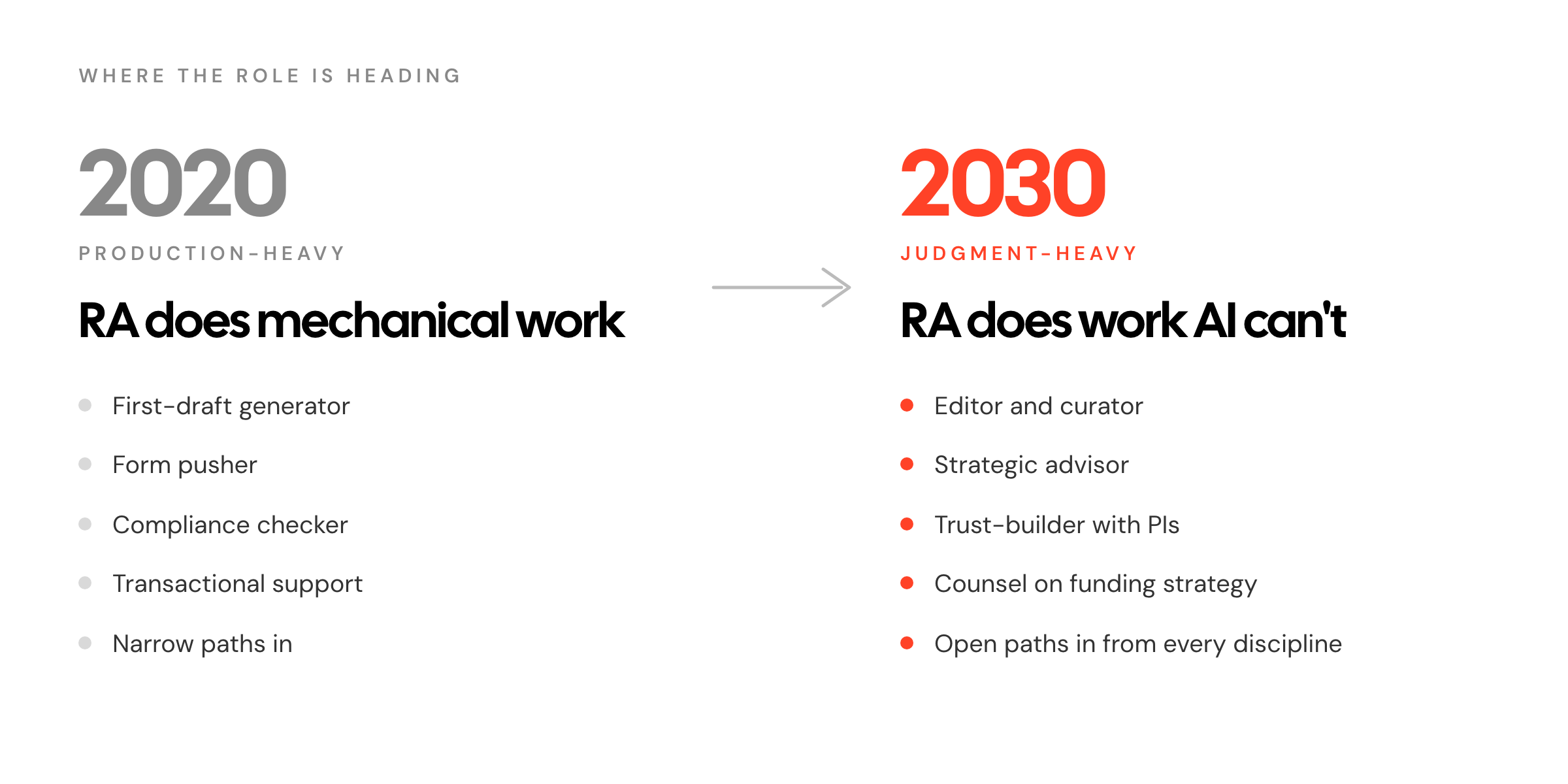
A few shifts we see over the next several years. More curation, less production: less time generating first drafts, more time evaluating, editing, and contextualizing, which rewards the deeper expertise Jose describes. More advisory, less transactional: as the mechanical work gets easier, the value an RA adds comes increasingly from strategic counsel, and this kind of work may become a larger share of the job at more levels of seniority. More paths in, from more places: job descriptions, especially entry-level, should reflect open requirements around degree and discipline. A great writer with no prior grants experience can get productive faster than ever, because the scaffolding is there.
What Teams Need to Keep Growing
A few investments we'd encourage every RA office to make now. AI literacy rather than AI dependency: spend time using frontier tools on your actual work, including watching where they fail. Writing and communication as core skills, which is exactly Jose's point about the English major, and a call to action for offices that have historically undervalued these skills in hiring. Deeper domain expertise, because the counterintuitive implication of AI is that specialists become more valuable, not less. And mentorship, because the senior RA who takes a new hire to coffee and explains how things actually work remains irreplaceable.
The Choice in Front of Us
The question we think about most isn't "will AI replace RAs." It's whether institutions will invest in their RAs during this transition, or try to use AI as a reason to cut headcount. This is a choice, not a technological inevitability. Offices that invest in their people and let AI take the repeatable work so humans can do the judgment work will thrive. Offices that treat AI primarily as a cost-cutting lever will find, probably around year three, that they've hollowed out the institutional knowledge and relationships that made their research enterprise work in the first place.
The research enterprise runs on trust, and trust is expensive to build and cheap to destroy.
So to Jose's question: no, AI will not replace research administrators. But the RAs of 2030 will do a meaningfully different job than those of 2020, and the profession that emerges will be shaped by the choices being made right now. We're optimistic, because the profession has always been defined by its adaptability and by the improbable range of people it welcomes. Those are exactly the qualities this moment calls for, and exactly the qualities Jose's piece celebrates.

More Blog Posts
The 10 Best Grant Databases for 2026
For universities, researchers, and nonprofits
Read post
Welcome to the team!
Meet our VP of Academics and Senior Software Engineer
Read post
SRAI Annual Meeting 2026
Leading Research Development in the Age of AI Panel
Read post
Introducing Admin Analytics
The numbers we bring to your check-ins, now in Atom whenever you need them.
Read post
NIH AI Policy: New Rules of AI in Proposal Development
Inside the 2026 NIH policies reshaping how researchers write grants and proposals.
Read post
Budgets, in Atom
A workspace for the whole budget: the spreadsheet, the justification Atom AI can write for you, and the funder rules that grade both.
Read post
Atom AI Reviewer
A funder-grade read of your whole proposal, before anyone else sees the draft.
Read post